Hiring & Teams
When Should a SaaS Startup Outsource Development — and When Should It Hire?
By Muhammad Usman • July 2026
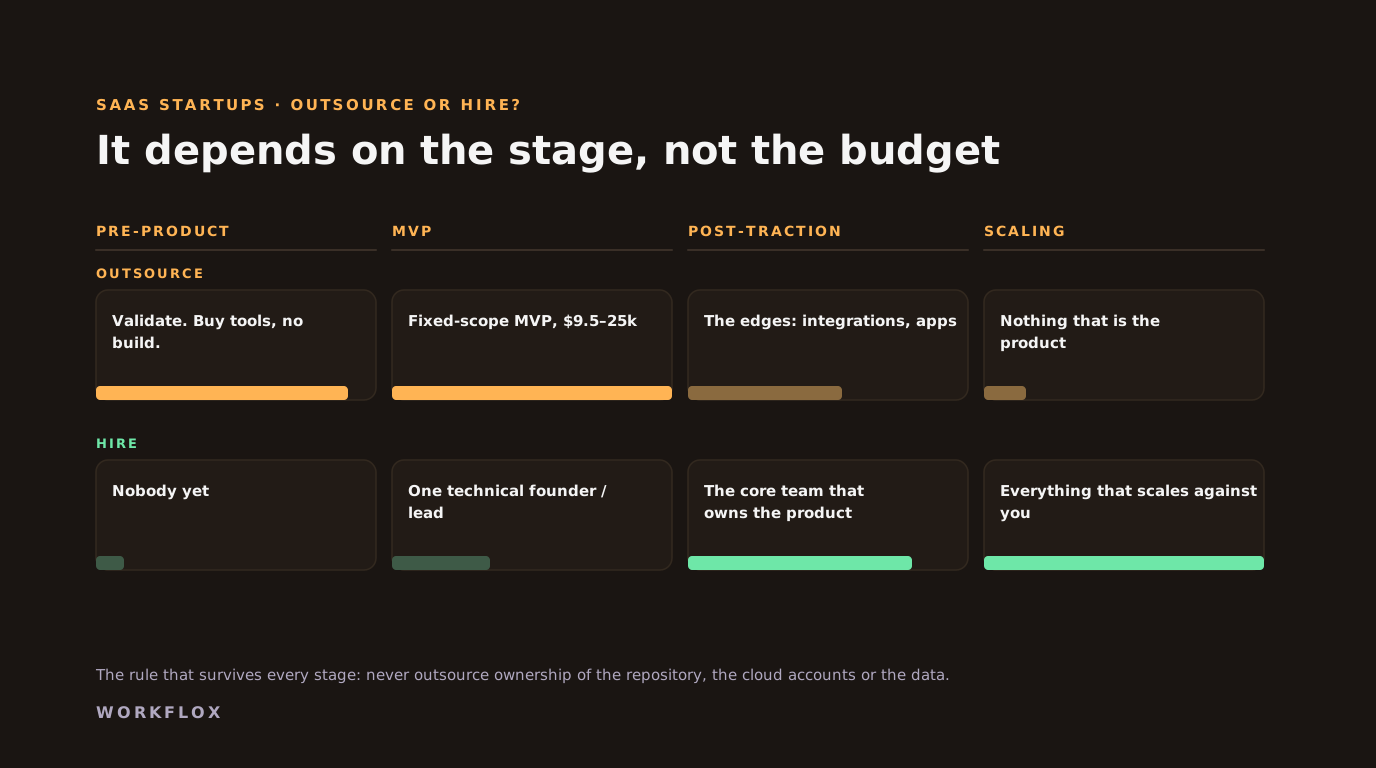
Table of Contents
- Pre-product: validate before you build
- MVP: outsource a fixed scope
- Post-traction: hire the core, outsource the edges
- Scaling: never outsource ownership
- The AI question
- The pre-product trap
- Reading an outsourcing contract as a founder
- When the numbers say hire
- A rough decision table
- The mistakes we see most
- A short version to keep
- What we do
The question is not whether a SaaS startup should outsource development. It is when: because the right answer changes with stage, and both mistakes are expensive: hiring engineers before you know what you are building, or outsourcing the product after it has become the business.
Pre-product: validate before you build
At this stage the honest answer is often to build almost nothing. No-code and AI app builders produce a working prototype in days, which is exactly enough to learn whether anyone wants it. Outsourcing a full build before validation spends money on assumptions; hiring before validation spends salary on them. Our note on going from a no-code MVP to a real app covers this stage.
The gaps appear fast: the moment you need a permissions model, an integration, or a customer to trust you with data, the builder's ceiling arrives. That is the signal to move to the next stage, not a reason to skip this one.
MVP: outsource a fixed scope
Once demand is validated, you need a real product on a sound foundation, and you do not yet know whether it will find traction, which makes a permanent team premature. This is where outsourcing a fixed-scope build is usually right: faster than recruiting, cheaper than salaries, and reversible.
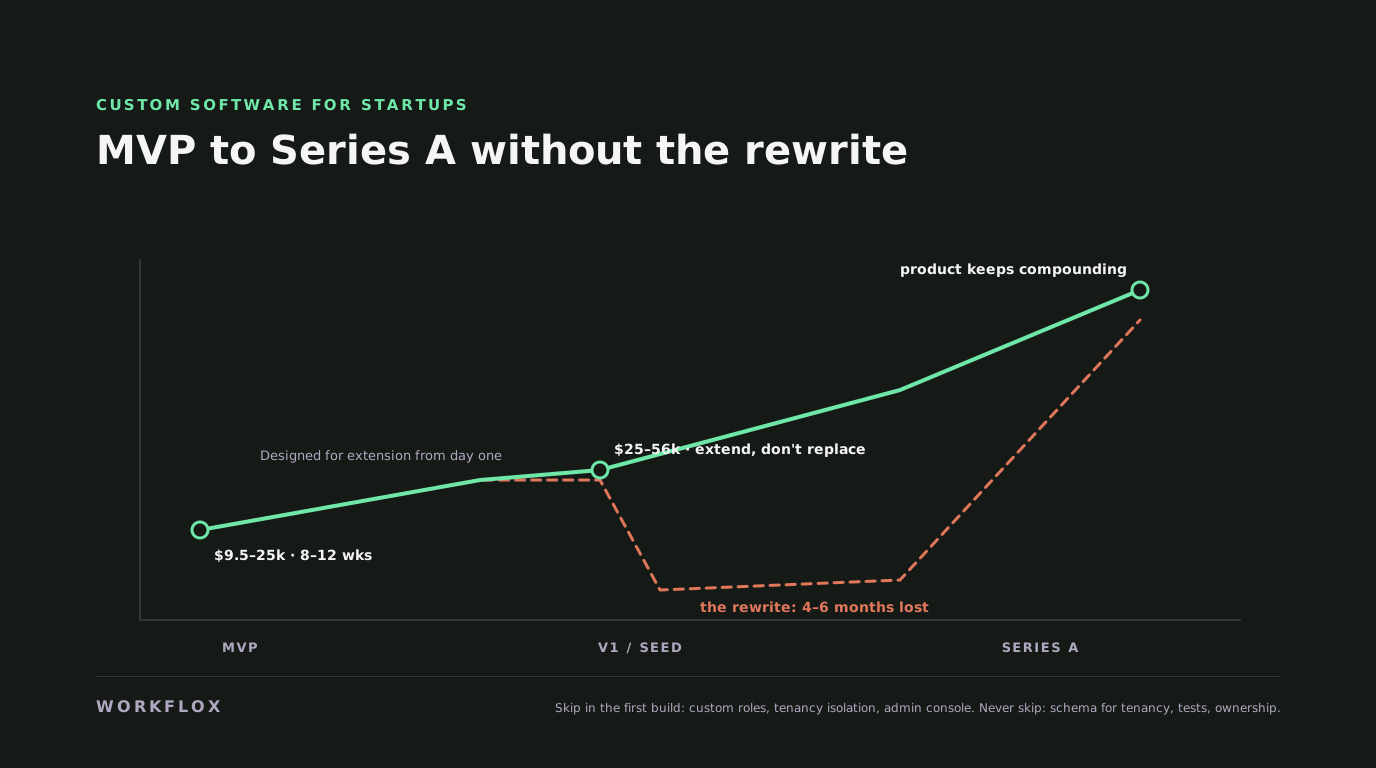
The discipline is to keep the scope deliberately narrow and the foundation deliberately sound. Accounts, one core workflow, billing, a simple admin view, a deployment pipeline. Sensible data modelling and real authentication, so that traction means extending rather than rewriting. A $9,500 to $25,000 fixed-price build that ships in six to ten weeks is the normal shape; our custom software for startups note goes deeper on the foundation.
What to insist on: a fixed price against a written scope, direct access to the engineers, and the repository and cloud in your name from day one, because if this works, you will be hiring against this codebase.
Post-traction: hire the core, outsource the edges
When customers are paying and the product is the business, institutional knowledge starts to compound and should compound in-house. Hire the core team. Against the codebase that exists, so new engineers join a house style rather than inventing one. This is where the outsourced MVP pays a second dividend: it established the conventions.
Keep outsourcing for what it is good at. Capacity for a defined feature push. A specialist skill you cannot justify permanently: a mobile client, a data pipeline, a security hardening pass. Staff augmentation inside your team for uneven demand.
Scaling: never outsource ownership
At scale the rule is simple. Product decisions, customer relationships and core architecture are yours. Everything downstream of them can be delivered by a partner against a scope, and usually should be where it is definable and time-bound.
The AI question
"Hire, outsource, or just use AI" is a real question in 2026 and the answer is: all three, at different stages. AI tools to validate. Outsourcing to build the foundation. Hiring to own it. AI inside the product and inside the engineering process throughout. Treating any one as a replacement for the others is how startups end up with a demo that cannot take payments or a payroll they cannot afford.
The pre-product trap
The founders who lose the most money are the ones who build before they have to. A landing page, a waiting list, a spreadsheet, a concierge version run by hand for ten customers: these tell you whether anyone wants the product, and they cost almost nothing. Outsourcing a build at this stage is expensive validation, and it is worse than expensive, because a finished product creates pressure to sell what was built rather than learn what was needed. We have declined to build for founders at this stage and pointed them at no-code tools instead. A few came back six months later with real users and a much better-shaped brief. That is the right order.
Reading an outsourcing contract as a founder
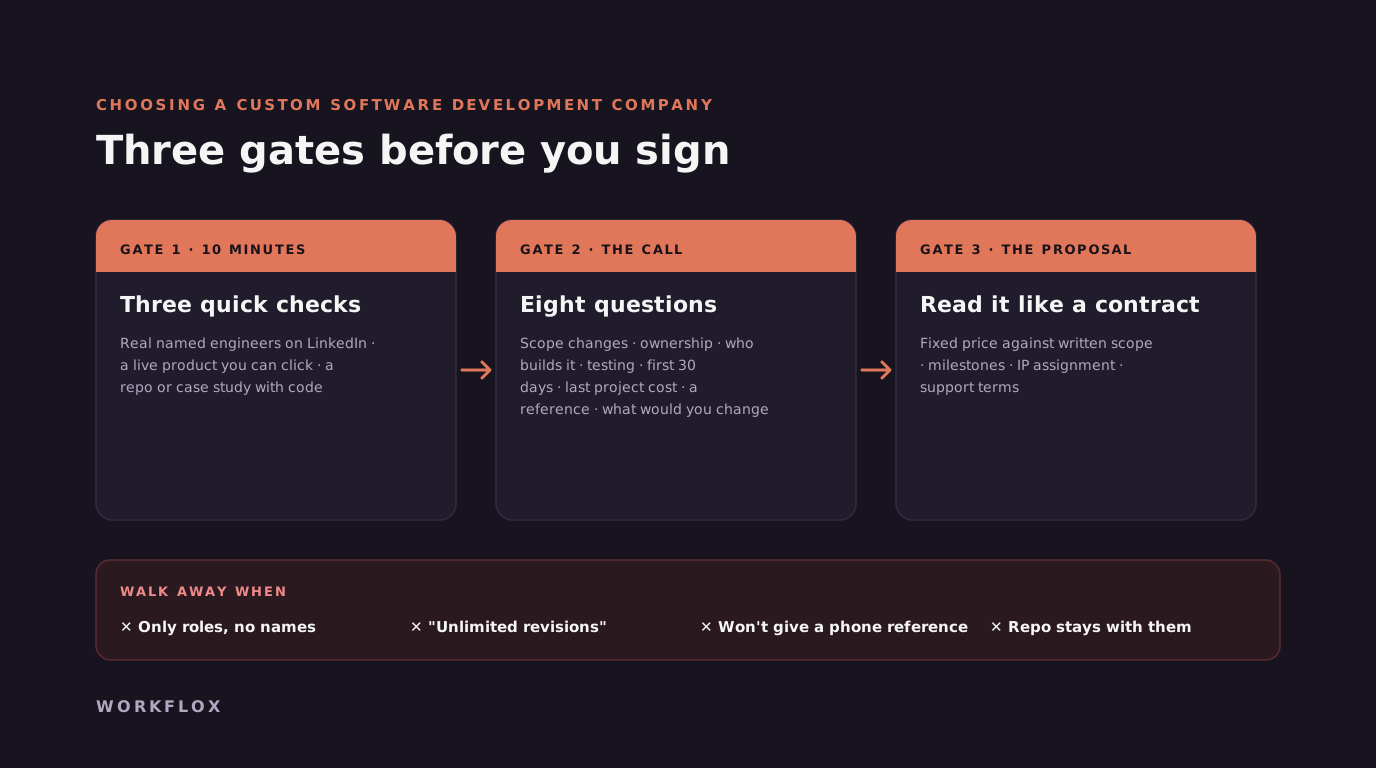
Three clauses decide whether an outsourced MVP is an asset or a liability at your seed round. Intellectual property: everything, code, designs, prompts and documentation, assigned to your company on payment, with no licence back. Investors will ask. Ownership of accounts: the repository, the cloud account, the app store accounts and the domain are created in your name, not the vendor's, because transferring them later is a nuisance at best and impossible at worst. And a defined end: what is delivered, when, at what price, with a named support period afterwards. A vendor who wants an open-ended hourly arrangement for an MVP is pricing their uncertainty into your runway. A fixed price against a written scope is what a definable first build should cost.
When the numbers say hire
There is a point where outsourcing the core stops making sense, and it usually arrives with revenue. Once customers depend on the product daily, once the roadmap is being set by what they ask for, and once the engineering decisions are the company's competitive position, the people making those decisions should be employees with equity and a long horizon. That is the moment to hire the first one or two engineers, ideally people who can read the outsourced codebase and take ownership of it. A good partner makes that handover easy: documentation, a pairing period, and a clean exit. A partner who resists it, or who has arranged things so that leaving is painful, was never a good partner. We build to be replaced by your own team, and we think that is the honest way to work with a startup.
A rough decision table
Pre-product: build nothing custom; validate with tools and by hand. MVP with a validated need: outsource a fixed-scope build, typically $9,500 to $25,000, and keep everything in your name. Post-traction: hire one or two core engineers, keep a partner for the edges, mobile apps, integrations, reporting, the work that does not need to be in-house. Scaling: the core team owns architecture and product; outsource only bounded projects with clear specifications. The line that never moves is ownership: at every stage, the code, the accounts and the data belong to the company. If the current arrangement violates that, fix it before the next funding conversation, because the investor's lawyer will find it.
The mistakes we see most
Three, and they recur. Outsourcing before validation, covered above. Choosing a vendor on price alone for the MVP and inheriting a codebase the first hire refuses to work in, which is more expensive than the difference in quotes. And treating the outsourced team as permanent, so that two years in, nobody at the company can explain how the product works. Each is avoidable by asking one question at the start: what does this arrangement look like when it ends, and does the company come out of it owning more than it went in with?
A short version to keep
Validate before you build anything. Outsource the first build at a fixed price, in your name. Hire the core once customers depend on it. Keep a partner for the edges. Never outsource ownership. If you remember one line, keep the last one, because every other mistake on this page is recoverable and that one is the hardest to undo.
What we do
We build SaaS products at the MVP and post-traction stages on a fixed price, and we place dedicated developers inside startup teams for the capacity and specialist gaps after that. Our SaaS stack guide covers what you will be running by the third stage, and the web app cost guide puts bands on each shape.
Frequently Asked Questions
Should a SaaS startup outsource development or hire?
It depends on stage. Pre-product and MVP, outsourcing a fixed-scope build is usually right. It is faster and cheaper than recruiting for something you have not validated. Post-traction, hire the core team and use outsourcing for capacity and specialist gaps. The mistake in both directions is expensive: hiring before validation, or outsourcing the product after it becomes the business.
Can a SaaS startup build with AI tools instead of hiring or outsourcing?
For a prototype or a validation experiment, often yes. AI app builders get a working demo in days. For a product customers pay for, the gaps appear at the permissions model, integrations, multi-tenancy and security review, and those are engineering work. The realistic pattern is AI tools to validate, then a real build on a sound foundation.
What should a SaaS startup never outsource?
Product ownership: what to build, for whom, and why. Also the relationship with customers, and, once the product is the business, the core architecture decisions. Everything downstream of those can be delivered by a partner against a scope.
How much does outsourcing a SaaS MVP cost?
A deliberately narrow SaaS MVP, accounts, one core workflow, billing, a simple admin view, deployment, typically runs $9,500 to $25,000 with an offshore partner and ships in six to ten weeks. A broader first version with several roles and integrations runs $25,000 to $62,000. The scope should be narrow on purpose; the foundation should not.
Related services
Related Articles