Hiring & Teams
Custom Software Development for Startups: MVP to Series A Without a Rewrite
By Muhammad Usman • July 2026
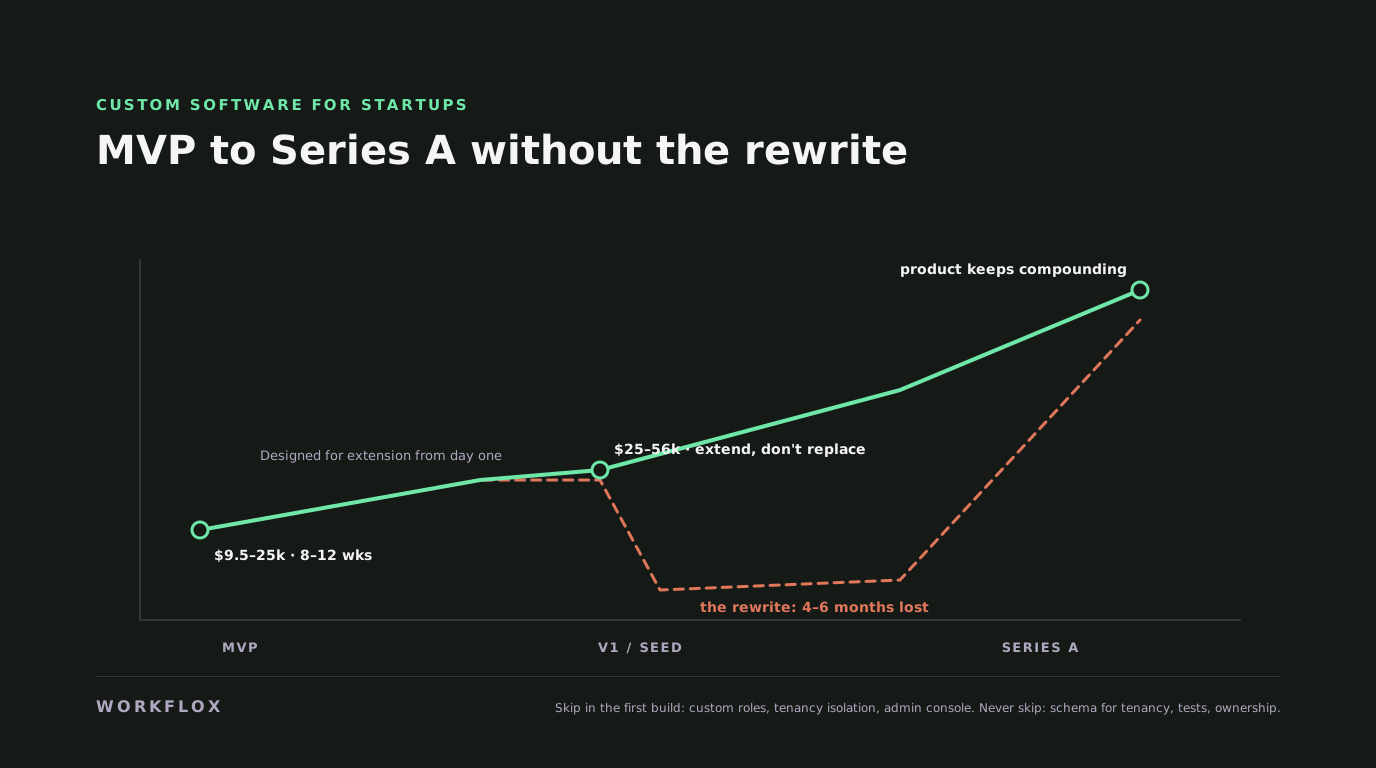
Table of Contents
Custom software development for startups is a different discipline from building for an established company, and most of the expensive mistakes come from not noticing. An enterprise knows what it needs and optimises for completeness. A startup does not know yet, and should optimise for learning without accumulating the technical debt that forces a rewrite the moment it finds traction.
The one principle
Narrow scope, sound foundation. Build the fewest features that let real users do the one thing the product exists for, and build them on a data model, an authentication layer and a deployment pipeline that will still be right when you have a thousand customers. The scope is disposable; the foundation is not.
What to skip in the first build
Breadth. Every feature a competitor has. Polish beyond what a paying user needs to trust the product. Integrations beyond the first one. An admin interface more elaborate than a table and a few actions. Native mobile apps, unless mobile is the product. Multi-tenancy, unless enterprise customers are the first customers. Each of these is a real feature that a real product will need, and each is far cheaper to add against evidence than to build on a guess.
What never to skip
The data model. Get the entities and relationships right, because every feature you add later sits on them. This is where an experienced engineer earns the fee.
Authentication and a permissions model. Even with two user roles today, design the model so a third does not mean touching every query.
A deployment pipeline. Ship a fix in minutes, not by hand. It costs a day now and saves a month later.
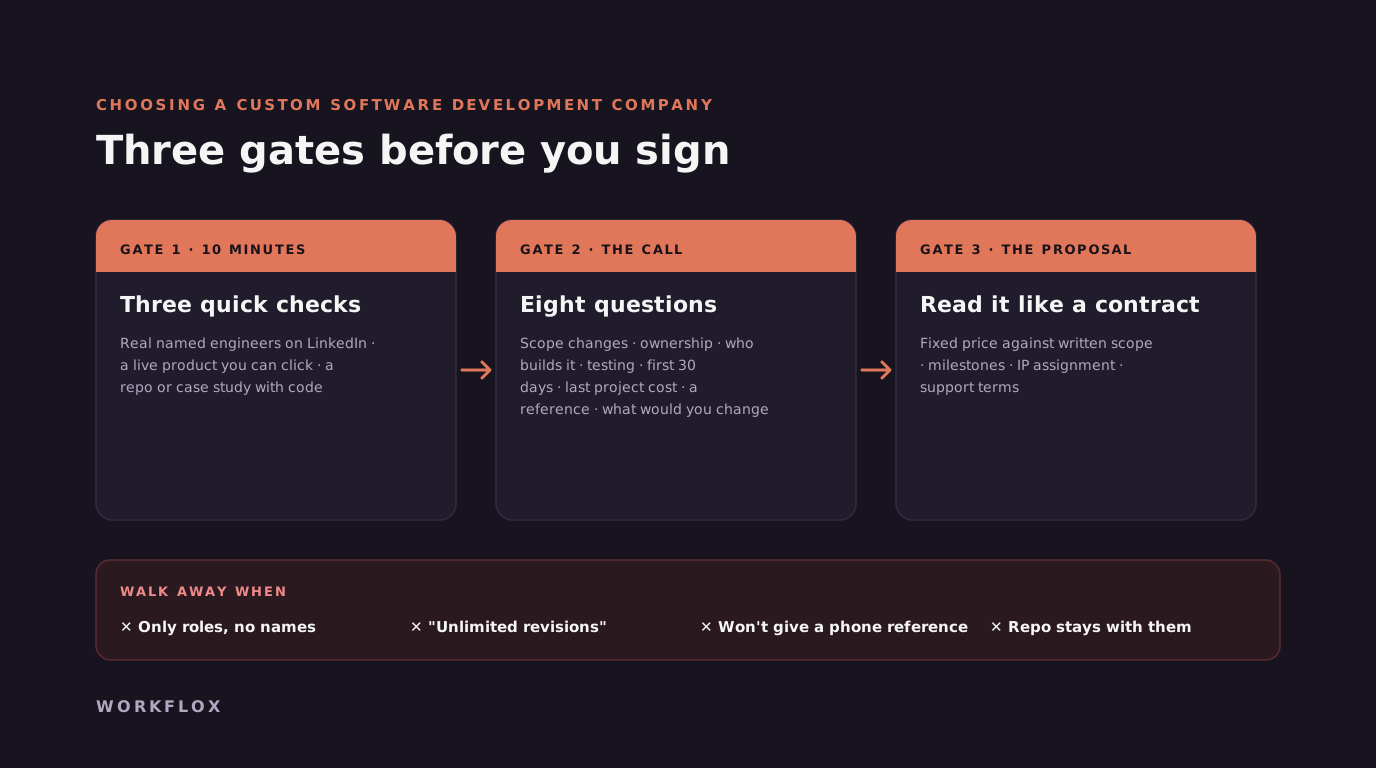
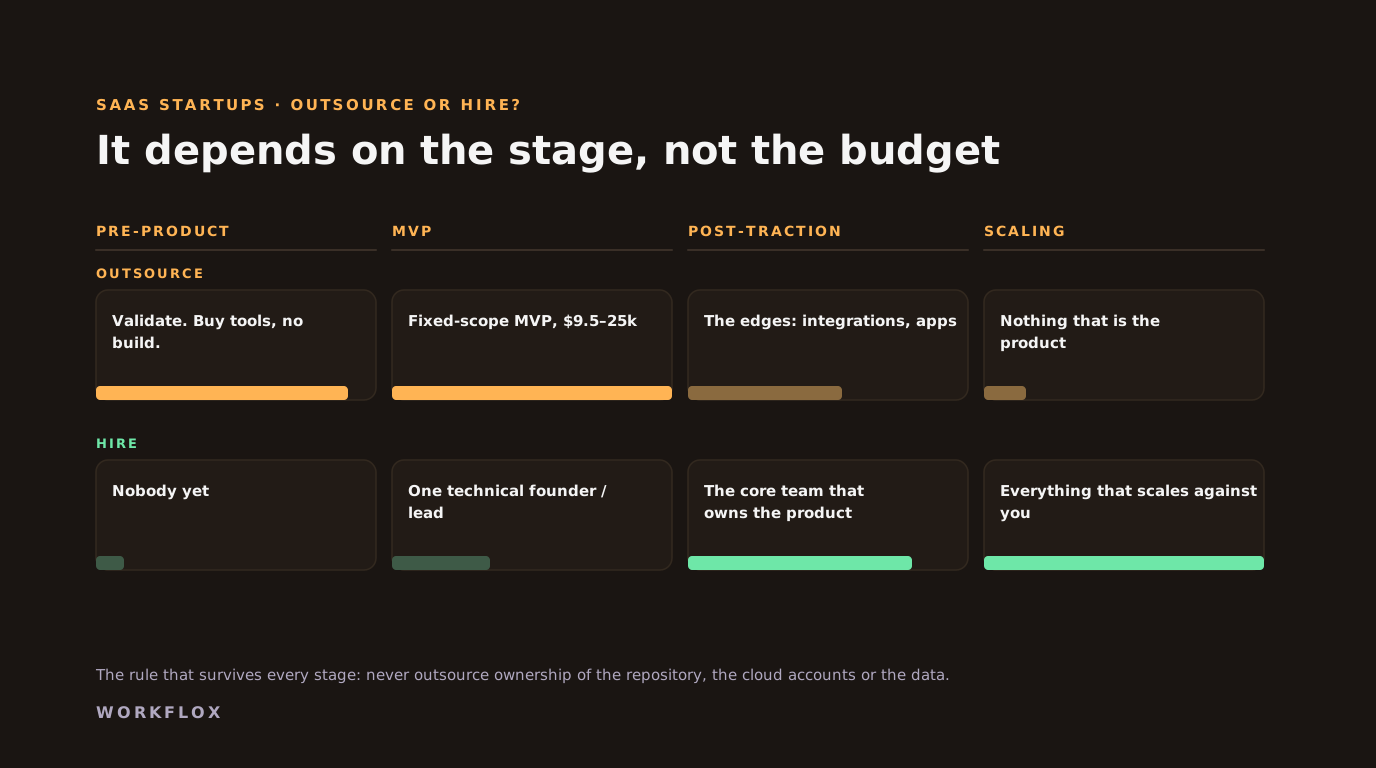
Ownership. Your repository, your cloud accounts, your domain, from day one. If the product works, you will be hiring engineers against this codebase, and you should be able to end any partner relationship on a Friday and keep working on Monday.
The rewrite, and how to avoid it
The classic startup arc is: MVP built fast, traction arrives, the MVP cannot take the load or the features, and a rewrite begins at exactly the moment the company can least afford one. The cause is nearly always a foundation that was skipped, not a scope that was too narrow. A narrow product on a sound foundation extends; a broad product on a weak one does not.
Engagement model by stage
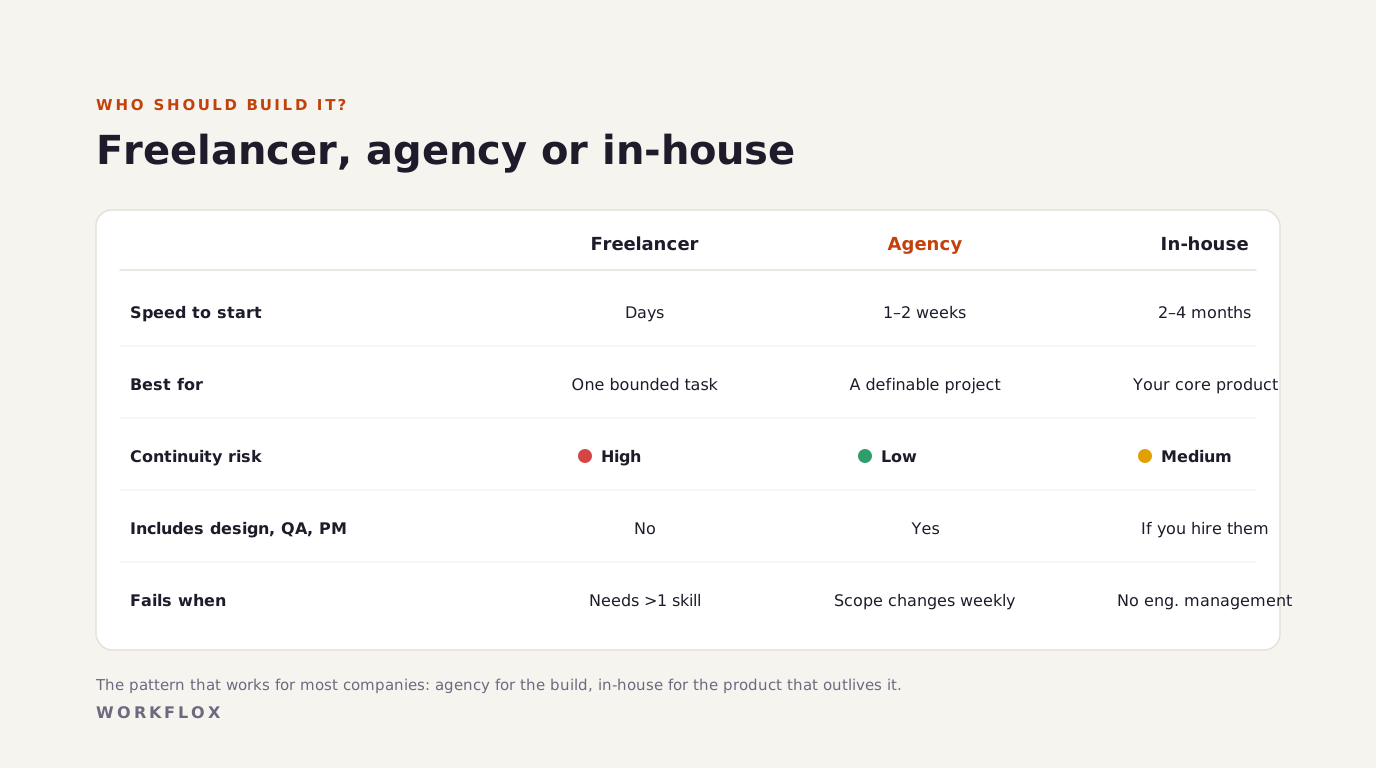
For the MVP, a fixed price against a written scope: it caps spend on something unvalidated and rewards delivery. Once the product is the business, a dedicated team you direct. Our SaaS outsourcing decision guide walks through the stages, and our agencies vs freelancers vs in-house comparison covers who should build at each.
What the rewrite actually costs
Founders hear that a rewrite is expensive and picture the engineering bill. The engineering is the smaller part. A rewrite means four to six months during which the product does not improve, while the company still pays for the team and still promises customers features that are now scheduled after the migration. It means a period where two systems run in parallel and every bug has to be checked in both. It means the accumulated knowledge in the old codebase, the odd workarounds that existed for good reasons, gets lost and rediscovered. We have seen a Series A company spend most of its round on a rewrite and arrive at the next one with roughly the product it started with. The whole argument of this article is that the rewrite is avoidable, and the way to avoid it is a handful of decisions in the first build that cost a week.
The week that saves six months
Here are the decisions, concretely. Design the database schema with a tenant identifier on every table from day one, even if the MVP has one customer, so that multi-tenancy is a filter rather than a migration. Put billing behind a thin interface of your own, so that switching from Stripe Checkout to metered plans later is a change to one module. Model permissions as data, roles and actions in tables, rather than as conditions scattered through the code. Put background work in a job queue with retries from the first version, even if the queue has one job type. Write the deployment as a script, not a set of instructions. And keep the API separate from the interface, so that a mobile app or a partner integration later does not require untangling them. Each of these adds a day or two to the first build. Together they are the difference between extending the MVP and replacing it.
Choosing the first stack
Founders sometimes ask for the newest framework because a competitor uses it, or the oldest because a friend said it was safe. Neither is the right basis. Choose the stack your first two hires will be able to work in, because the outsourced build is a bridge to an in-house team and the handover is easier if the technology is one engineers commonly know. For most SaaS products in 2026 that means TypeScript across the stack, React or Next.js on the front, Node or Python behind it, and Postgres underneath, with managed hosting rather than self-run infrastructure. It is not exciting and it is not a limitation. Products that outgrow this stack have usually earned the money to rebuild the piece that needs it, and that is a good problem.
Fixed price, and what it protects
For a first build, a fixed price against a written scope protects the startup in two ways. It caps the spend, obviously. Less obviously, it forces the scoping conversation that hourly engagements let everyone skip. To quote a fixed price, the vendor has to ask what is in and what is out, which means the founder has to decide, which means the MVP gets narrower and ships sooner. The proposals we write list the features, the integrations, the acceptance criteria and the price on one page, and we have found that the page itself is worth almost as much as the discount. A focused MVP with accounts, one core workflow, billing and deployment now runs about $9,500 to $25,000 with us, and ships in six to ten weeks.
The handover, planned from the start
Everything above assumes that one day your own engineers will own this code. Plan for that on the first day of the build. Documentation written as the code is written, not afterwards. A README that gets a new engineer to a running local environment in under an hour. Architecture decisions recorded in a few paragraphs each, with the reasons, so that the second team does not undo them for lack of context. And a pairing period in the contract when the time comes. A build that is easy to hand over is also, not by coincidence, a build that was done well.
What it costs
A narrow MVP, accounts, one core workflow, billing, a simple admin view, deployment, typically runs $9,500 to $25,000 with us and ships in six to ten weeks. A fuller first version, with several roles and integrations, lands between $25,000 and $56,000. US agencies at $150 to $350 per hour land three to four times higher. Full bands are in our custom software cost guide and web app cost guide.
We build startup products on exactly this principle through our custom software development and SaaS development practices: narrow on purpose, sound on purpose, fixed price, your codebase.
Frequently Asked Questions
What is different about custom software development for startups?
The uncertainty. A startup does not yet know which features matter, so the discipline is a deliberately narrow scope on a deliberately sound foundation, minimal features, real data modelling and authentication, so that finding traction means extending the product rather than rewriting it. Established companies optimise for completeness; startups should optimise for learning without technical debt.
How much does custom software development cost for a startup?
A narrow MVP with accounts, one core workflow, billing and deployment typically runs $9,500 to $25,000 with an offshore partner and ships in six to ten weeks. A broader first version with several user roles and integrations runs $25,000 to $56,000. US agencies at $150 to $350 per hour land three to four times higher for the same scope.
What should a startup never skip in its first build?
A sensible data model, real authentication and a permissions model, a deployment pipeline, and ownership of the repository and cloud accounts. These are cheap to do first and close to a rewrite to retrofit. Everything else, polish, breadth, integrations beyond the first, can wait for evidence.
Should a startup use a fixed-price or hourly engagement?
Fixed price against a written scope for the MVP, because it caps the spend on something unvalidated and puts the incentive on delivery. A dedicated team once the product is the business and priorities change monthly. Hourly with no ceiling is the wrong model for a startup at any stage.
Related services
Related Articles