Hiring & Teams
How to Choose the Right Custom Software Development Company
By Muhammad Usman • June 2026
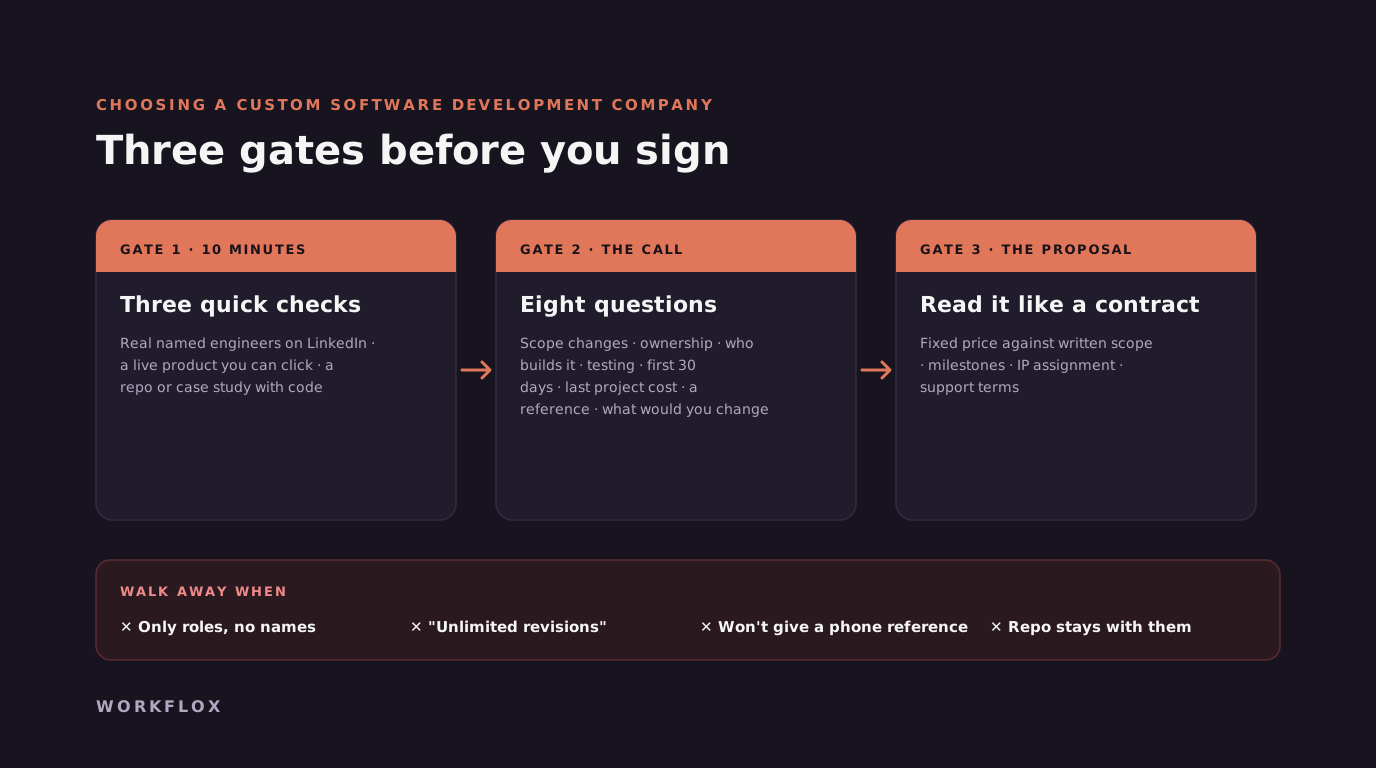
Table of Contents
- Before you talk to anyone
- Custom software development companies: three checks that take ten minutes
- Eight questions for the call
- Reading the proposal
- When to walk away
- What a good reference call sounds like
- Where the proposal hides the risk
- Fixed price, time and materials, or a mix
- Signs you have found the right one
- After you sign
- The honest summary
Most guides to choosing a custom software development company are written by custom software development companies, and they tend to describe the author. This one is too, we build software for a living, so it is organised around things you can verify rather than things we would like you to believe.
Before you talk to anyone
Write the scope first. Two pages: what the software must do, who uses it, what it connects to, and what done looks like. You will refine it with whoever you hire, but without it every quote you receive is priced against a different assumption, and the cheapest is the one that assumed the least.
Decide your engagement model. Fixed price against scope suits a definable project. A dedicated team suits continuous work with changing priorities. Time-and-materials suits neither unless you have your own technical lead managing it daily. Knowing which you want narrows the field before you search.
Custom software development companies: three checks that take ten minutes
Have they shipped something structurally similar? Not the same industry, the same shape. A multi-role platform with payments and integrations is a different build from a content site, regardless of sector. Look at what the portfolio actually describes, not the logos.
Can you talk to engineers? If every conversation routes through an account manager, so will every decision on your project, and each one gains a day of latency and loses detail. A company that puts engineers on the first call is telling you how it works.
Do they quote fixed price against scope? Hourly with no ceiling rewards the clock. A fixed number against a document you both sign rewards delivery. Where a company says the scope is too uncertain to fix a price, that is often true: and the answer is a short, paid scoping engagement that produces one, not an open-ended contract.
Eight questions for the call
- What happens when scope changes? You want a defined change process with a price attached, not a shrug.
- Who owns the repository, the cloud accounts and the credentials? The answer must be you, from day one.
- Who exactly will build this, and can I meet them? Names, not roles.
- How do you test? Automated coverage, review process, and who signs off.
- What does the first thirty days after launch look like? Included support, response times, who to call.
- What did your last similar project cost, and what did it actually cost? Honest companies have a story about a project that overran and what they changed.
- Ask for a reference you can call. Then call them.
- What would you build differently if you were us? A good company has an opinion; a vendor only has a proposal.
Reading the proposal
A proposal that is mostly the company's history is a brochure. A good one restates your scope in their words, which tells you whether they understood it, then itemises what is included, what is excluded, the timeline with milestones, the price, and the assumptions the price rests on. The assumptions section is the most important paragraph in the document. If there is not one, ask why.
When to walk away
A discovery phase billed before any scope exists. A refusal to name engineers. The company wanting to hold your repository or domain. A price far below every other quote against the same scope. Someone has misread it or intends to renegotiate. And a reference list nobody will let you call.
What a good reference call sounds like
A reference call is only as useful as the questions, and most people ask whether the vendor was good, which every reference answers yes. Ask instead: what went wrong, and how did they handle it? Every project has something; a reference who cannot name one was not close to the work. Did the final cost match the proposal, and if not, why? Who from the vendor's team actually worked on it, and are they still there? What did the handover look like, and can your own team work in the code now? Would you use them for a project twice the size? A good reference has specific answers and at least one criticism. A bad one is a testimonial read aloud. Also ask for a reference whose project ended more than a year ago, because how the code aged is the question that matters most.
Where the proposal hides the risk
Proposals tend to be precise about what is exciting and vague about what is hard. Read for the vague parts. Integrations described as straightforward, without naming the systems or the API version. Data migration mentioned in one line. Testing as a phase at the end rather than a practice throughout. Deployment and hosting left to be decided later. A launch date with no acceptance criteria attached. Each of these is a place where the price will move. A proposal that names the three integrations, states which have been tested against the real API before, allocates time to migration, and defines what done means for each feature is usually the more expensive one on paper and the cheaper one in practice.
Fixed price, time and materials, or a mix
The pricing model tells you how the vendor thinks about risk. A fixed price against a written scope puts the risk of estimation on the vendor, which is appropriate for a definable first build and is what we quote for most projects, typically $9,500 to $25,000 for a focused product. Time and materials puts the risk on you, which is appropriate when the scope genuinely cannot be known, such as an exploratory AI project or a rescue of a codebase nobody understands. The common failure is a vendor who quotes fixed to win the deal and then bills the change requests hourly, so ask how changes are priced before you sign. A good answer is that small changes are absorbed, material changes are quoted in writing before work starts, and either party can raise one.
Signs you have found the right one
They asked more questions than you did on the first call, and some of them were uncomfortable. They told you something you did not want to hear, such as that a feature you consider essential could wait. They named the people who would do the work. Their proposal is shorter than the others and more specific. They talked about how the engagement ends. Their references described a problem and how it was solved. And the price, while perhaps not the lowest, came with a scope you could hold them to. That combination is rare enough that when you find it, the difference between their quote and the cheapest one is usually worth paying.
After you sign
Choosing well is half of it. Give the vendor a single decision-maker on your side who can answer questions within a day. Review the work every week or two on a running system, not in slide decks. Keep the scope document alive and mark what changed. Insist that the repository, hosting and any third-party accounts are in your name from the first week. And when something goes wrong, which it will, judge the vendor on how they handle it rather than on whether it happened. The vendors we lose sleep over are not the ones who tell us about a problem. They are the ones who do not.
The honest summary
The right custom software development company for you is the one whose shipped work matches the shape of yours, whose engineers you can reach, and whose price is attached to a scope you both signed. Everything else, size, city, awards, the rankings page they appeared on, is decoration.
We are a custom software development company and we answer all eight questions on the first call, because losing a project on question 7 is better than winning it on question 1. For the cost side, our custom software development cost guide puts real bands on project types, and our offshore vs in-house comparison covers the delivery-model decision with the arithmetic shown.
Frequently Asked Questions
How do I choose the right custom software development company?
Start from a written scope, not a shortlist. Then check three things before any call: whether the company has shipped something structurally similar, whether you can talk to the engineers rather than a sales layer, and whether they quote fixed price against scope. On the call, ask how they handle scope change, who owns the repository and cloud accounts, what happens after launch, and for a reference you can actually phone.
What are the best custom software development companies?
There is no universal best. There is the best fit for your scope, budget and sector. The companies worth shortlisting share traits rather than a ranking position: relevant shipped work, direct engineer access, transparent pricing, and clients who will take a reference call. Ranking lists are useful for discovery and useless for selection, because they cannot know your requirements.
How much does a custom software development company charge?
US and Western European agencies typically quote $150 to $350 per hour. Offshore partners run $30 to $80. Fixed-price engagements for a focused internal tool land around $9,500 to $25,000; a multi-role platform with integrations $62,000 to $125,000. The number matters less than what it is quoted against. A written scope makes quotes comparable, an hourly rate does not.
Should I pick a custom software development firm in my own city?
Only if you need people physically present. For hardware, on-site systems or a regulated environment. Otherwise timezone overlap and communication discipline matter far more than postcode. Many firms that market themselves by city deliver from elsewhere anyway; ask where the engineers on your project actually sit.
What are the warning signs when choosing a software development company?
A discovery phase that costs money before any scope exists; refusal to let you meet the engineers; hourly pricing with no ceiling; the company wanting to own your repository or cloud account; a portfolio of logos with no description of what was built; and any reluctance to give a reference you can call.
Related services
Related Articles