Hiring & Teams
Staff Augmentation: What It Is, When It Beats Hiring, and What It Costs
By Muhammad Usman • July 2026
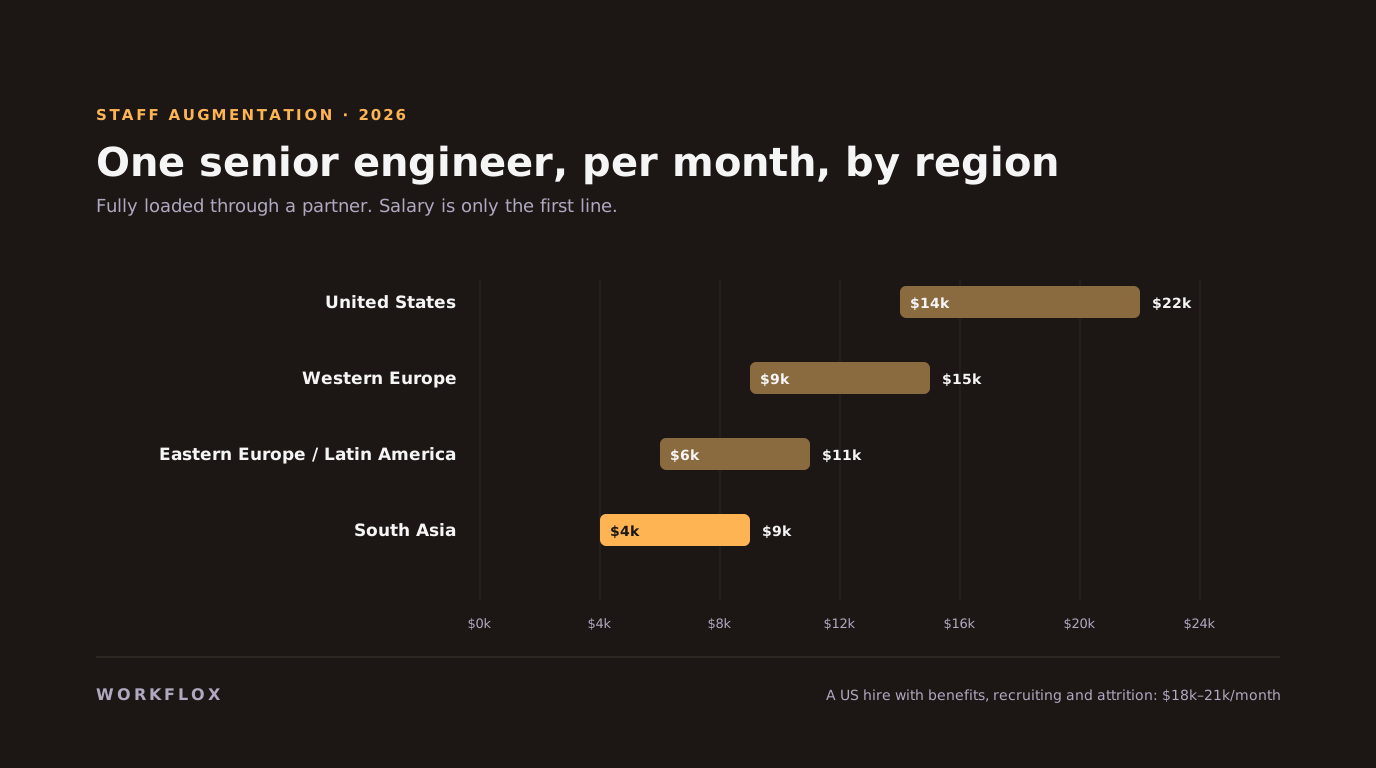
Table of Contents
Staff augmentation is the least glamorous way to get engineers and, for a specific set of situations, the best one. It is also widely misunderstood. Sold as outsourcing by some vendors and as hiring by others, when it is neither.
What software development staff augmentation actually is
You add engineers from a partner to your own team. They work on your backlog, in your repository, under your process, in your standups, for as long as you need them. You keep ownership of the product, the priorities and the code. The partner recruits, vets, pays and replaces them, and absorbs the risk that one of them leaves.
That is the whole model. It is not a project handed to a vendor, and it is not an employee. It is capacity, on your terms, without the hiring cycle.
When it beats hiring
Speed. A senior engineer in a US metro takes two to four months to recruit. Augmented engineers start in one to two weeks. If the work is waiting, that gap has a cost that never appears in a rate comparison.
Uneven need. Five engineers this quarter and two the next is a normal product rhythm and an impossible hiring plan. Augmentation scales in both directions without a hiring or layoff event.
A skill you cannot justify permanently. A Go specialist for a services rewrite, a data engineer for one pipeline, a mobile engineer for a client you will maintain but not extend. Renting the skill beats recruiting for it. Our note on hiring Go developers covers one such case.
You have management, not hands. Augmentation works when there is a technical lead to direct it. If you have that person and lack the people, it is the cheapest way to fill the gap.
When it does not
When the software is your core product and will be for years. Institutional knowledge compounds in-house; augmented engineers take theirs with them when the engagement ends, unless you deliberately structure the handover. And when you do not have engineering management. Augmented engineers without direction produce the same result as employees without direction, at a lower rate and with less commitment.
What it costs
Per engineer per month, roughly:
| Region | Monthly cost |
|---|---|
| United States | $14,000 – $22,000 |
| Western Europe | $9,000 – $15,000 |
| Eastern Europe / Latin America | $6,000 – $11,000 |
| South Asia | $4,000 – $9,000 |
Against a fully loaded US hire of $18,000 to $21,000 a month, the offshore bands save roughly half. Not seventy percent: that figure compares a salary to a rate and ignores your own management time, ramp, and the occasional replacement. Our offshore vs in-house comparison shows the full arithmetic.
The four ways it goes wrong
Body-shopping. A partner sends whoever is available rather than whoever fits. Insist on interviewing the specific engineers, and on the right to swap.
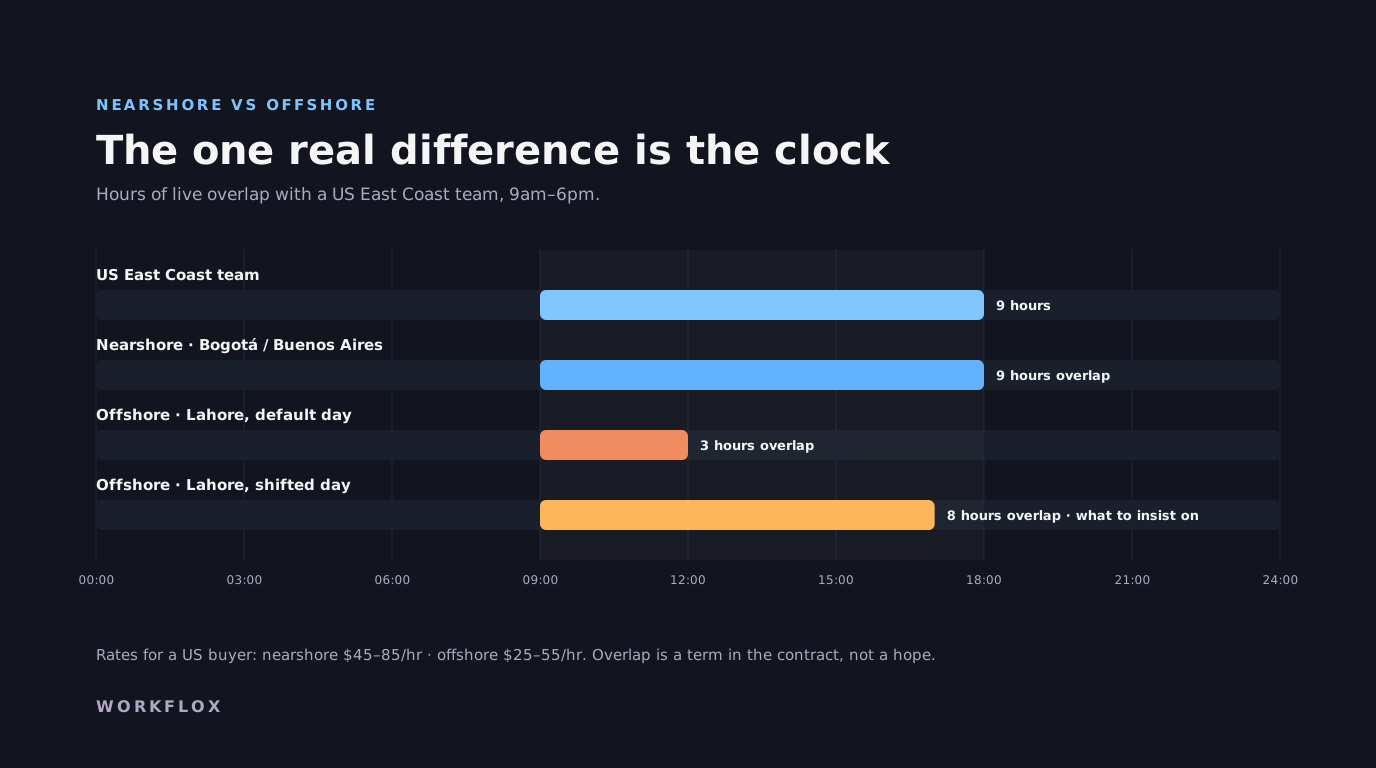
No overlap. Four hours of shared working time is the difference between a team member and a ticket queue. Get the overlap hours in writing.
Account-manager latency. If every question to the engineer routes through a coordinator, you have bought a slower employee. Direct access is non-negotiable.
Undefined ownership. Your repository, your cloud, your credentials, from day one. And a handover plan before the engagement ends, not after.
What the first two weeks look like
The engagements that work have a predictable first fortnight. Before day one, the engineer has access to the repository, the issue tracker, the staging environment and the team's chat, and has read the onboarding document your team wrote for its own hires. Day one is a working session with the person they will report to, not a tour. By the end of week one they have shipped something small to production, a bug fix or a minor feature, so that the whole path from ticket to deploy has been exercised with your review process. By the end of week two they are picking up tickets from the board like anyone else. If a partner's onboarding is a fortnight of reading with no commits, or if the engineer is waiting on access after day three, the engagement is already behind and it is worth saying so.
Managing an augmented engineer
The most common failure is not the engineer; it is nobody managing them. Augmented engineers work best inside your existing rituals: your standup, your sprint planning, your code review. They should not have a separate process or a separate manager on the vendor side who filters their work. Give them the same access, the same expectations and the same feedback you would give a hire. Two habits make a large difference. Written tickets with acceptance criteria, because an engineer in another time zone cannot tap someone on the shoulder to ask what was meant. And a weekly fifteen-minute check-in with the vendor about the relationship rather than the work, which surfaces problems early. When those are in place, the engineer's location stops mattering within a month.
Ending well
Every augmentation engagement ends, and the ending is where knowledge walks out of the door if nobody planned for it. Build the offboarding into the start. Code goes through your review process from the first commit, so nothing lives only in the engineer's head. Documentation is part of the definition of done for every ticket. Credentials are yours and are rotated when the engagement closes. And for longer engagements, a handover period of a week or two during which the departing engineer pairs with whoever inherits the work. We put all of this in the contract because the alternative, an engineer who leaves and a team that discovers a month later that the deployment pipeline only ran from their laptop, is a story we have heard too many times from clients who came to us after a different vendor.
Rates, and what sits behind them
A dedicated senior engineer through us runs $2,000 to $4,000 a month, depending on seniority and specialism, and that figure includes the vendor's recruiting, equipment, HR and management. Compare that with a US hire at $145,000 base, which comes to roughly $240,000 a year once benefits, recruiting, tooling and attrition are counted, or about $20,000 a month. The gap is real, and it is also not the whole story. Add the time your team spends directing the work, which a good partner keeps to around ten percent. Add the cost of getting the wrong person, which a partner absorbs by replacing them and a hire does not. And weigh the working-hours overlap, which should be written into the contract rather than promised. On those terms, augmentation wins for most bounded work and loses for the core product your company will build for years.
A note on trial periods
Ask for one, and read it carefully. A reasonable trial is two to four weeks at the normal rate, with the right to end the engagement at the end of it with no penalty. That is enough to see whether the engineer can work in your codebase and communicate in your rhythm. A free trial is not the bargain it looks like, because a vendor who does not charge for the trial has no reason to put a strong engineer on it. What you want is a paid trial with a named person you interviewed, a small real ticket on day one, and a review at the end that either party can walk away from.
How we run it
We place dedicated developers inside client teams on exactly this model: you interview them, you direct them, you speak to them directly, and the overlap hours are committed in writing. When the work is a definable project rather than ongoing capacity, our offshore development team model owns delivery instead, and our agencies vs freelancers vs in-house comparison explains when each applies.
Frequently Asked Questions
What is staff augmentation in software development?
Adding external engineers to your own team, under your direction and your process, for as long as you need them. You keep product ownership, priorities and the codebase; the partner supplies vetted people and absorbs recruiting, payroll and replacement. It sits between hiring, which you own entirely, and a project agency, which owns delivery against a scope.
When is staff augmentation better than hiring?
When you need capacity in weeks rather than months, when the need is uneven or time-bound, when the skill is one you cannot justify a permanent salary for, or when you have strong engineering management and lack only hands. It is worse than hiring when the work is your core product for the long term and institutional knowledge should compound in-house.
How much does software development staff augmentation cost?
Per engineer per month, roughly: US $14,000 to $22,000; Western Europe $9,000 to $15,000; Eastern Europe and Latin America $6,000 to $11,000; South Asia $4,000 to $9,000. Against a fully loaded US hire of $18,000 to $21,000 a month the offshore bands save around half, not the seventy percent often quoted, once management overhead and ramp time are counted.
What is the difference between staff augmentation and outsourcing?
Direction. With staff augmentation the engineers work inside your team, on your backlog, under your process; you manage the work. With outsourcing a partner takes a defined scope and delivers it under their process. Augmentation suits continuous work with changing priorities; outsourcing suits a definable project.
Related services
Related Articles