Hiring & Teams
Software Development Agencies vs Freelancers vs In-House: Who Should Build It?
By Muhammad Usman • June 2026
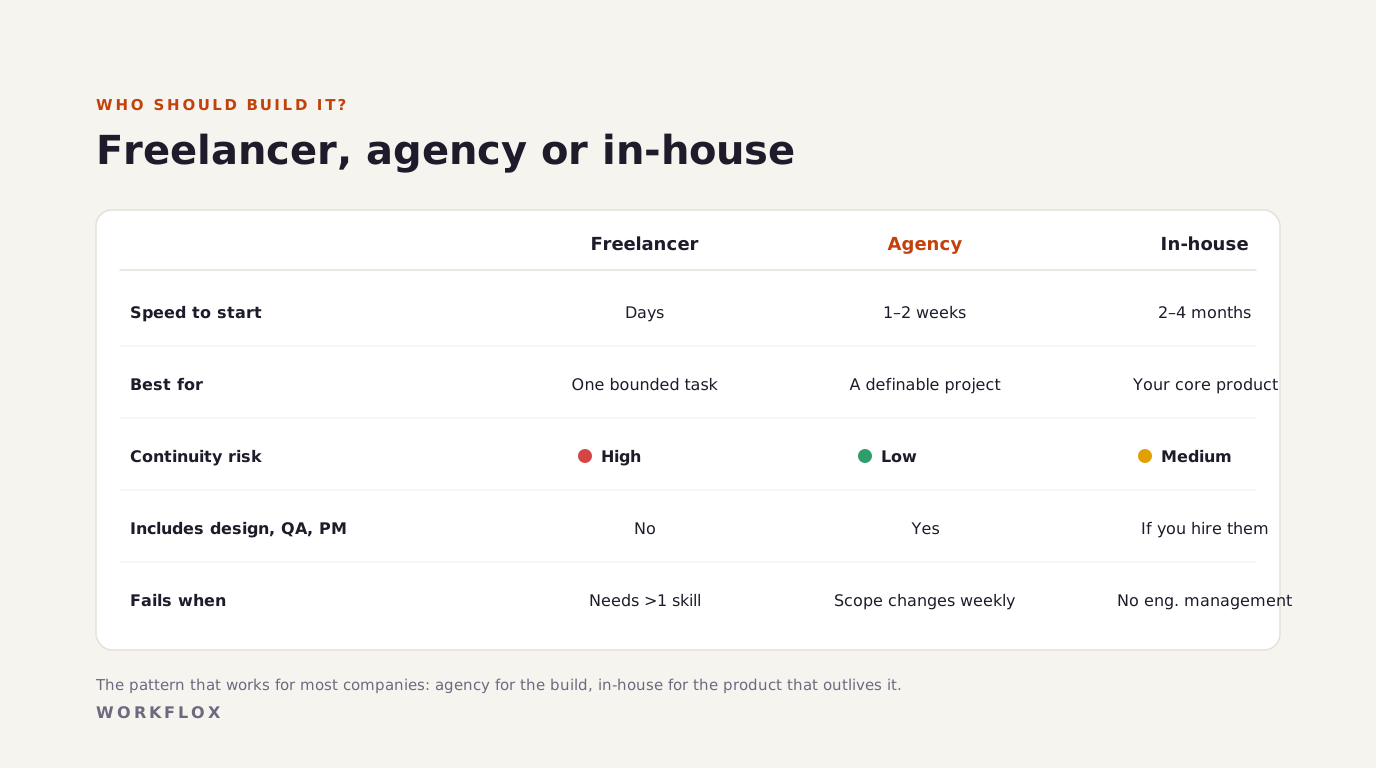
Table of Contents
- The three models in one table
- When a freelancer is right
- When a software development agency is right
- When in-house is right
- What each model costs, with the same project
- The freelancer failure, and how to avoid it
- The agency failure, and how to avoid it
- The in-house failure, and how to avoid it
- A short decision procedure
- The pattern that works for most companies
- A note on the words
There are three ways to get software built and each is the right answer for a different situation. The mistake is not choosing the wrong one. It is choosing by habit or by price without looking at what the choice actually trades.
The three models in one table
| Freelancer | Agency | In-house | |
|---|---|---|---|
| Best for | A bounded task, one skill | A definable project needing several skills | Your core product, evolving indefinitely |
| Speed to start | Days | One to two weeks | Two to four months to recruit |
| Cost | Lowest rate; excludes design, QA, PM, deployment | Higher rate; includes the whole delivery process | Highest fully loaded; fixed regardless of workload |
| Continuity risk | High, one person | Low, a team absorbs absence | Medium, turnover takes context with it |
| Control | High if you supervise; low if you cannot | Medium, you own scope, they own delivery | Highest |
| Fails when | The task needs more than one skill | Requirements are undefined and changing weekly | You lack engineering management |
When a freelancer is right
A landing page. A script that moves data between two systems. One integration. A design refresh. Anything you can specify precisely, that one skill covers, and that you can review yourself. Freelancers are fast, cheap and often excellent within those bounds.
They stop being right the moment a task needs design and backend and frontend and deployment, because you become the project manager coordinating four people who have never met: and the moment your one freelancer is ill, on another contract, or gone.
When a software development agency is right
Most software products. Anything with several user roles, integrations, a database, and a launch. The agency brings the whole delivery process, design, engineering, QA, deployment, post-launch support, as one accountable unit, at a rate that reflects all of it. Agencies also scale: five engineers this quarter, two the next, without a hiring or layoff event.
They are wrong for discovery work. If you cannot yet describe what you want because you are still finding the product, an agency will build what you said rather than what you meant, and the coordination cost of a distant team exceeds the rate saving. Agencies execute specifications; they do not read minds.
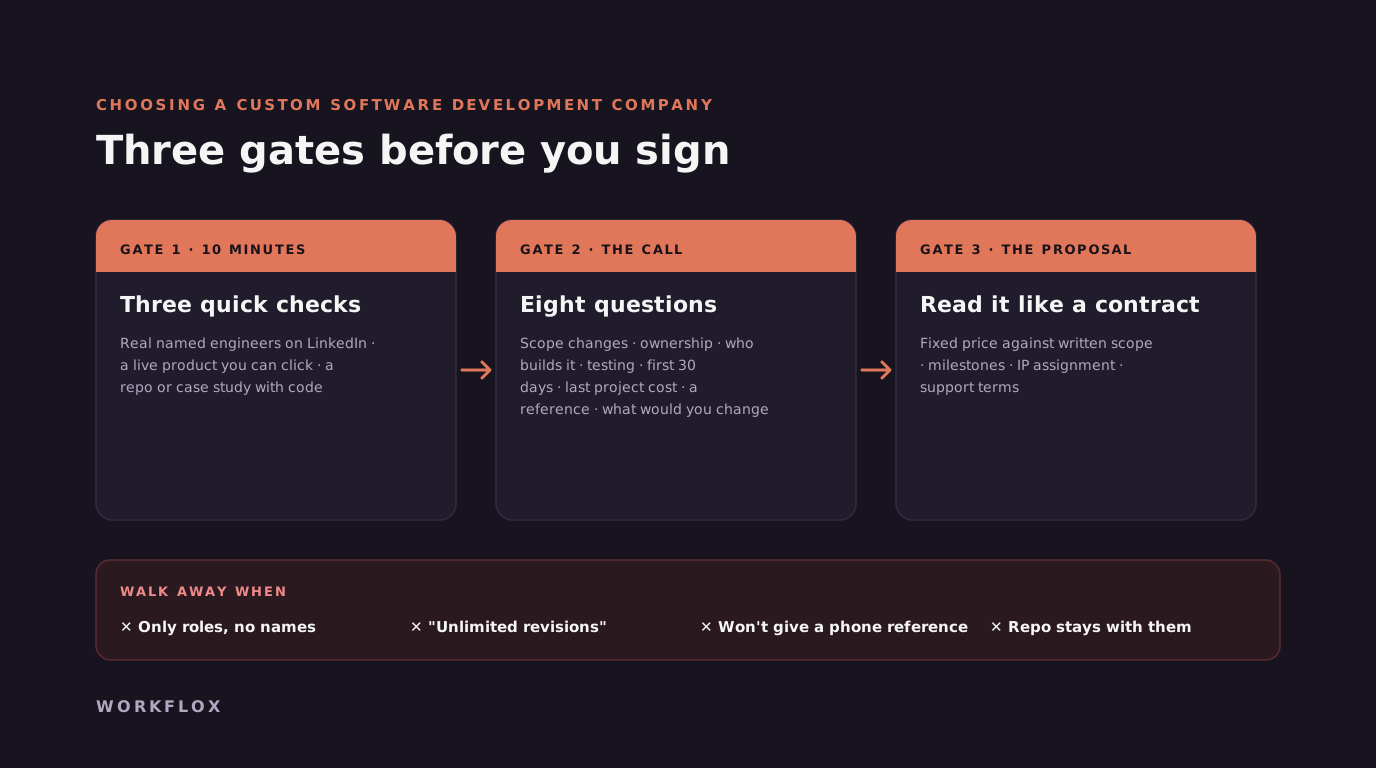
Two things separate good agencies from the rest: whether you can talk to the engineers directly, and whether the price is fixed against a written scope. Our guide to choosing a custom software development company covers the rest of the vetting.
When in-house is right
When the software is the business. Compounding knowledge of your own codebase is worth more than any rate saving over a five-year horizon, and an in-house team can absorb requirements that change weekly. It is also right when you need physical presence, hardware, on-site systems, regulated environments, and when you already have strong engineering management, which makes an in-house team materially more productive than the same people badly managed.
The cost is real and mostly invisible: a US senior engineer at $180,000 base is roughly $240,000 fully loaded, the recruiting cycle is two to four months during which nothing gets built, and the capacity is fixed whether you need it or not. Our offshore vs in-house comparison puts the full arithmetic side by side.
What each model costs, with the same project
Take a customer portal with authentication, a dashboard pulling from two internal systems, and a billing integration, about ten weeks of work. A senior freelancer at $60 to $100 an hour, full time, comes to roughly $24,000 to $40,000, plus your own time managing them and the risk that they are unavailable for the follow-on. An agency at fixed price: a US firm would quote $60,000 to $120,000; we would quote around $9,500 to $25,000 for the same scope, with a named team and a support period. An in-house engineer: the project is roughly a quarter of a US salary with on-costs, about $50,000 to $60,000, but the engineer is then there for the next project, which is the whole point of the model. The numbers only make sense against the question of what happens after week ten.
The freelancer failure, and how to avoid it
Most freelancer engagements that go wrong go wrong the same way. The freelancer is excellent and the project ships. Six months later, a change is needed, the freelancer is on another contract, and nobody else can work in the code because documentation was never in scope. The fix is not to avoid freelancers; it is to contract for the handover. Documentation and a README as part of the deliverable. Code in your repository from day one. A short written note of the architecture decisions. And an agreed hourly rate for future support, in writing, even if it is never used. With those, a freelancer is a fine choice for bounded work. Without them, you are renting a dependency.
The agency failure, and how to avoid it
Agencies fail differently: the team on the proposal is not the team on the project, the project manager filters every conversation, and the code arrives at the end with the vendor's opinions baked in and no one on your side who understands it. The fixes are all in the contract and the first week. Named engineers, with the right to interview them. Direct access to those engineers, not only to an account manager. A running system you can see every fortnight. Repository, hosting and third-party accounts in your name. And a handover period at the end, priced in. An agency that resists these has told you what kind of agency it is.
The in-house failure, and how to avoid it
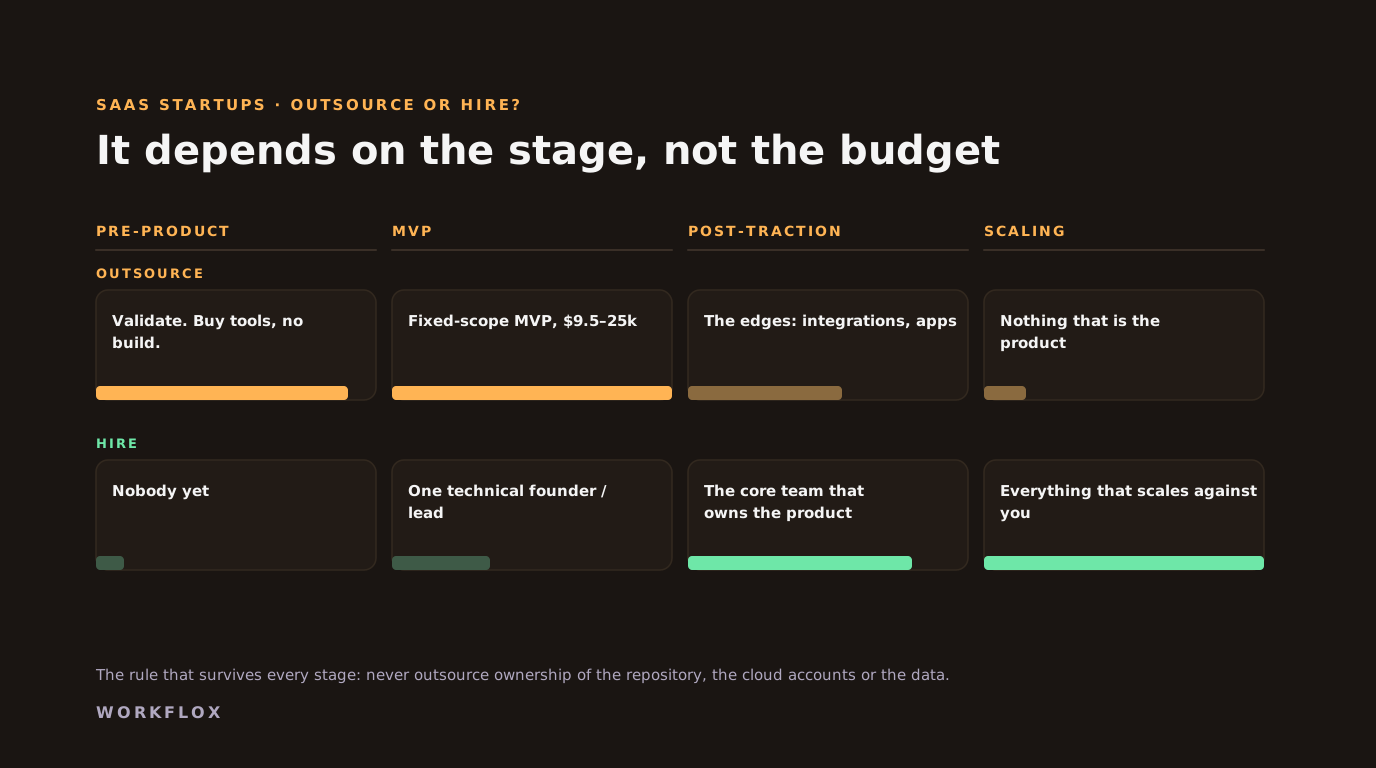
The in-house failure is slower and more expensive: hiring takes months, the first engineer is a generalist who becomes a bottleneck, and the company ends up with a team sized for the peak of the last project rather than the average of the next one. The fix is to hire for the work that is continuous and core, and to use an agency or freelancers for the peaks and the specialisms. A company with two in-house engineers who own the product and a partner for the mobile app, the data pipeline and the occasional large feature will spend less and move faster than one with six in-house engineers, three of whom are between projects.
A short decision procedure
Is the work bounded, with a clear end? If not, it is in-house work, or it becomes in-house work once it has been running for a year. Is the scope definable well enough to write down? If yes, an agency at fixed price is usually the best value; if no, a freelancer or an agency on time and materials. Does the project need more than one discipline, such as design, backend, mobile and infrastructure together? Then an agency, because assembling that from freelancers is a job in itself. Is the technology core to what the company sells? Then own it in-house eventually, whatever model builds the first version. And in every case: whose name is on the repository. If it is not yours, fix that before anything else.
The pattern that works for most companies
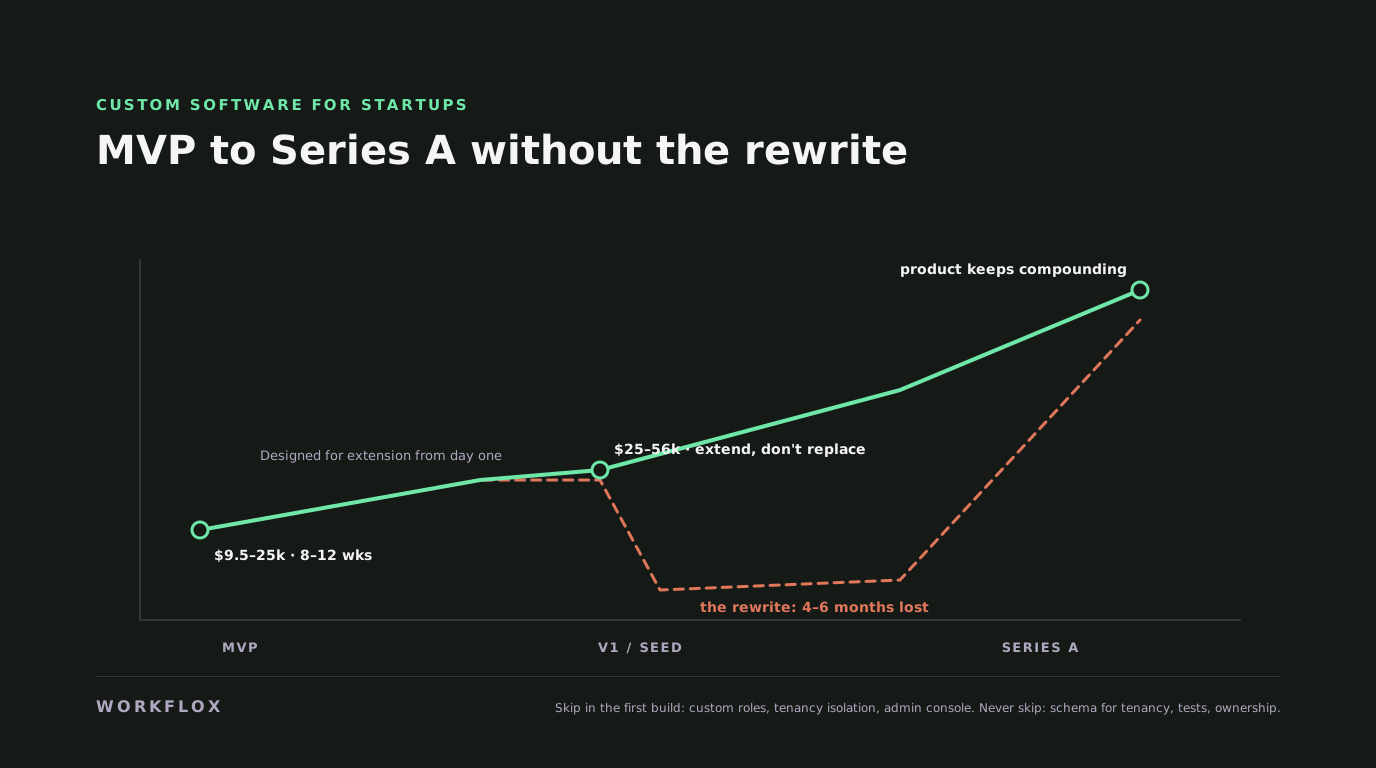
Contract an agency to build the first version and establish the conventions, architecture, testing, deployment, documentation, then hire in-house against a codebase that already demonstrates the standard. New hires join a house style instead of inventing one. Freelancers fill bounded gaps along the way. This is not a compromise between the three models; it is using each for what it is good at.
A note on the words
Agency, firm, studio, shop, company. They mean the same thing and the choice signals marketing, not substance. An "app programming company" and a "software development firm" can be identical organisations. Judge on work, access and pricing.
We operate as a custom software development agency and also place dedicated developers inside client teams, so we see this decision from both sides. If the question is cost, our custom software development cost guide has the bands.
Frequently Asked Questions
Should I use a software development agency or a freelancer?
A freelancer suits a bounded task with one skill, a landing page, a script, a single integration, where you can specify it precisely and supervise it yourself. An agency suits anything needing several skills at once, a delivery process, and continuity if one person is unavailable. The crossover is roughly where a project needs design, backend, frontend and deployment together, which is most software products.
What is the difference between a software development agency and a software development firm?
Nothing consistent. Agency, firm, studio, shop and company are used interchangeably; the words signal marketing positioning rather than a different service. Judge on shipped work, engineer access and pricing model, not vocabulary.
When does hiring in-house beat a software development agency?
When the software is your product and will evolve indefinitely, when institutional knowledge compounds and losing it would hurt, when requirements change weekly because you are still discovering the product, or when you already have engineering management to make a team productive. An agency executes a definable scope well; it reads minds poorly.
How much more does an agency cost than a freelancer?
On rate, an agency typically costs two to three times a freelancer. On outcome, the comparison is less clear: a freelancer's rate excludes the design, QA, project management and deployment work an agency includes, and it carries key-person risk an agency absorbs. For a bounded task the freelancer is cheaper; for a product the agency usually is, once the missing pieces are priced in.
Related services
Related Articles