Hiring & Teams
Hiring Go Developers: What to Test For, and What Most Interviews Miss
By Rana Sami Ullah • May 2026
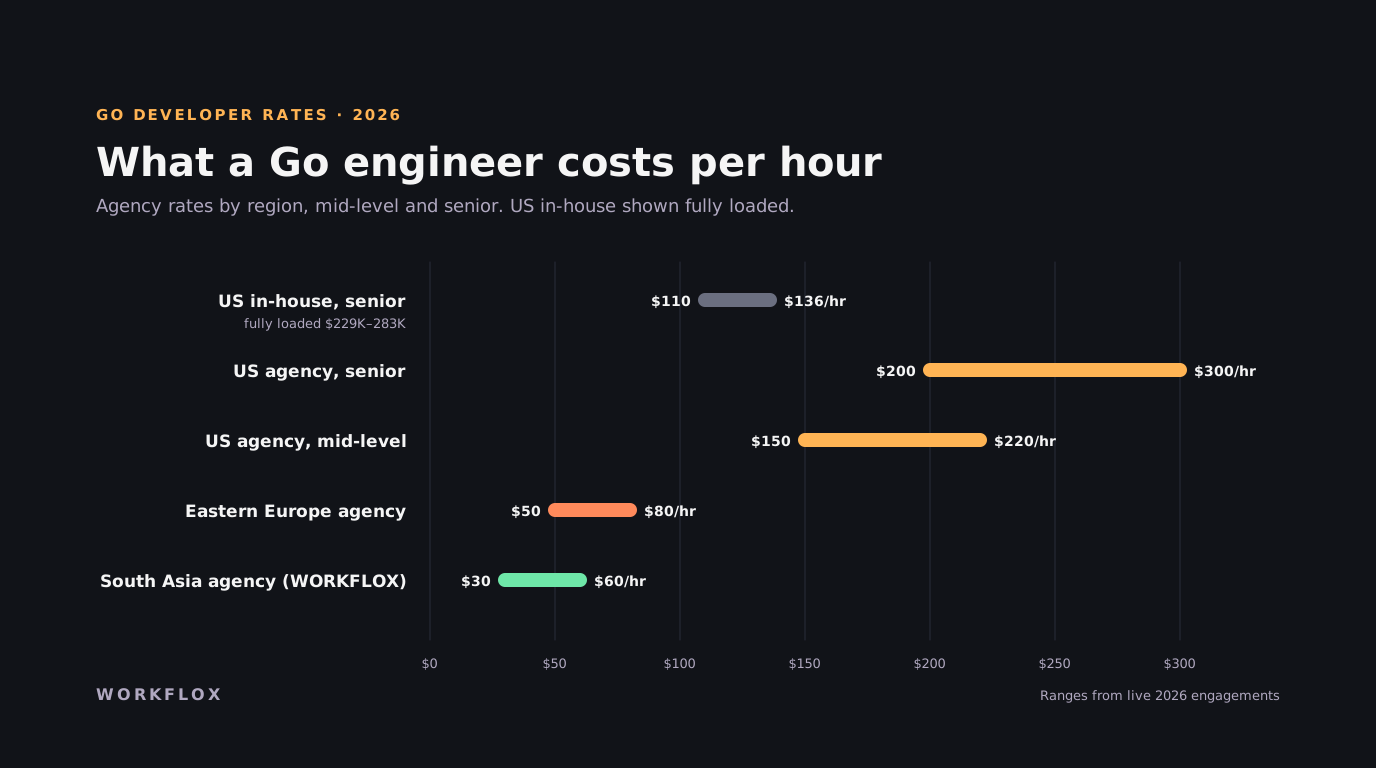
Table of Contents
- Why Go hiring is different
- The four things worth testing
- 1. Concurrency correctness
- 2. Context and cancellation
- 3. Error handling discipline
- 4. Interface design and API judgement
- What to test with an actual exercise
- Production judgement, briefly
- What Go developers cost
- Hire or contract?
- Is Go even the right choice?
- The short version
Go interviews tend to test the wrong things. Candidates get asked to recite the difference between a slice and an array, or to invert a binary tree, and neither question tells you whether they will write a service that stays up.
Go is an unusual language to hire for because it is genuinely easy to learn and genuinely hard to use well. A competent engineer from any background reads Go fluently within a week. The difficulty is concentrated somewhere else entirely, in concurrency, in error discipline, and in API design, and those are precisely the areas a syntax-focused interview skips.
This is what we actually test for, and why.
Why Go hiring is different
Most languages spread their difficulty across syntax, ecosystem and model. Go deliberately removes most of that. The spec is small, the formatting is not up for debate, and the standard library covers more than most teams realise.
What is left is unforgiving in a specific way. Go hands every developer cheap concurrency primitives with almost no guardrails. A goroutine costs a couple of kilobytes and one keyword, which means a developer who does not fully understand goroutine lifecycle can introduce a leak in a single line: and it will pass code review, pass tests, and surface three weeks later as a slow memory climb in production.
So the question is not whether a candidate knows Go. It is whether they have the judgement the language assumes you already have.
The four things worth testing
1. Concurrency correctness
This is the highest-signal area and the one most interviews handle badly. Do not ask candidates to explain channels. Ask them to reason about code that is subtly wrong.
Good probes:
- Show a worker pool where the results channel is never closed, and ask what happens.
- Give them a function that spawns a goroutine per request without any cancellation, and ask what breaks under load.
- Ask directly: how does this goroutine exit? A strong candidate asks that question unprompted about their own code.
- Ask when they would use a mutex rather than a channel. Anyone who says channels are always preferable has absorbed the slogan rather than the reasoning.
What you are listening for is whether goroutine lifecycle is something they track deliberately. Weak candidates talk about starting goroutines. Strong candidates talk about how they end.
2. Context and cancellation
Closely related, and worth separating because it is so often skipped. Ask how they propagate cancellation through a request path, what happens to in-flight database queries when a client disconnects, and where they would set a timeout.
The tell is whether context.Context is something they thread through deliberately or an argument they pass along because the linter wants it. Ask what context.Background() versus context.TODO() signals, not because the distinction is critical, but because the answer reveals whether they have read the conventions or absorbed them by osmosis.
3. Error handling discipline
Go's error handling is verbose by design, and the verbosity is the point: it forces a decision at every call site. What you want to know is whether they make that decision or reflexively bubble everything upward.
Ask when they wrap an error with context and when they do not. Ask how they would let a caller detect a specific failure: you are listening for sentinel errors, custom types, errors.Is and errors.As. Ask when panic is appropriate. The correct answer is roughly "programmer error at startup, and almost never in request handling", and candidates who use panic for ordinary control flow will write services that take the process down over a malformed input.
One practical question worth asking: what do they do with an error they genuinely cannot handle? The honest answer involves logging with enough context to debug it and failing in a defined way, not swallowing it.
4. Interface design and API judgement
Go rewards small interfaces and punishes speculative abstraction, and this is where developers from Java or C# backgrounds most often stumble.
Ask them to critique an interface with eight methods. Ask where they would define an interface. The Go convention is to define it in the consuming package rather than alongside the implementation, and knowing that signals real familiarity. Ask when they would use generics now that they exist, and listen for restraint rather than enthusiasm.
The underlying question is whether they write Go as Go, or write their previous language in Go syntax.
What to test with an actual exercise
If you run a practical exercise, keep it small and make it resemble the work. A good one: give them an HTTP handler that calls two upstream services, and ask them to make it concurrent, cancellable and correctly error-handled. It takes a competent Go developer under an hour and it exercises every area above at once.
Avoid algorithm puzzles. They test something real, but not something that distinguishes Go developers from any other engineer, and they select against experienced people who have better things to do than practise them.
Ask to see production code they have written where possible. Go codebases are unusually readable, which makes a code sample more informative in Go than in most languages.
Production judgement, briefly
For senior hires, add a handful of operational questions. How do they profile a service that is using too much memory, you are listening for pprof. Do they know why allocation matters and how to reduce it in a hot path. Have they implemented graceful shutdown, and do they know what happens to in-flight requests when the process receives a termination signal. Have they used the race detector, and do they run it in CI.
None of these are exotic. They are the difference between someone who has written Go and someone who has operated it.
What Go developers cost
Go commands a premium over general backend work because supply is tighter than demand, particularly at the senior end.
| US base salary | US fully loaded | Agency rate | |
|---|---|---|---|
| Mid-level | $130K - $165K | $175K - $222K | $150 - $220/hr |
| Senior | $170K - $210K | $229K - $283K | $200 - $300/hr |
| Eastern Europe (agency) | — | — | $50 - $80/hr |
| South Asia (agency) | — | — | $30 - $60/hr |
Recruiting timelines matter as much as rates. A senior Go hire in a US metro typically takes two to four months to close, during which the work is not happening. We cover the full arithmetic in our offshore vs in-house cost comparison, including why the honest saving from going offshore is nearer 50% than the 70% usually quoted.
Hire or contract?
Worth deciding deliberately rather than by default.
Hire when Go is becoming your platform language, when the work is continuous, and when institutional knowledge of the codebase will compound. Contract a specialist when you have one service to build, one migration to run, or one performance problem to solve. A bounded piece of work does not justify a four-month search or a permanent salary.
A pattern that works well: contract a senior Go engineer to build the first service and establish the conventions, project layout, error handling, logging, testing approach, deployment, then hire against a codebase that already demonstrates the standard you want. New hires join a house style instead of inventing one, which is a materially easier onboarding than a blank repository.
If that is the shape of your problem, we place Go developers on both models, either as dedicated developers embedded in your team or as a full offshore development team owning a service end to end. Where the work is a defined build rather than ongoing capacity, custom software development against a fixed scope is usually the cleaner arrangement, and our DevOps and cloud team handles the deployment side.
Is Go even the right choice?
Worth asking before you hire for it.
Go is a strong fit for network services and APIs, infrastructure and platform components, CLI tooling, and anything where predictable latency and modest memory use matter more than raw expressiveness. Its operational properties are the real draw: fast compilation, a single static binary, excellent built-in tooling, and a standard library strong enough that most services carry few dependencies, which is its own long-term maintenance advantage.
It is a weaker fit for data science and machine learning, where Python's ecosystem is not close to being matched, and for heavily domain-modelled business software where a richer type system earns its keep.
If you are choosing Go because your team already knows it and the workload suits it, that is sound. If you are choosing it because it is fashionable, the hiring premium is real and you will feel it.
The short version
Test concurrency correctness, context discipline, error handling and interface judgement. Skip the syntax quiz and skip the algorithm puzzle. Ask how goroutines exit, not how they start. And decide honestly whether you need a Go developer on payroll or a Go specialist for eight weeks, because those are different purchases with very different costs.
Need Go engineers on a defined scope and a fixed price? Talk to our team, or see indicative figures on our packages page.
Frequently Asked Questions
What should I test when hiring a Go developer?
Test four things: concurrency correctness (goroutine lifecycle, context cancellation, and whether they can spot a leak), error handling discipline (wrapping with context, sentinel errors, and knowing when not to panic), interface design (accepting interfaces and returning structs, and keeping interfaces small), and production judgement (profiling with pprof, understanding allocation cost, and graceful shutdown). Syntax quizzes and algorithm puzzles predict almost nothing about Go performance specifically, because Go's difficulty is concentrated in concurrency and API design rather than language features.
How much does it cost to hire a Go developer in 2026?
Go developers command a premium over general backend engineers because supply is tighter. In the US, mid-level Go engineers typically run $130,000-$165,000 and senior $170,000-$210,000 in base salary, which is roughly $175,000-$285,000 fully loaded. Through an agency, US rates run $150-$300 per hour, Eastern Europe $50-$80, and South Asia $30-$60. For a single service rewrite or a defined migration, engaging a specialist rather than recruiting one is usually both faster and cheaper.
Is Go a good choice for our backend in 2026?
Go is a strong fit for network services, APIs, CLI tooling, infrastructure components and anything where predictable latency and low memory use matter. It is a weaker fit for data science and machine learning work, where Python's ecosystem is far ahead, and for heavily domain-modelled business applications where a richer type system pays off. Go's real advantages are operational: fast compilation, static binaries that deploy trivially, excellent built-in tooling, and a standard library strong enough that most services need few dependencies.
What are the red flags when interviewing a Go developer?
Watch for candidates who reach for goroutines as a default rather than when concurrency is warranted, who cannot explain when a goroutine exits, who ignore context cancellation entirely, or who treat errors as noise to be swallowed. Heavy use of empty interfaces and reflection where generics or plain types would serve is another signal. The strongest single red flag is someone writing Go as though it were Java or Python. Deep inheritance-style abstraction layers, or panic used for ordinary control flow.
Should we hire a Go developer full-time or contract a specialist?
If Go is becoming the language of your platform and you will keep building in it, hire. If you have one service to write, one migration to complete, or one performance problem to solve, contract a specialist. Recruiting a senior Go engineer in the US typically takes two to four months, and a bounded piece of work does not justify that delay or that permanent cost. A common pattern is contracting a specialist to build the first service and establish conventions, then hiring against the codebase that exists.
Related services
Related Articles