Pricing & Strategy
Offshore vs In-House Development: A Real Cost Comparison for 2026
By Muhammad Usman • May 2026
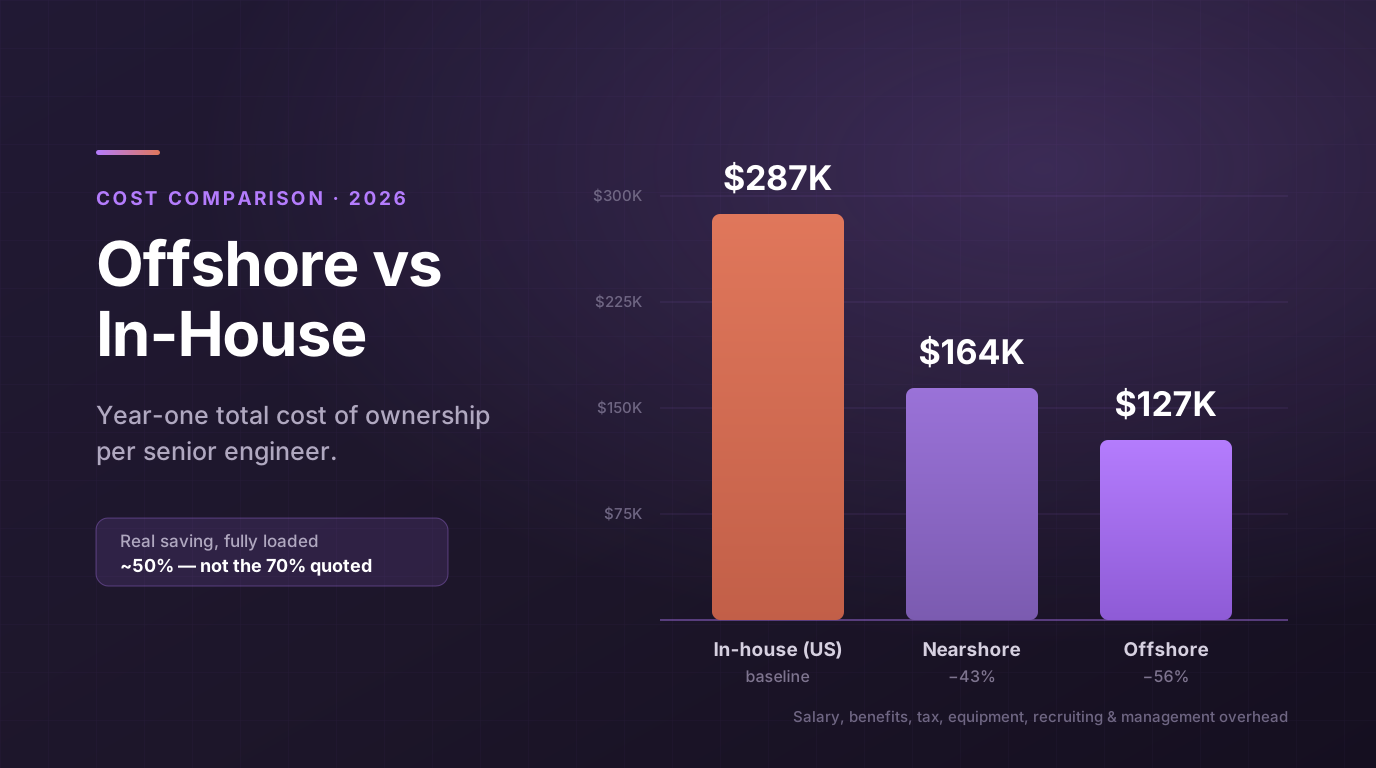
Table of Contents
Every founder eventually runs the same comparison: a US developer costs $180,000 a year, an offshore developer costs $55 an hour, so offshore must be roughly a third of the price. Then the project runs long, the rework lands, and the saving turns out to be smaller than the spreadsheet promised.
The rate comparison is not wrong. It is just incomplete. This guide puts the actual numbers on both sides, fully loaded employment costs, offshore rates by region, and the costs that appear on neither quote, so you can make the decision on real figures rather than a headline rate.
We build software offshore for US and European clients, so we have an obvious interest in the answer. We have tried to write the version we would want to read before signing something, including the parts that do not favour us.
What a US in-house developer actually costs
Salary is roughly two-thirds of what an employee costs. The rest is invisible until you run payroll.
For a senior software engineer in a major US metro in 2026, a realistic build-up looks like this:
| Line item | Annual |
|---|---|
| Base salary (senior, US metro) | $180,000 |
| Payroll taxes (FICA, FUTA, SUTA) | ~$14,000 |
| Health, dental, vision | ~$18,000 |
| 401(k) match, insurance, other benefits | ~$9,000 |
| Equipment, software licences, tooling | ~$6,000 |
| Recruiting (amortised agency fee) | ~$15,000 |
| Fully loaded | ~$242,000 |
That is a multiplier of roughly 1.35 on base salary, which matches the range most finance teams use. Divide by about 1,900 genuinely productive hours a year, the working year minus holiday, sick leave, training and the meetings that are not the work, and you land near $120-$127 per productive hour.
Two things are worth noting. Recruiting cost is real and recurring: median engineer tenure is under three years, so a 20% agency fee amortises to a meaningful annual number. And this build-up excludes management. Someone senior spends time hiring, onboarding, reviewing and retaining that person, and that time has a cost even though it never appears as a line item.
What offshore actually costs
Offshore rates cluster by region rather than by skill, which is the arbitrage. Indicative 2026 ranges for mid-to-senior engineers working through an agency:
| Region | Hourly rate | Typical overlap with US Eastern |
|---|---|---|
| United States (agency) | $150 - $350 | Full |
| Western Europe | $90 - $160 | 4-6 hours |
| Latin America (nearshore) | $50 - $85 | 6-8 hours |
| Eastern Europe | $45 - $75 | 2-4 hours |
| Southeast Asia | $30 - $60 | 1-3 hours |
| South Asia | $25 - $55 | 2-4 hours |
Rates below roughly $25 an hour deserve scrutiny. At that level the economics usually mean junior engineers, high turnover, or one person quietly working three contracts. That is not a bargain; it is a different product.
Engaged full-time, a mid-to-senior offshore developer generally runs $4,500-$11,000 per month against a fully loaded US equivalent of $14,000-$21,000.
The costs that appear on neither quote
This is where most comparisons go wrong, and it cuts both ways.
Costs that make offshore more expensive than the rate implies. Management overhead is the big one: a distant team needs clearer specifications, more written communication and more review than someone at the next desk. Budget 10-20% of the engagement in your own team's time, and more in the first two months. Timezone friction turns a question that would take two minutes into a next-day answer, which matters most when requirements are still moving. Rework from misunderstood requirements is real, and it is a function of specification quality rather than of the developers' ability. Onboarding takes three to six weeks before output is trustworthy, whoever you hire.
Costs that make in-house more expensive than the salary implies. Recruiting a senior engineer in the US takes two to four months, during which the work is not happening. That delay has a cost that never enters the comparison. Fixed capacity is the other: an employee is a year-long commitment regardless of whether you need five developers in Q1 and two in Q3. And a single in-house engineer carries genuine key-person risk, because when they leave they take the context with them.
The one people forget entirely. Management attention is a scarce resource in a small company. In-house teams consume it through hiring, performance and retention. Offshore teams consume it through specification and coordination. Neither is free, and if your senior people are already at capacity, the model that consumes less of their time may be worth more than the rate difference.
Total cost of ownership, side by side
For one senior engineer over twelve months, assuming a full-time equivalent in each case:
| In-house (US) | Offshore agency | Nearshore agency | |
|---|---|---|---|
| Direct cost | ~$242,000 | ~$105,000 | ~$145,000 |
| Management overhead | ~$20,000 | ~$18,000 | ~$14,000 |
| Recruiting / ramp delay | ~$25,000 | ~$4,000 | ~$5,000 |
| Year one total | ~$287,000 | ~$127,000 | ~$164,000 |
| Effective saving | — | ~56% | ~43% |
Treat these as a shape rather than a quote. The direction is reliable and the magnitude moves with your specifics, but note that the honest saving is closer to 50% than to the 70% a raw rate comparison suggests. Anyone quoting you 70% is comparing a US salary to an offshore rate and ignoring everything in between.
When in-house is the right answer
We say this to prospective clients often enough that it is worth putting in writing. Build in-house when:
- The software is your product and always will be. Compounding institutional knowledge is worth more than the rate saving over a five-year horizon.
- Requirements change weekly because you are still finding the product. Discovery work is the worst fit for a distant team. Offshore executes specifications well; it does not read minds.
- You need physical presence: hardware, lab access, on-site customer work, or a regulated environment requiring employees.
- You already have strong engineering management. Good managers make in-house teams significantly more productive, and that advantage disappears if nobody is doing the managing.
When offshore is the right answer
- The scope is definable. A rebuild, a well-understood product, an integration, a platform migration. Anything you can specify, you can delegate.
- You need capacity now. An agency can staff a team in one to two weeks against two to four months to recruit.
- The workload is uneven. Scaling a team up and down without layoffs is a genuine structural advantage, not just a cost one.
- You need a skill you cannot justify hiring full-time. A specialist for eight weeks is easy to buy and hard to employ. If you need Go developers for a services rewrite, or a data engineer for one pipeline, renting the skill beats recruiting for it. Our guide to what to test for when hiring Go developers covers how to judge one either way.
- Budget is the binding constraint on whether the thing gets built at all. A 50% saving is often the difference between shipping and not.
How to de-risk an offshore engagement
The failure modes are well known, and nearly all of them are avoidable.
Run a paid pilot on real work. Two to four weeks, a genuine piece of your backlog, priced fixed. You will learn more from one pilot than from ten sales calls, and any competent partner will agree to one.
Insist on direct developer access. If every question routes through an account manager, you are adding a day of latency to every decision and losing the detail in translation. We put clients in direct contact with the engineers doing the work, because the alternative produces exactly the misunderstandings offshore is blamed for.
Buy scope, not hours. A fixed price against a written scope aligns the incentive with delivery. An hourly contract rewards the clock. We quote fixed price for this reason, and publish indicative figures on our packages page rather than making you ask.
Own your infrastructure from day one. Your GitHub organisation, your AWS or GCP account, your domain, your credentials. A partner who wants to hold these is telling you something. You should be able to end the relationship on a Friday and keep working on Monday.
Agree overlap hours in writing. Four hours of genuine overlap is the difference between a team and a dropbox. Our engineers work US business hours for US clients. That is a scheduling decision, and any partner can make it if they choose to.
Define done before you start. Test coverage, documentation, code review standards, deployment process. Ambiguity here is where fixed-price projects turn adversarial.
What we do and what we charge
We are a Lahore-based engineering team building for clients in the US, the Gulf and Europe. We work US hours where the client needs them, quote fixed price against written scope, and put you in direct contact with the developers rather than an account layer.
Depending on how you want to engage, that looks like dedicated developers embedded in your team, a full offshore development team owning a workstream, or project-based custom software development against a defined scope. Where the decision itself is the problem, our software consulting engagements start with the architecture and the build-versus-buy question rather than with a team.
Indicative pricing is on our packages page, with a fuller breakdown in our AI app development cost guide. For US-specific engagement details, see our US development services page.
The honest summary
Offshore development in 2026 saves a well-run US company roughly 45-55% against in-house hiring, not the 70% the rate comparison implies. That is still a large number and for most companies it is the deciding one.
But the saving is contingent. It holds when the scope is definable, the overlap is real, the specification is written down and somebody on your side owns the relationship. It evaporates when you delegate a problem you have not defined to a team you cannot reach and measure by hours rather than outcomes.
The model matters less than the execution. Plenty of in-house teams burn more money than any offshore engagement, and plenty of offshore engagements deliver more than the internal team they replaced. Choose based on whether the work is definable and who has the management capacity to run it, then hold whichever you pick to the standards above.
If you want a fixed-price number against your actual scope rather than a rate card, start a conversation with our team. If you are earlier than that and still weighing the model, our piece on why fast-growing companies partner with agencies over in-house hiring covers the strategic side, and our guide to launching an MVP in under six weeks covers what a first engagement usually looks like.
Frequently Asked Questions
How much does it cost to hire an offshore development team in 2026?
Offshore development rates in 2026 vary sharply by region. Eastern Europe typically runs $45-$75 per hour, Latin America $50-$85, South Asia $25-$55, and Southeast Asia $30-$60. A dedicated mid-to-senior offshore developer engaged full-time generally costs $4,500-$11,000 per month depending on region and seniority, against a fully loaded US equivalent of $14,000-$21,000 per month. The gap is real, but comparing hourly rates alone overstates it. Management overhead, timezone friction and rework are genuine costs that belong in the comparison.
Is offshore development actually cheaper than hiring in-house?
Usually yes, but by less than the headline rate suggests. A US senior engineer at a $180,000 salary costs roughly $225,000-$250,000 fully loaded once payroll taxes, benefits, equipment, software and recruiting are included. About $110-$125 per hour of actual productive time. An offshore senior engineer at $55 per hour with 15% overhead for management and coordination lands near $63. That is still a substantial saving, but it is roughly 45-50% rather than the 70% implied by comparing rates directly.
What is the difference between offshore, nearshore and outsourcing?
Offshore means a team in a distant timezone, typically South Asia, Southeast Asia or Eastern Europe relative to the US. Nearshore means a team within a few hours of your timezone, usually Latin America for US companies or Eastern Europe for Western European ones. Outsourcing is the broader term for delegating work to an external party, which includes both. The practical difference is overlap hours: nearshore buys you most of a working day together at a 20-40% higher rate than offshore.
When does hiring in-house make more sense than going offshore?
In-house wins when the work is the core of your business and will keep evolving indefinitely, when institutional knowledge compounds and losing it would hurt, when you need someone physically present with customers or hardware, or when regulatory constraints require employees rather than contractors. It also wins when you genuinely cannot describe what you want built. Offshore teams execute specifications well and read minds poorly. If your requirements change weekly because you are still discovering the product, the coordination cost of a distant team can exceed the rate saving.
How do I reduce the risk of an offshore development engagement?
Start with a small paid pilot of two to four weeks on real work rather than a trial task, and judge the output rather than the sales call. Insist on direct access to the developers who will do the work, not an account manager relaying messages. Require a fixed price against a written scope so the incentive is delivery rather than hours. Own your repository, your cloud accounts and your credentials from day one. And agree the overlap hours in writing. Four hours of genuine overlap is the difference between a team and a dropbox.