Hiring & Teams
Nearshore vs Offshore: An Honest Comparison From a Company That Is One of Them
By Muhammad Usman • July 2026
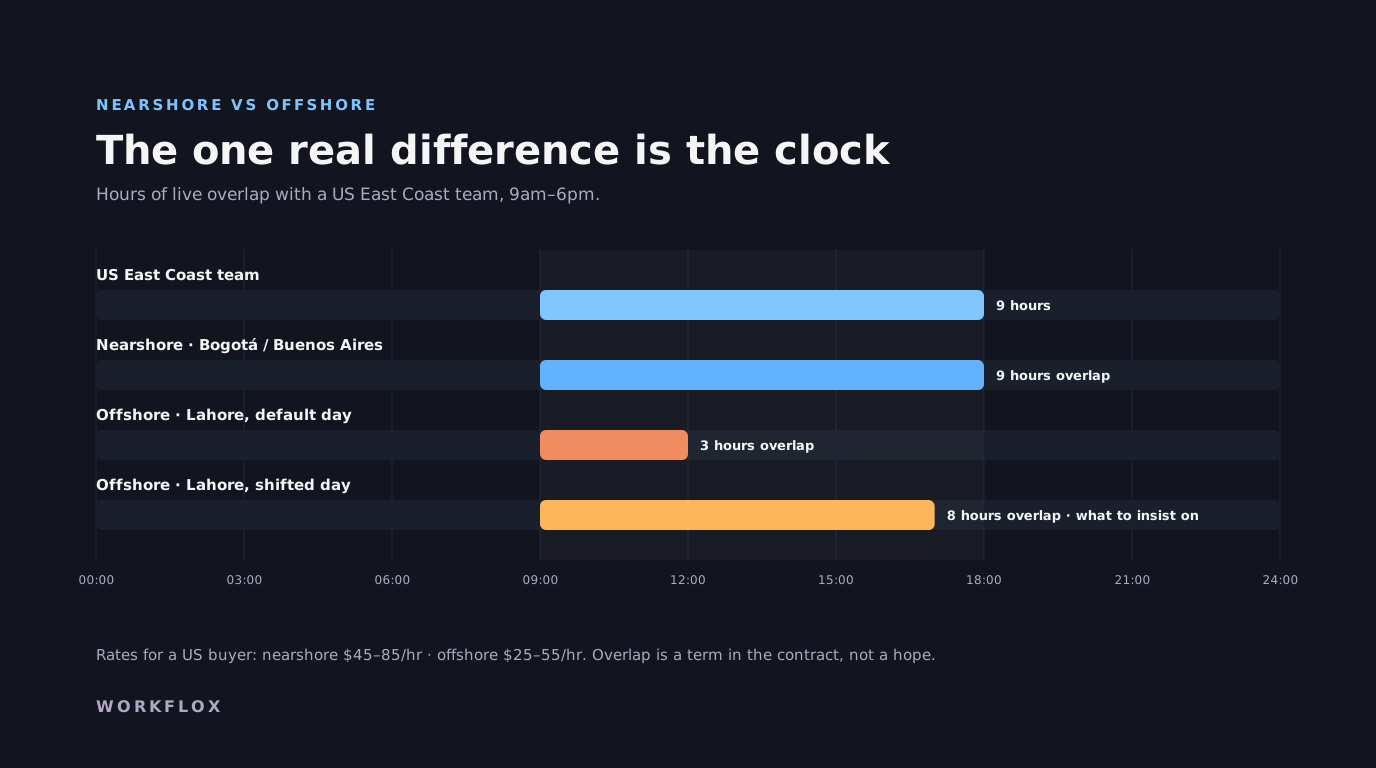
Table of Contents
- The one real difference
- Compared
- Nearshore software development: when it is the right answer
- When offshore is the right answer
- The honest arithmetic
- A tale of two engagements
- Hidden costs on both sides
- Questions that separate a good partner from a cheap one
- What we tell prospects who should go nearshore
- If you are still undecided
- What to insist on either way
We are an offshore company. That makes this an unusual comparison to write, because the honest version says nearshore is the better choice for some of the people reading it. Here it is anyway, because a comparison you cannot trust is not worth publishing.
The one real difference
Everything else follows from time zones. Nearshore is a partner a few hours from you. Latin America for a US company, Eastern Europe for a Western European one. Offshore is a distant zone, usually South or Southeast Asia. That difference sets the overlap window, and the overlap window sets how the engagement runs.
Compared
| Nearshore | Offshore | |
|---|---|---|
| Live overlap | Most of a working day | 2–4 hours by default; 4–8 if the partner shifts its day |
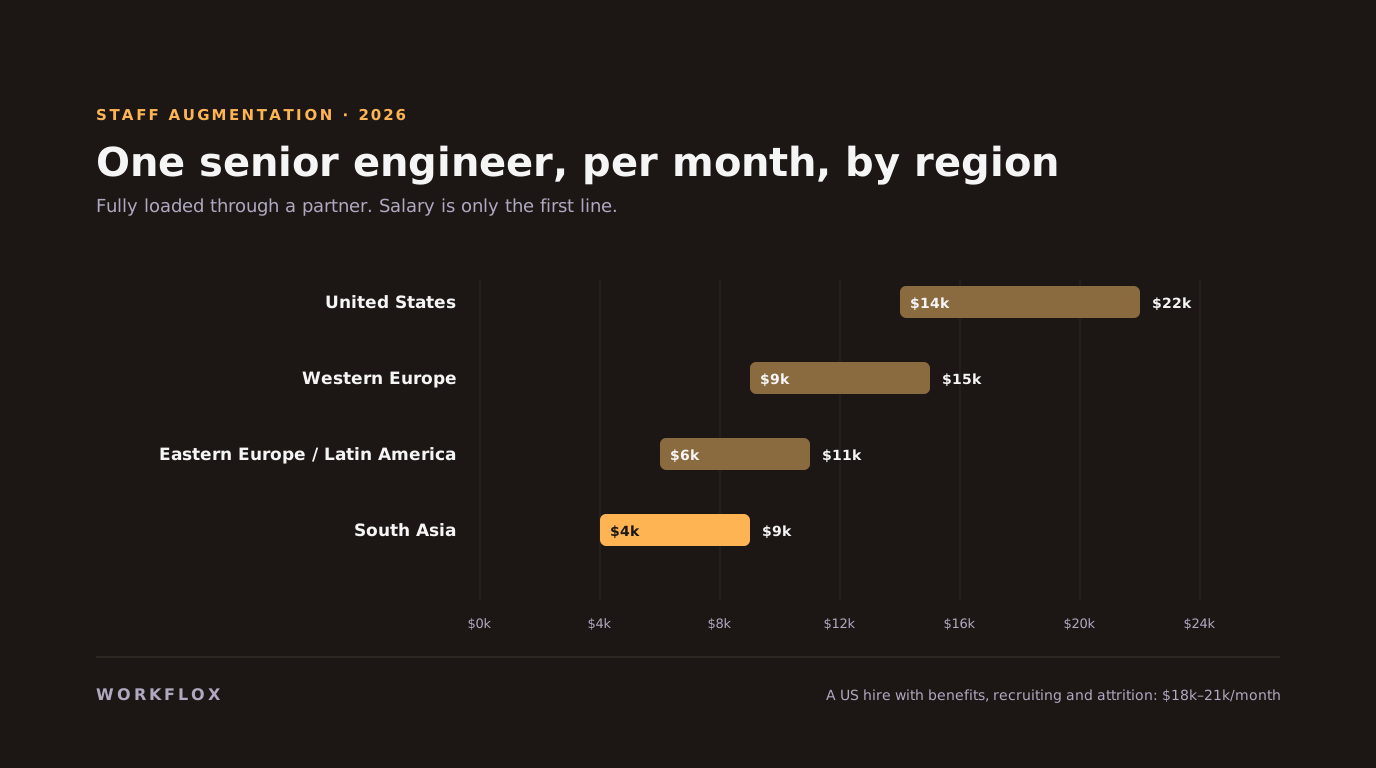
| Hourly rate (US buyer) | $50–85 Latin America; $45–75 Eastern Europe | $25–55 South Asia; $30–60 Southeast Asia |
| Talent depth | Strong, smaller pools; competitive for senior people | Very large pools; quality varies sharply by partner |
| Communication | Easier by default | Depends entirely on the partner's process and English standard |
| Cultural proximity | Higher for US–LatAm and EU–Eastern Europe | Lower; matters for consumer product, less for engineering |
| Best fit | Discovery-heavy, fast-changing work | Definable scope, written spec, committed overlap |
Nearshore software development: when it is the right answer
Your requirements change daily. If the product is still being discovered and decisions happen in conversation, a full day of shared hours is worth the premium. Offshore executes specifications well and reads minds poorly, and the asynchronous gap compounds when nothing is written down.
Your team cannot work asynchronously. Some teams simply operate in real time. That is a fact about your organisation, not a flaw, and nearshore fits it.
Cultural fit is part of the product. A consumer app for a Spanish-speaking market built by a team in Mexico or Colombia has an advantage no amount of process replaces.
Data residency favours the nearby jurisdiction. Some regulated workloads are simpler to place in a neighbouring country.
When offshore is the right answer
The scope is definable. A rebuild, a well-understood product, an integration, a platform migration. Anything you can specify, a good offshore partner can deliver. At a rate a third lower than nearshore.
The partner commits to overlap in writing. This is the whole question. An offshore team working its own hours is a ticket queue. One that shifts its day to give you four to eight hours of live overlap is a team. We work UK, Gulf and US hours from Lahore because it is a scheduling decision, and we put the hours in the contract.
You have someone who owns the relationship. A named person on your side who reviews, decides and unblocks. That is true of nearshore too, but the shorter overlap makes it non-negotiable offshore.
Budget decides whether the thing gets built. A third lower is frequently the difference between shipping and not.
The honest arithmetic
On rate, offshore wins clearly. On total cost, the gap narrows, management time, ramp, occasional rework, but does not close; our offshore vs in-house comparison puts numbers on it. For a definable project with a partner that commits to overlap, offshore is usually cheaper overall by a meaningful margin. For discovery-heavy work with a team that lives in real time, nearshore's premium buys something real.
A tale of two engagements
A San Francisco company hired a nearshore team in Colombia for a product with weekly changing requirements and daily design decisions. It went well, because the two teams were in the same room, virtually, for most of the day, and questions got answered in minutes. A New York logistics company hired us, offshore in Lahore, for a warehouse system with a written specification, a fixed integration list and a product owner who wrote clear tickets. That also went well, because the work suited asynchronous delivery and the overlap hours, committed in writing, covered the decisions that needed a conversation. Both companies made the right choice, and either would have struggled with the other's model. The mistake is not choosing nearshore or offshore. It is choosing without looking at how the work actually flows.
Hidden costs on both sides
Nearshore rates look reasonable until the invoice arrives with the management layer added. Many nearshore firms bill a project manager and a technical lead on top of the engineers, and the effective rate for the people writing code ends up higher than the headline. Offshore rates look low until you count the hours your own team spends writing the specifications and reviews that make asynchronous work possible, which is real time and should be in the model. The other hidden cost on the offshore side is a partner who says yes to everything and surfaces problems late, which is a communication culture problem rather than a geography problem and which the reference check should catch. Ask both kinds of vendor for a fully loaded monthly cost per productive engineer, and ask your own team how many hours a week they will spend on direction. Then compare.
Questions that separate a good partner from a cheap one
Whichever side of the clock you choose, six questions do most of the work. What overlap with our hours will you commit to in writing? Who exactly will work on this, and can we interview them? What happens when one of them leaves? How do you handle a specification that turns out to be wrong halfway through? Where does our code live and who holds the credentials? And can we phone a client whose engagement ended, not one that is still running. A nearshore firm that stumbles on these is not made better by its time zone, and an offshore firm that answers them cleanly is not made worse by its distance.
What we tell prospects who should go nearshore
Sometimes the honest answer on the first call is that we are not the right shape. If the product is being invented in daily conversations with the founder, if the requirements will change every week for the next six months, and if the team wants an engineer who can join a two o'clock meeting on Pacific time without planning, a nearshore team in Latin America is the better fit and we say so. We would rather lose that engagement than run it badly. The engagements we take are the ones with a definable scope, a product owner who writes things down, and a willingness to hold us to overlap hours in a contract. Those we deliver at a fraction of nearshore cost, with the same seniority, and the references are happy to say so.
If you are still undecided
Run a two-week paid pilot with one vendor from each model on the same small piece of work. Same specification, same access, same review process. At the end you will know how each communicates, how each handles an ambiguity in the spec, how much of your own time each required, and what the code looks like. The cost of the pilot is a rounding error against a year of the wrong engagement.
What to insist on either way
A paid pilot on real work before a long contract. Direct access to the engineers, not an account layer. Fixed price against a written scope, or a dedicated team you direct, not open hours. Your repository, cloud and credentials in your name. And overlap hours in writing. Our note on staff augmentation covers the engagement model in more depth, and our offshore development team page sets out how we run one.
Frequently Asked Questions
What is the difference between nearshore and offshore?
Distance in time zones. Nearshore means a partner within a few hours of yours. Latin America for US companies, Eastern Europe for Western Europe. Offshore means a distant time zone, typically South or Southeast Asia. Nearshore buys most of a working day of live overlap at a twenty to forty percent higher rate; offshore buys a lower rate and a shorter overlap window, which a good partner extends by shifting its working day.
Is nearshore or offshore cheaper?
Offshore, on rate: South Asia runs $25 to $55 per hour against $50 to $85 for Latin America and $45 to $75 for Eastern Europe. On total cost the gap narrows once management time and overlap are counted, but it does not close. For a well-specified project with a partner that shifts its hours, offshore is usually cheaper overall; for discovery-heavy work needing constant conversation, nearshore's overlap can be worth the premium.
When should I choose nearshore over offshore?
When the work is undefined and changing daily, when your team cannot operate asynchronously, when cultural or language proximity matters for the product, or when data-residency rules favour a nearby jurisdiction. When the scope is definable and the partner commits to overlap hours in writing, offshore delivers the same outcome at a lower cost.
Can an offshore team really work my hours?
Yes, if the partner chooses to. Our engineers in Lahore work shifted days that give full overlap with UK and Gulf hours and four to six hours of live overlap with US Eastern and Central time. It is a scheduling decision, not a geographic constraint, and it should be a written commitment rather than a best-effort promise.
Related services
Related Articles