Product Engineering
Why Fast-Growing Tech Companies are Partnering with Development Agencies over In-House Hiring
By Muhammad Usman • January 2026

Table of Contents
- The Hidden Costs of Recruiting and Retaining Senior Developers in Lahore
- The "Co-Founder Level Agility" Model: What Modern Agencies Offer
- Scaling React and Node.js Teams on Demand
- Code Ownership
- The arithmetic, with real numbers
- What a fast-growing company actually outsources
- How to run an agency team so it feels in-house
- The contract clauses that protect you
- When to stop outsourcing
- Two weeks from first call to first commit
- A pattern we see in Lahore and Dubai startups
Hiring a senior engineer in Lahore, Dubai or Austin now takes three to five months and a salary that keeps rising, and by the time the hire starts, the roadmap has moved. Fast-growing companies have noticed, and many are choosing a different model: an agency team that starts in two weeks and scales with the work. This article looks at why, what it costs compared to hiring, and how to keep ownership when someone else builds your product.
The Hidden Costs of Recruiting and Retaining Senior Developers in Lahore
Building an in-house engineering team is slow. Between vetting candidates, negotiating salaries, and managing churn, founders lose months of runway. The hidden cost of software development isn't the salary, it's the opportunity cost of moving slowly.
The "Co-Founder Level Agility" Model: What Modern Agencies Offer
The old outsourcing model, a specification thrown over a wall and a product thrown back, deserved its reputation. The agencies worth hiring now work inside your team. They bring established CI/CD pipelines, proven design systems, and senior architectural oversight on day one.
Scaling React and Node.js Teams on Demand
When you hit product-market fit, you need to scale instantly. An agency lets you add or reduce React and Node engineers month to month, without the notice periods and severance that make permanent hiring hard to reverse.
Code Ownership
Your IP is everything. Senior agencies build in your repositories, deploying directly to your Vercel and AWS accounts. You maintain absolute ownership of the source code. Skip the 3-month hiring process. Integrate an agile web and mobile development team in Pakistan directly into your product roadmap today.
The arithmetic, with real numbers
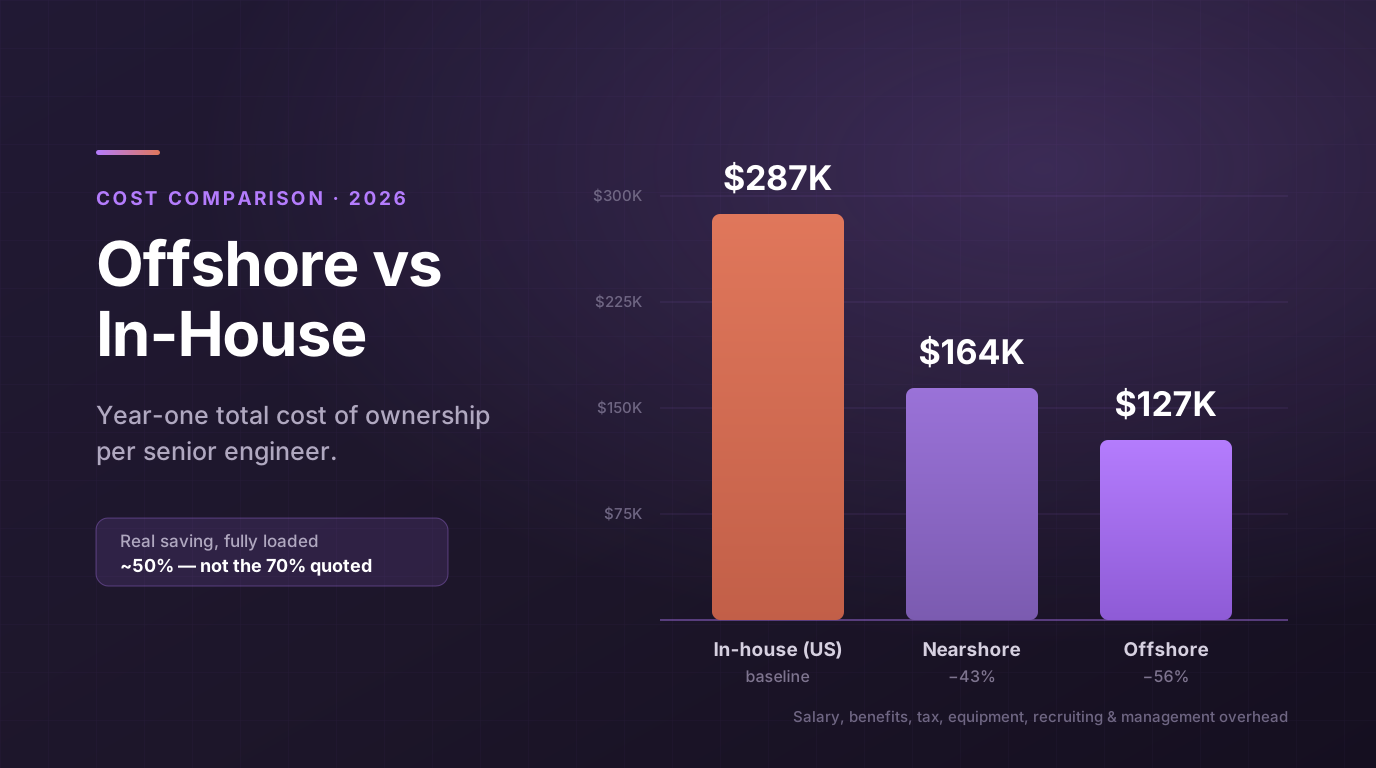
A senior engineer hired in the United States costs $18,000 to $22,000 a month once salary, benefits, recruiting fees, equipment and the cost of the occasional wrong hire are counted, and the search takes three to five months. A dedicated senior engineer through an agency such as ours runs $2,000 to $4,000 a month, starts in about two weeks, and comes with design, QA and project management on the same team when needed. The gap is large, and it is also not the whole story. Add the hours your team spends directing the work, which should be around ten percent. Add the value of being able to reduce the team when a project ends. And subtract the equity and the long horizon an employee brings, which matter for the core product and less for everything else.
What a fast-growing company actually outsources
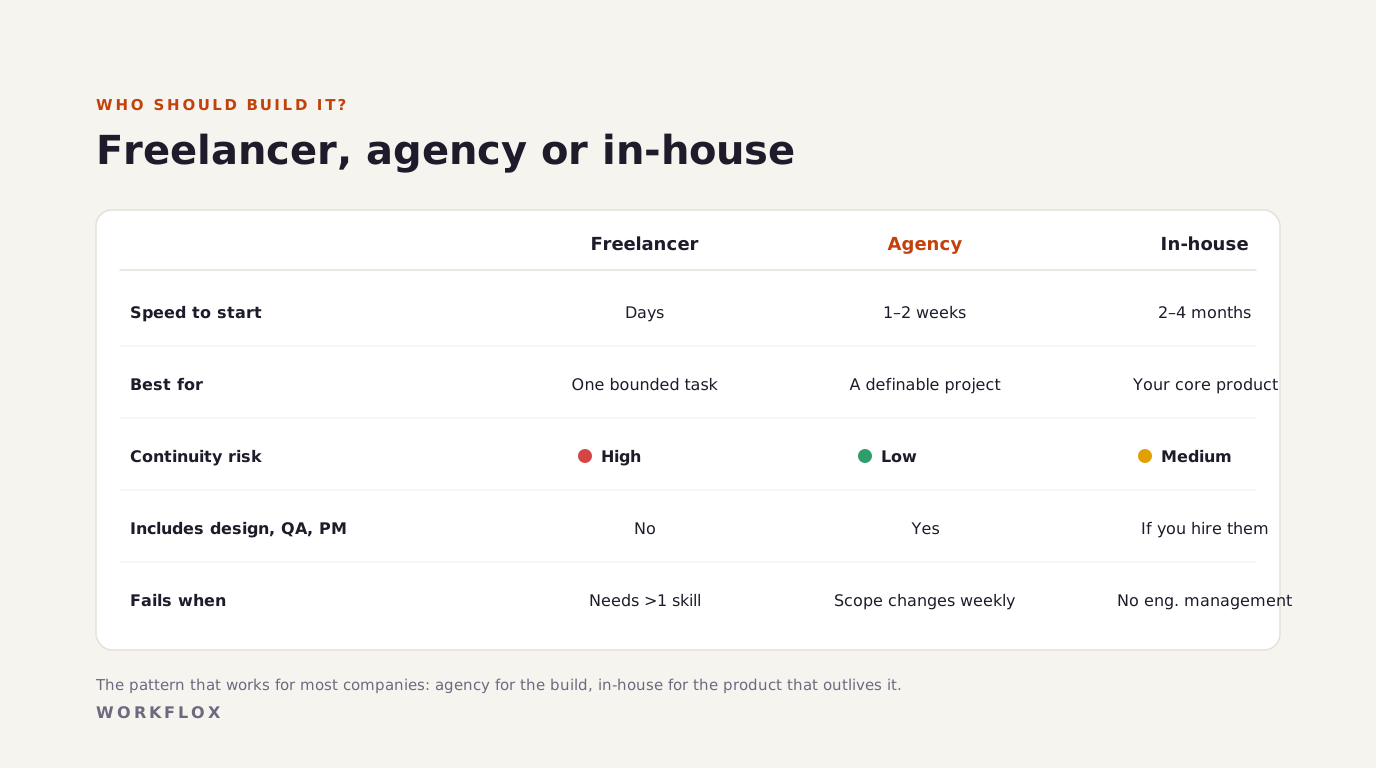
The pattern that works is not all or nothing. The company hires two or three engineers who own the architecture and the product's core, and brings in an agency for the work that is bounded, specialised or bursty: the mobile app, the data pipeline, the integrations, the redesign, the feature that needs a skill nobody in-house has. The in-house team reviews everything and owns the repository. The agency team works inside the company's standup, tracker and review process. When the bounded work ends, the agency team shrinks, and the company is left with a product its own engineers understand.
How to run an agency team so it feels in-house
Give the agency engineers the same access, rituals and expectations as employees: the standup, the sprint board, the code review, the chat channels. Insist on named engineers you have interviewed, and a written commitment to working-hours overlap. Write tickets with acceptance criteria, because an engineer six time zones away cannot lean over and ask. Hold a short weekly check-in about the relationship rather than the work. And review a running system every fortnight, not a status deck. Companies that do these five things stop noticing where the engineers sit within a month. Companies that treat the agency as a vendor to be managed through an account manager get vendor results.
The contract clauses that protect you
Intellectual property assigned to your company on payment, with no licence back. Repository, cloud accounts, app store accounts and domains created in your name, never the agency's. A defined notice period to scale down, and no minimum term longer than a quarter. Named engineers, with a replacement process if one leaves. Documentation as part of the definition of done. And a handover period at the end, priced in. An agency that resists any of these has told you how it plans to keep you. We put all of them in our standard agreement because the alternative is the story every founder has heard about the codebase nobody could take back.
When to stop outsourcing
Every engagement should end, and the good ones end on purpose. When the product has paying customers who depend on it daily, when the roadmap is set by what those customers ask for, and when engineering decisions have become the company's competitive position, the people making those decisions should be employees with equity. That is the moment to hire the core and to move the agency to the edges or out entirely. We build to be replaced by the client's own team, and we say so in the first conversation. The agencies that make leaving hard were never worth hiring.
Two weeks from first call to first commit
The timeline that surprises companies used to hiring is the start. A scoping call this week. Named engineers proposed and interviewed the next. Access to the repository, tracker and staging environment on day one. A small real ticket shipped to production by the end of the first week, so the whole path from ticket to deploy has been exercised. Full velocity by the end of the second. Compare that with a job posting that has been open for four months, and the case for at least starting with an agency team makes itself.
A pattern we see in Lahore and Dubai startups
The company raises a round, posts three engineering roles, and four months later has hired one. Meanwhile the roadmap that justified the round is untouched. The companies that avoid this start an agency team the week the round closes, ship the roadmap, and hire in parallel without the pressure. When the hires arrive, they inherit a documented codebase and a working delivery process rather than a blank repository and a list of promises. The agency team shrinks as the in-house team grows. That overlap is the point.
If your roadmap is waiting on a hire that is months away, a dedicated team can start in two weeks with the repository, accounts and documentation in your name from the first commit. Ask us for a fixed monthly quote for the roles you need.
Frequently Asked Questions
When does an agency beat hiring in-house?
When you need a definable product built quickly with several skills at once, when recruiting senior engineers would take months, or when the workload is not permanent. In-house wins for the core product that will evolve for years once there is engineering management to run it.
What does a development agency cost compared to a senior hire?
A senior engineer in the United States costs $18,000 to $22,000 a month once benefits, recruiting and attrition are counted. A dedicated senior engineer through an agency such as WORKFLOX runs $2,000 to $4,000 a month, with design, QA and project management available on the same team.
How do we keep ownership when an agency builds the product?
The repository, cloud accounts, credentials and documentation belong to you from day one, and the contract says so. A good agency also hands over runbooks and works alongside your first in-house engineers rather than guarding the codebase.
Related services
Related Articles