AI Technology
Custom Chatbot Development Services: What “Custom” Should Actually Mean
By Rana Sami Ullah • June 2026
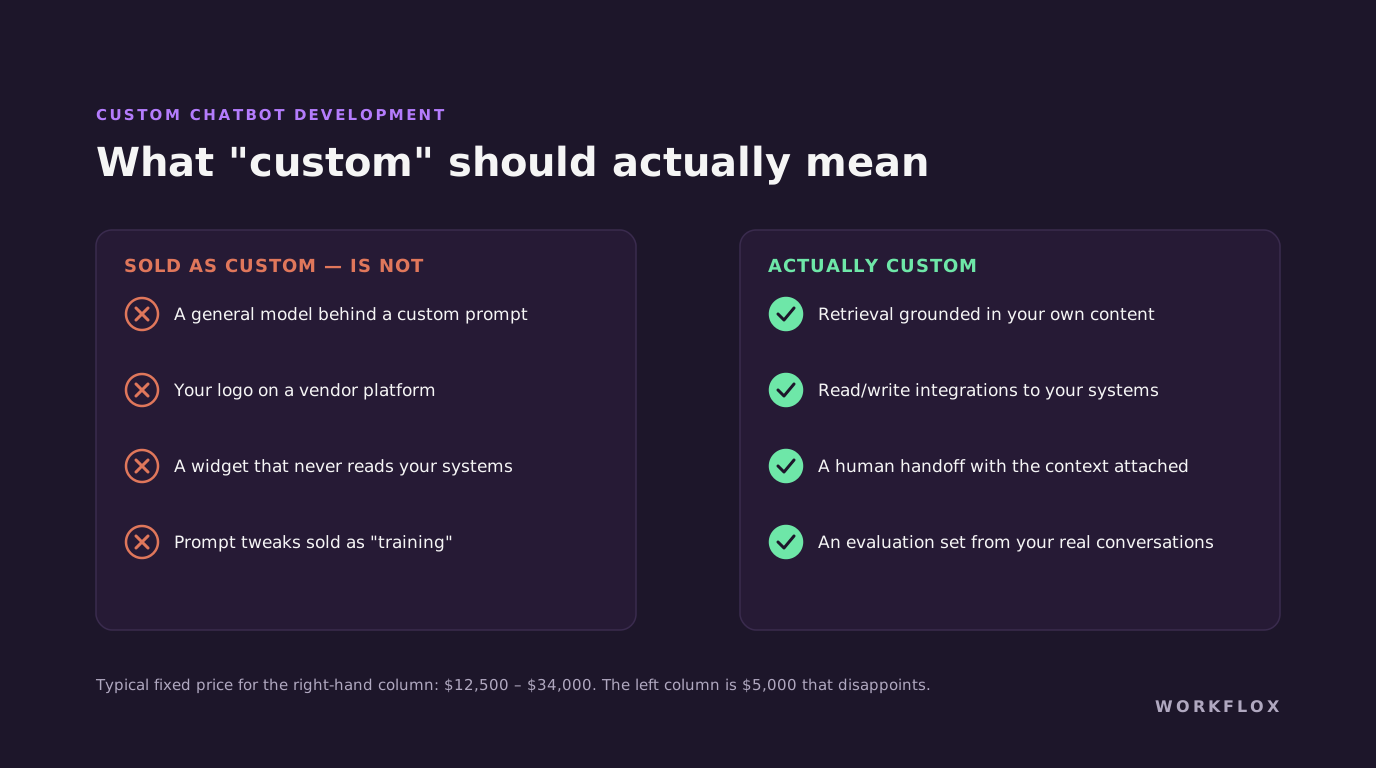
Table of Contents
- Four things vendors call custom that are not
- What custom actually requires
- How to tell which one you are being sold
- A conversation with a vendor, annotated
- What the build actually involves
- Questions that expose the difference
- When the configured product is the right choice
- What we charge, and for what
- What it costs, honestly
Every vendor sells custom chatbot development services. Almost none of them mean the same thing by it, and the gap between the meanings is the gap between a bot that deflects half your tickets and one that gets switched off in month three.
This is what custom should mean, what it usually means instead, and how to tell the difference before you sign.
Four things vendors call custom that are not
A custom look. Your logo, your colours, a greeting in your brand voice. Cosmetic, and available from every template platform for a few dollars a month.
Custom intents. A list of questions the bot recognises and canned answers for each. This was chatbot development in 2019. It cannot handle a question phrased differently from the training list, and it knows nothing you did not type into it.
A custom prompt. A system prompt telling a general model to act as your company's assistant. Cheap to build and dangerous to run, because the model will answer questions about your refund policy from its training data, confidently and wrongly.
A custom widget. A chat box on your site connected to a generic model. Same problem as the prompt, with a nicer interface.
None of these are worthless. None of them are what a business paying for custom chatbot development should receive.
What custom actually requires
Grounding in your own data. The bot answers from your help centre, product documentation, policies and resolved tickets, not from a model's general knowledge. That needs a retrieval layer: ingestion, chunking, embeddings, re-ranking, and a sync process so the bot does not drift as your content changes. It also needs the bot to say it does not know when a question falls outside what it has been given, rather than guessing. Our LLM integration work is mostly this layer.
Integration with the systems you run. A bot that can read an order status from your platform, check availability in your booking system, or open a ticket in your helpdesk is doing something a template cannot. Each integration is a discrete piece of work, authentication, permissions, error handling, tests, and it is the part most templated offerings skip entirely.
A defined human handoff. The bot needs an explicit confidence boundary below which it hands the conversation to a person, with the transcript and context attached. Where that boundary sits, what travels with it, and who owns the queue are design decisions, not defaults.
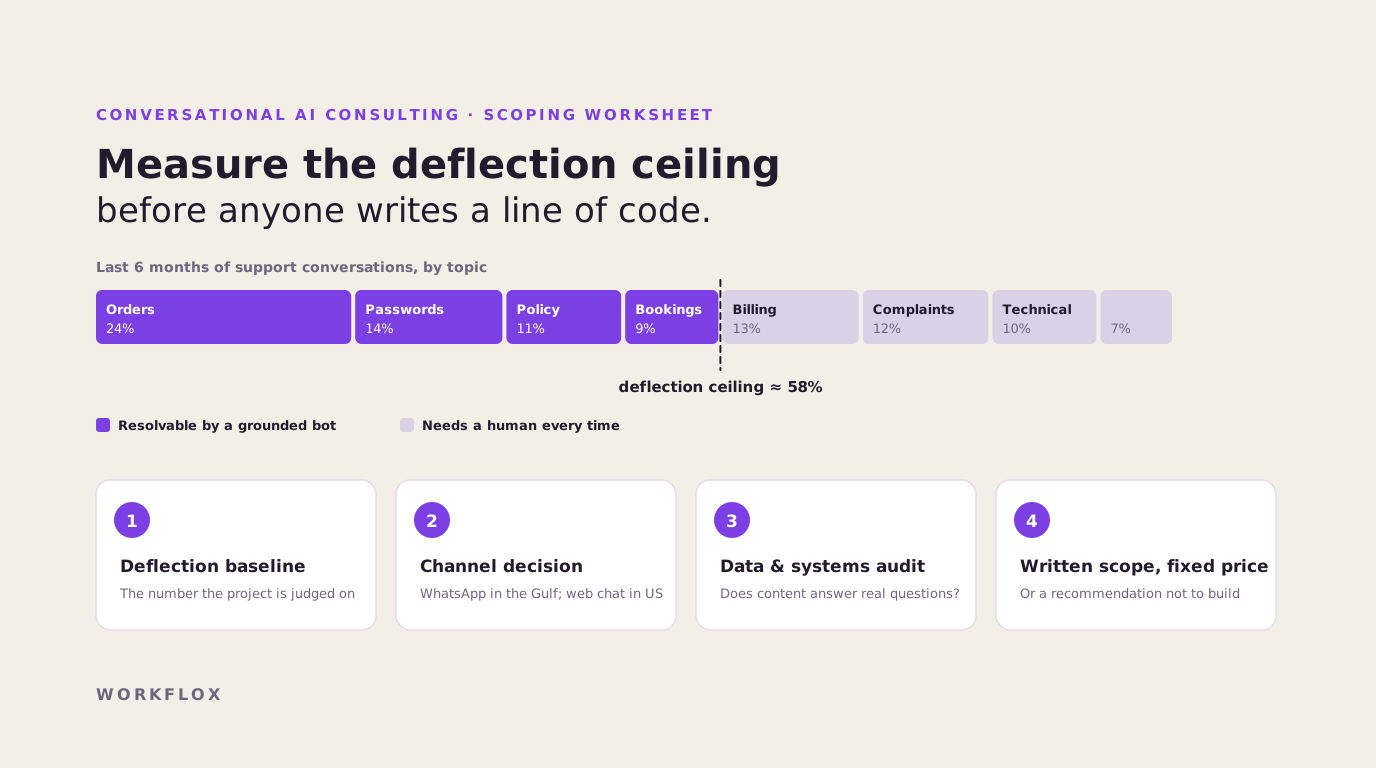
Evaluation before launch. A set of real conversations from your history, scored before the bot goes live, so there is an objective number to improve. Retrieval quality and answer quality measured separately, because they fail differently.
Channel fit. A web widget, WhatsApp, in-app chat and Slack have different length limits, formatting rules and latency expectations. The same knowledge layer should serve all of them, tuned per channel rather than pasted identically. Our guide to chatbots on the WhatsApp Business API covers the channel that matters most across the Gulf.
How to tell which one you are being sold
Ask three questions in the first call.
Where does the bot's knowledge come from, and what happens when my content changes? If the answer involves you maintaining a list of questions and answers, it is a template.
What can the bot do, as opposed to say? If it cannot read from or write to any system you run, it is a widget.
Show me the evaluation set. If there is no plan to measure the bot against your real conversations before launch, there is no plan to know whether it works.
A conversation with a vendor, annotated
Here is a pitch we were asked to review for a client, with the translation. "Our custom AI chatbot is trained on your business." It reads a PDF you upload; nothing is trained. "It integrates with all your systems." It has a Zapier connector, and the integrations you actually need are not on the list. "Fully branded and customised to your needs." The colours and the welcome message are editable. "Learns and improves over time." It stores conversations; nobody reviews them and nothing changes. "Enterprise-grade security." The data goes to a shared multi-tenant service in a region the salesperson could not name. None of this is dishonest exactly. It is the word custom doing more work than it can bear. The client's actual requirement, a bot that could look up an order by number and issue a return, was not something the product could do at any price.
What the build actually involves
When custom means what it should, the work looks like this. A week of discovery to write down the twenty or so things the bot must do and the systems it must touch. A retrieval layer over the client's own documents, with chunking and ranking tested against a set of real questions. Tool connections to the order system, the CRM and the ticketing platform, each with a narrow credential and a test suite. A conversation design that handles the top intents, knows when to ask a clarifying question, and hands off to a person with the transcript attached. An evaluation set of real customer questions with expected outcomes, run before launch and after every change. And a review queue where someone reads a sample of conversations weekly. That is what the price buys, and it is why the price is not $99 a month.
Questions that expose the difference
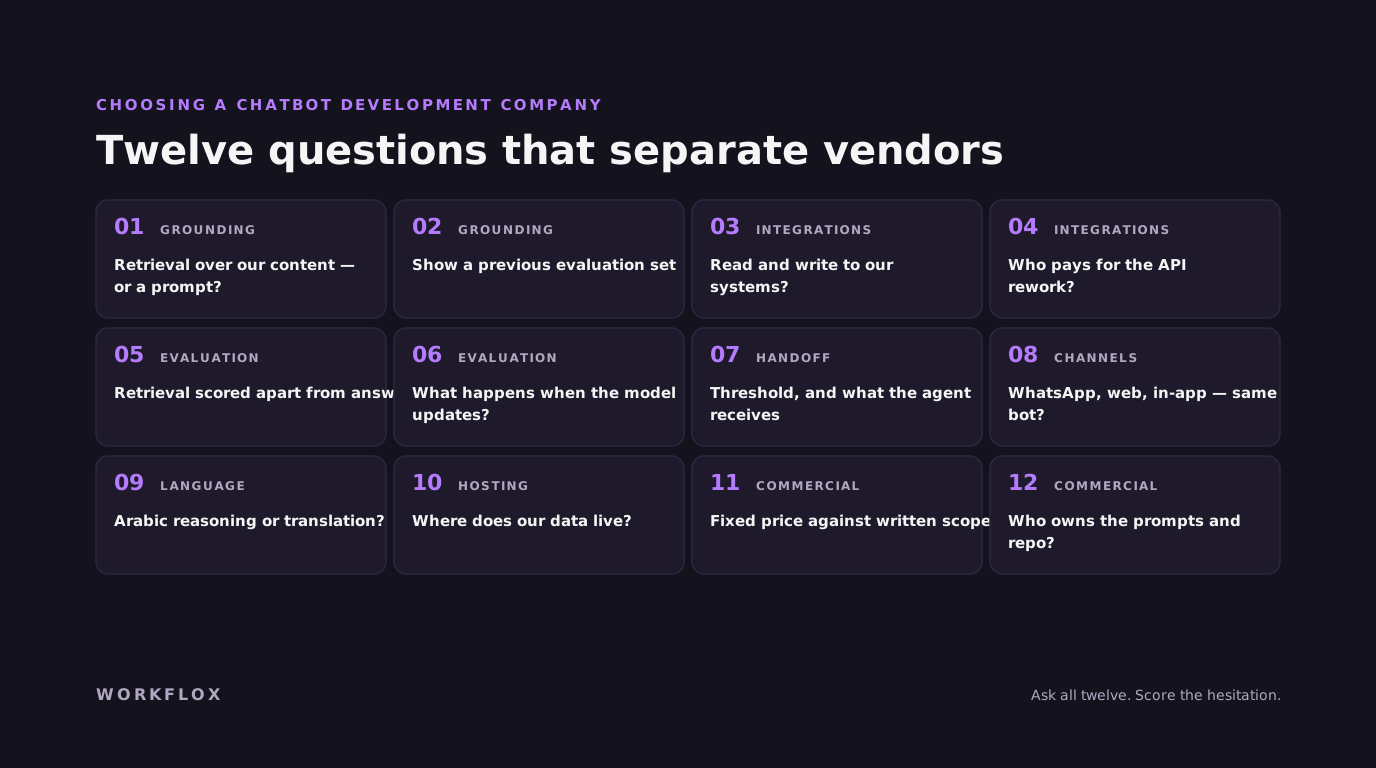
Ask any vendor these, and listen for specifics. Which of our systems will the bot read from, and which will it write to? Show me a bot you built that takes an action, not just answers a question. What happens when the bot is not confident? How will we know if it is getting worse? Where does our data go, and can we have it back? Who owns the prompts, the retrieval index and the conversation logs? A vendor selling a configured product will answer in generalities, and that is fine if a configured product is what you need. A vendor who builds will answer with the names of systems and the shape of the evaluation.
When the configured product is the right choice
Custom is not always better. If your questions are mostly answered by your existing help centre, if you do not need the bot to take actions, if your volume is a few hundred conversations a month, and if you are not in a regulated industry, a good configured product on top of your documentation is cheaper and faster and will do the job. We tell prospects this on the first call when it is true. The point of this article is not that everyone needs a custom build. It is that the word custom on a pricing page tells you nothing, and the questions above tell you everything.
What we charge, and for what
A retrieval-grounded bot over your own content, with a human handoff and an evaluation set, runs $4,000 to $10,000 with us. Add tool connections that let it look things up and take actions in your systems, and the range is $10,000 to $25,000 depending on how many systems and how well documented their APIs are. Multilingual support, Arabic and English for Gulf clients in particular, adds a modest amount and a larger evaluation set. Ongoing: a monthly retainer for reviewing conversations, updating the knowledge base and re-running the evaluation, because a bot that is not maintained degrades quietly. Every figure comes with a written scope, and the code, prompts and index are yours.
What it costs, honestly
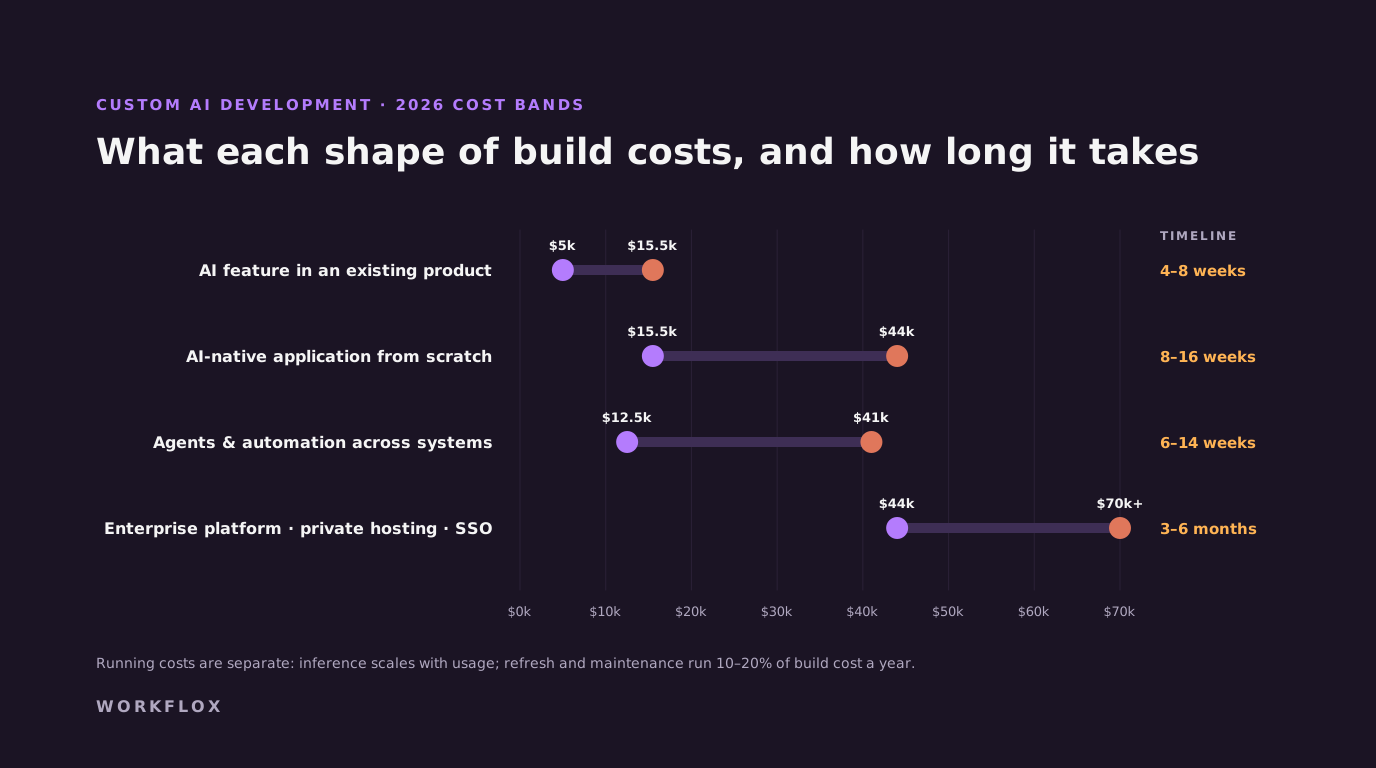
A grounded, single-channel chatbot with read-only access to your content typically lands between $4,000 and $10,000 and ships in four to six weeks. A bot with several integrations, multiple channels and an admin interface generally runs $10,000 to $25,000 over eight to twelve weeks. Enterprise deployments with SSO, audit logging and private hosting scale above that. Running costs, model inference and retrieval refresh, are separate and we model them against your expected volume before you commit, because a bot that costs more to run than the tickets it deflects is not a saving.
We build custom AI chatbots on exactly this definition, at a fixed price against a written scope. If your questions are really about actions rather than answers, our AI agent vs chatbot comparison will tell you which you need, and our chatbot development case study shows the deflection numbers from a live deployment.
Frequently Asked Questions
What are custom chatbot development services?
Custom chatbot development services build a bot around your own data, systems and workflows rather than configuring a template. In practice that means a retrieval layer over your documents, integrations that let the bot act in your CRM or ticketing system, a defined handoff to a human, and evaluation against your real conversations before launch. A bot that only has a custom logo and a custom greeting is not custom in any sense that affects results.
How long does a custom chatbot take to build?
A grounded question-answering chatbot with one channel and read-only access to your content typically ships in four to six weeks. A bot that takes actions in your systems, checking an order, booking a slot, updating a record, usually runs eight to twelve weeks because each integration carries its own permissions, error handling and testing.
How much do custom chatbot development services cost?
A grounded single-channel bot typically costs $4,000 to $10,000. A bot with several integrations, multiple channels and an admin interface generally runs $10,000 to $25,000. Enterprise deployments with SSO, audit logging and private hosting scale above that. We quote fixed price against a written scope and model the monthly inference cost before you commit.
Can a custom chatbot use our existing knowledge base?
Yes, and it should. We ingest help centre articles, product documentation, policies and past tickets into a retrieval layer that stays in sync as your content changes, so the bot answers from your material rather than a model's general training. Retrieval quality is evaluated separately from answer quality, because a strong model over weak retrieval produces confident wrong answers.
What is the difference between a custom chatbot and an AI agent?
A chatbot answers questions; an agent takes actions. A grounded chatbot can ship in weeks with read-only access. An agent that changes state in your systems needs permissions design, approval gates and a rollback story. Many teams ask for an agent when a well-built chatbot resolves most of their volume, and our comparison page sets out where the line falls.
Related services
Related Articles