AI Technology
Custom AI Development: What It Includes, What It Costs, and When Off-the-Shelf Is Better
By Rana Sami Ullah • September 2026
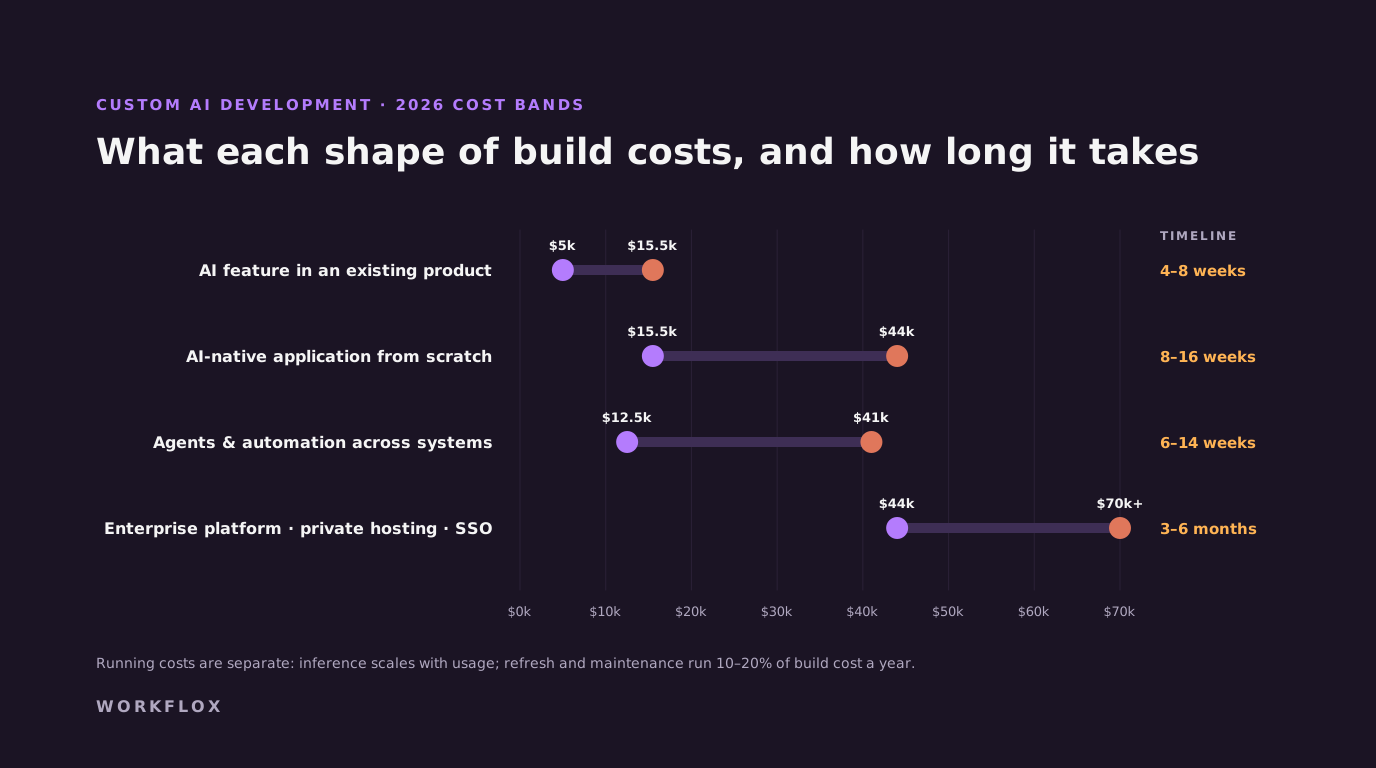
Table of Contents
Custom AI development is sold as one thing and is actually six, and the price difference between vendors usually comes down to how many of the six they include. Here is what a custom build contains, roughly what each part costs, and, because we build them for a living and still say this, when you should buy a product instead.
The six parts
Data and retrieval. The layer that grounds the system in your own documents, records and policies: ingestion, chunking, embeddings, re-ranking, sync. Without it the system answers from a model's general training, confidently and wrongly. This is usually a third of the effort and the part most quotes skip.
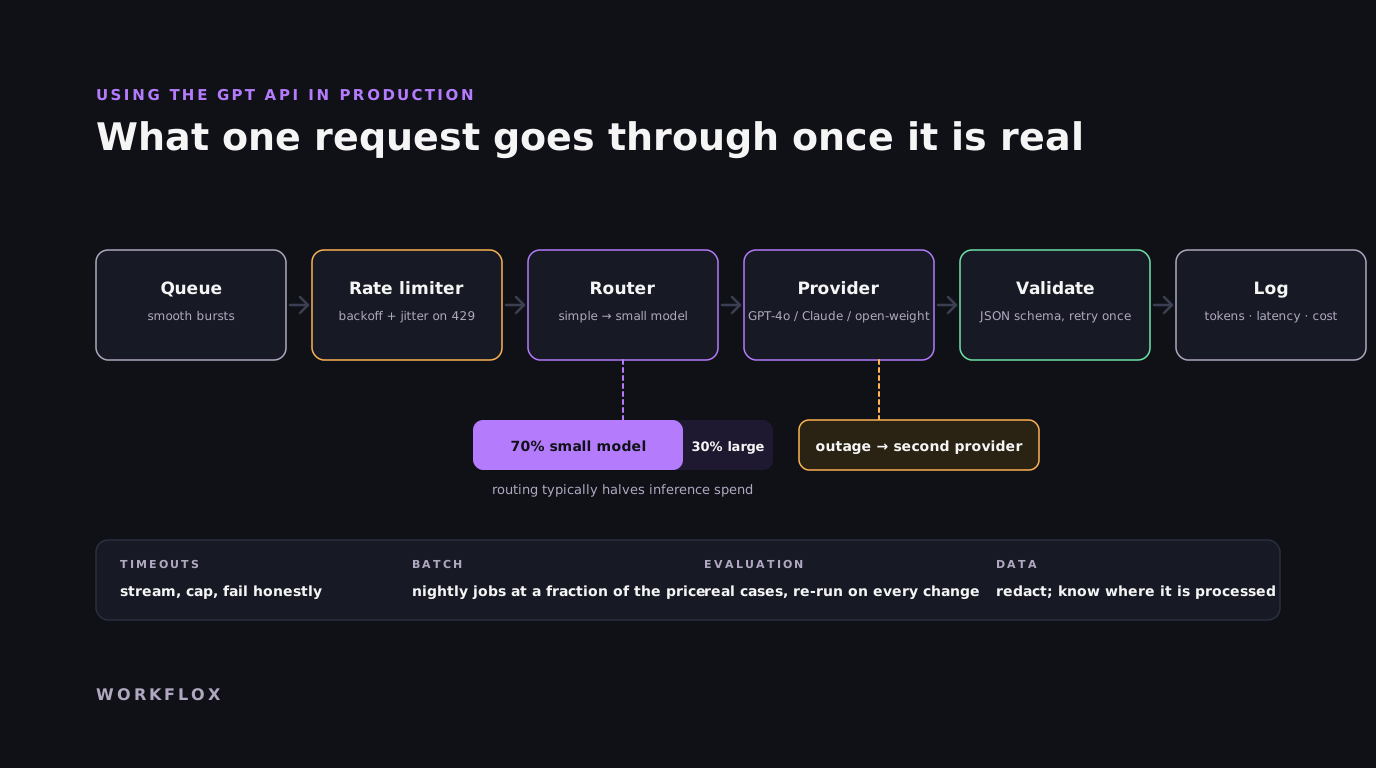
Model selection and routing. Choosing between frontier and open-weight models on evidence from your cases, and routing simple steps to cheaper models, which typically halves inference cost with no measurable quality loss. Our OpenAI vs Claude comparison covers the leading options.
Integration. The system reads from and acts in your CRM, ERP, ticketing or core platform. Each integration carries authentication, permissions, error handling and testing, and is a discrete piece of work.
Evaluation. A set of real cases scored before launch, retrieval and generation measured separately, and re-run whenever a model version changes. No evaluation set means no way to know whether it works.
Hosting and data handling. Where the data lives and which rules apply: GDPR, HIPAA, PDPL, SOC 2. Settled before the data model, not during legal review.
Interface and admin. The screens users touch and the tools your team uses to operate the system without an engineer. The admin side is the one most builds forget.
What each part costs
Indicatively, for 2026:
| Shape | Typical range | Timeline |
|---|---|---|
| AI feature added to an existing product | $5,000 – $15,500 | 4 – 8 weeks |
| AI-native application from scratch | $15,500 – $44,000 | 8 – 16 weeks |
| Custom agents and automation across systems | $13,500 – $41,000 | 6 – 14 weeks |
| Enterprise platform, private hosting, SSO, compliance | $44,000+ | 3 – 6 months |
Running costs are separate: model inference scales with usage, retrieval refresh and maintenance run 10 to 20 percent of build cost annually. A vendor who cannot estimate your monthly inference cost before you commit has not run a system long enough to know. Our AI app development cost guide sets the bands out in full.
When to buy instead
If your requirement is genuinely common, meeting transcription, standard summarisation, generic support chat, a mature vendor product is cheaper, faster and better maintained than anything built for you alone. Custom AI development earns its cost when the workflow is specific to how you operate, when the data cannot leave your control, when integration with your own systems is the hard part, when the capability is a competitive differentiator, or when vendor pricing scales against your growth. Our custom AI vs SaaS comparison is the framework we use, and we run it honestly. Several times a year the answer is buy.
Where quotes go wrong
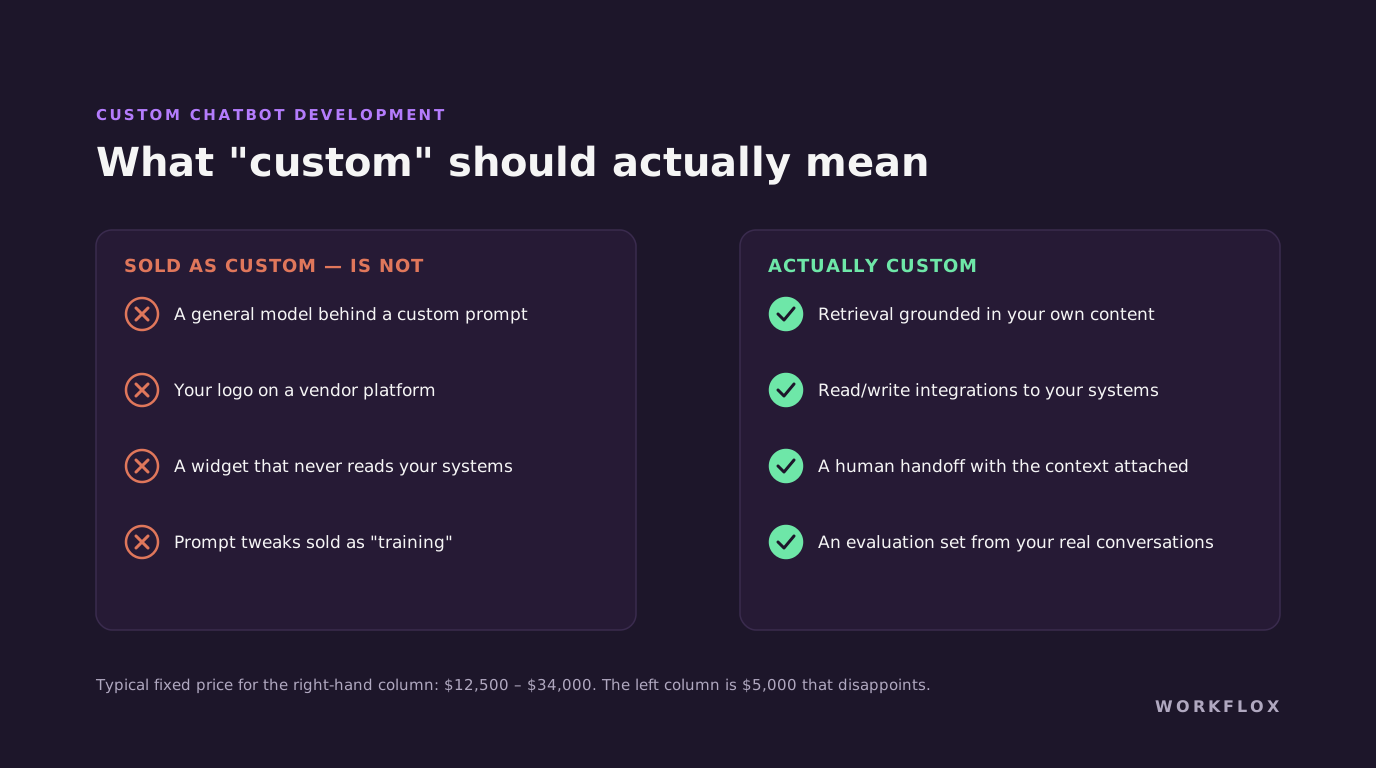
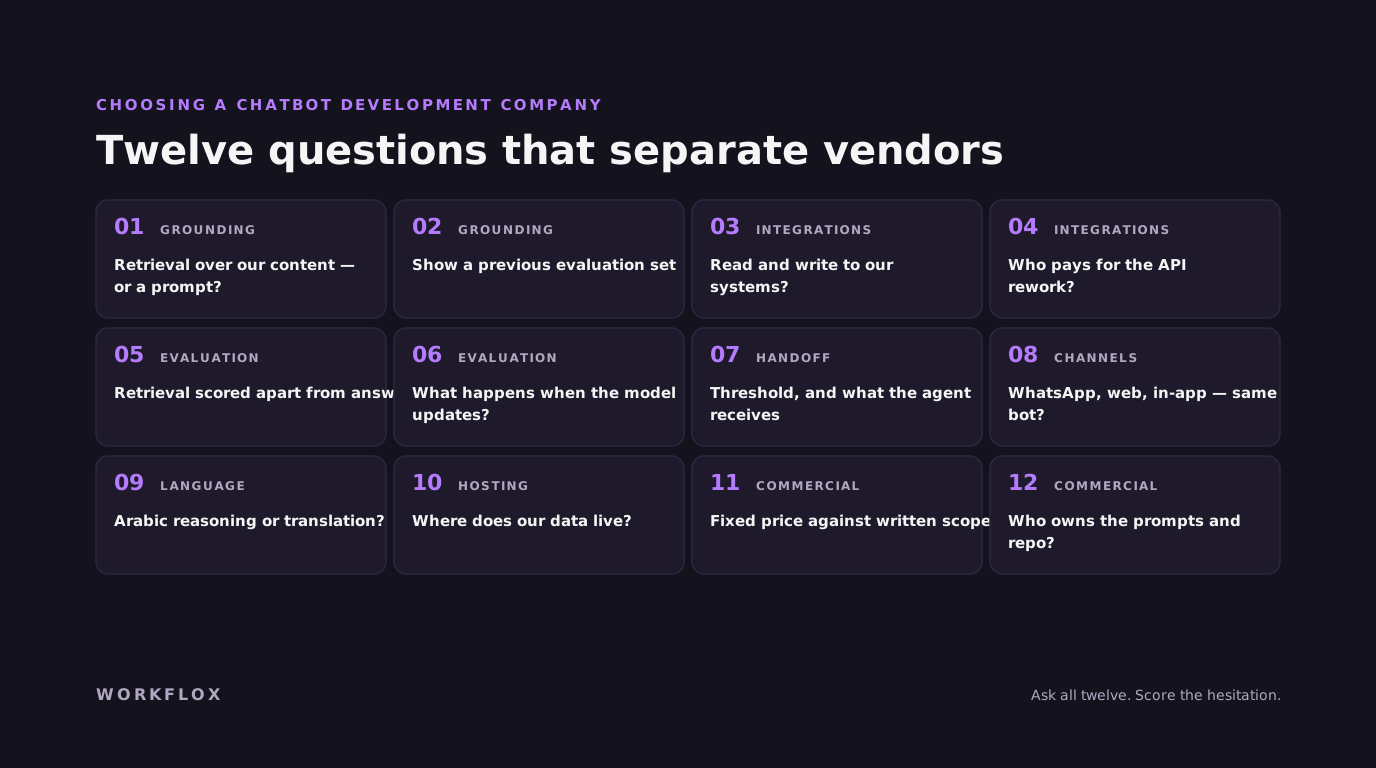
When two proposals for the same custom AI project differ by three times, the difference is almost never the hourly rate. It is what each vendor counted. The cheaper quote usually covers the model integration and the interface, and leaves out the retrieval layer, the evaluation set and the admin tooling. Those are not optional. Without retrieval the system answers from general training and is wrong about your business. Without an evaluation set nobody can say whether it works. Without admin tooling your team needs an engineer for every change. So the cheap quote is not a cheaper project; it is the first third of one. When comparing proposals, ask each vendor to map their price against the six parts above. The one that cannot is not quoting the same thing.
A build we would do differently now
Two years ago we built a document-processing application for a logistics client. It read supplier invoices and matched them to purchase orders. It worked, and it still runs. What we would change is the order of the work. We built the extraction and the interface first, then the evaluation set, then the integration to the accounting system. The integration turned out to be the hard part, because the accounting system had no API and its export format changed with each release. We should have scoped it first and priced it separately. Today every proposal we write starts with the integration inventory, and the integrations are the first thing we test against a sandbox, before the AI work begins. The lesson generalises: the AI is rarely the risky part of an AI project. The systems around it are.
Running costs, honestly
The build price is the number everyone negotiates, and the running cost is the one that decides whether the system survives year two. Three lines matter. Inference is the largest and the most controllable. A grounded assistant handling a few thousand conversations a month typically runs a few hundred dollars in model calls if simple turns are routed to a small model, and several times that if everything goes to a frontier model. Retrieval refresh is the second: re-indexing content as it changes, which is a scheduled job and some storage. Maintenance is the third, and the one people forget: prompt regressions when models update, integration changes when a connected system upgrades, and the occasional new document type. Plan for 10 to 20 percent of the build cost per year. If a vendor cannot put numbers against those three lines before you sign, they have not run a system long enough to know them.
The scoping call, and what to bring
The most useful hour in a custom AI project happens before any proposal is written. Come to it with three things. A description of the workflow in plain terms, as a sequence of what happens now, who does each step, and where it goes wrong. Real examples of the inputs: twenty actual documents, a week of actual support messages, a real export from the system the AI will read. And a number you would accept as success, whether that is minutes saved per case, tickets deflected, or errors caught. With those three, a competent team can tell you on the call whether the data supports the idea, which of the six parts the build needs, and roughly what it costs. Without them, the proposal you receive is a guess dressed as a quote, and the price will move once the real inputs arrive. We have turned down projects on that call, and the clients who heard why usually came back with a better-shaped one.
Signs a project is going well at week four
By the end of the first month you should be able to see three things. The evaluation set exists and has been run at least once against real data, with a number attached, even a poor one. The riskiest integration has been tested against the real system or its sandbox, not mocked. And your own team has logged into something, whether an admin screen or a review queue, and used it. If any of those is missing, ask why, because the pattern of a project that overruns is a polished interface at week four and the hard parts still ahead. The pattern of one that ships on time is the reverse: an ugly screen, a working retrieval layer, and a spreadsheet of scores that is slowly improving.
What we build
Our AI application development practice covers all six parts at a fixed price against a written scope, with the running costs modelled upfront. Where the system needs to act rather than answer, our AI agent development work applies the same discipline, and if you are still deciding whether AI is the right first investment, our AI consulting engagements start there.
Frequently Asked Questions
What is custom AI development?
Building an AI system around your own data, workflows and systems rather than configuring a vendor product: the retrieval layer over your documents, the model selection and routing, the integrations that let the system read from and act in your platforms, the evaluation against your real cases, and hosting that satisfies your data rules. A generic model behind a custom prompt is not custom AI development in any sense that affects outcomes.
How much does custom AI development cost?
Adding a focused AI feature to an existing product typically runs $5,000 to $15,500. An AI-native application built from scratch $15,500 to $44,000. Custom agents and automation across existing systems $13,500 to $41,000. Enterprise platforms with private hosting, SSO and compliance review $44,000 and up. Running costs, inference, retrieval refresh, maintenance, are separate and should be modelled before you commit.
When is off-the-shelf AI better than custom?
When your requirement is genuinely common, general meeting transcription, standard document summarisation, generic support chat, a mature vendor product is cheaper, faster and better maintained. Custom wins when the workflow is specific to how you operate, when the data cannot leave your control, when integration with your own systems is the hard part, or when vendor pricing scales against your growth.
How long does custom AI development take?
A focused feature ships in four to eight weeks; an AI-native application in eight to sixteen; enterprise deployments with private hosting and compliance review in three to six months, with approval processes rather than engineering usually setting the critical path.
Related services
Related Articles