AI Automation
Building an AI Chatbot with WhatsApp Business API for GCC Businesses
By Rana Sami Ullah • March 2026
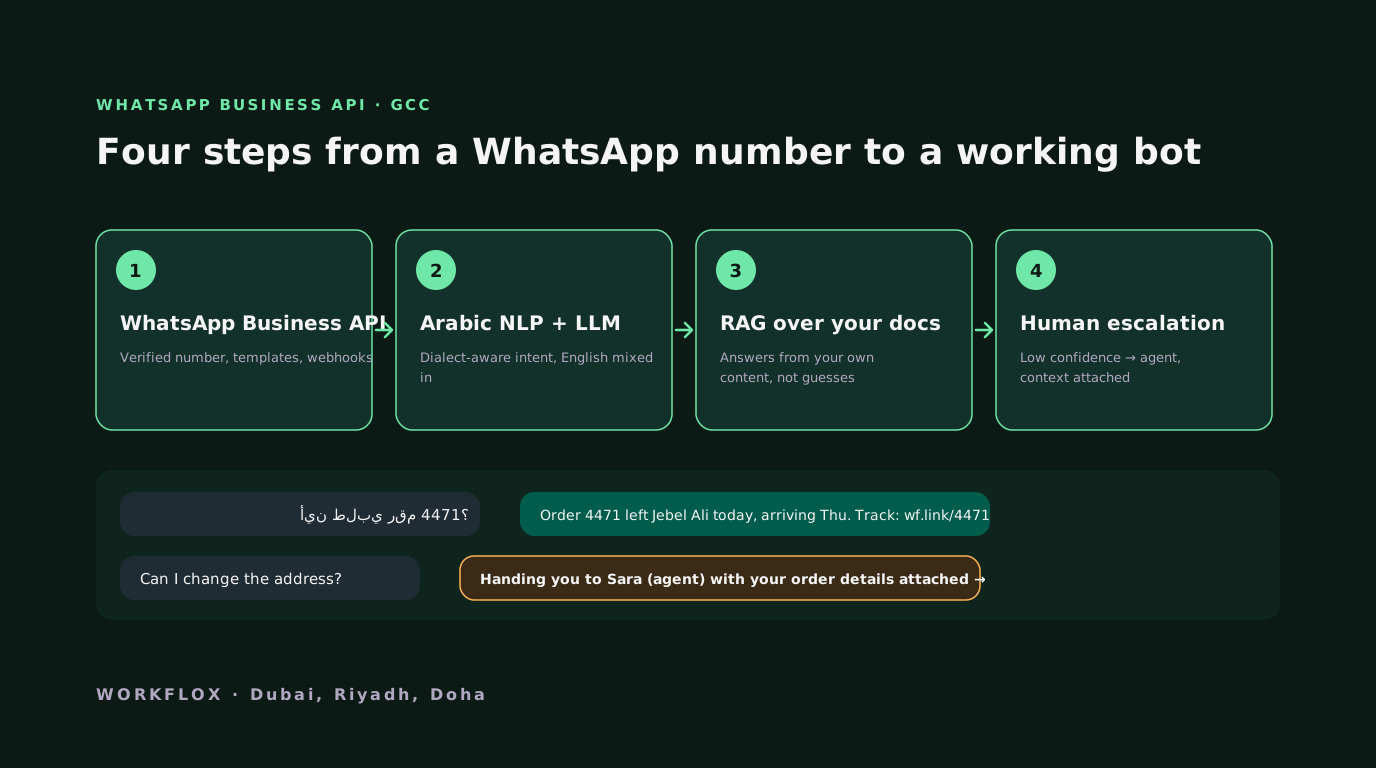
Table of Contents
In the GCC, WhatsApp is not just a messaging app, it's the primary channel for business communication. If your business relies solely on web-based live chat, you are missing out on the platform where your customers actually live.
Here is how to build and deploy an AI chatbot on the WhatsApp Business API.
Step 1: WhatsApp Business API Setup
First, you need access to the official API through a Business Solution Provider (BSP) like Twilio or MessageBird. This allows programmatic access to send and receive messages at scale, bypassing the limitations of the standard WhatsApp Business App.
Step 2: Arabic NLP and LLM Selection
The bot must understand local dialects. Models like GPT-6 and Claude Sonnet 5.5 have reliable Arabic capabilities. We configure the system to detect the user's language automatically and respond natively, maintaining context even if the user switches between Arabic and English mid-sentence.
Step 3: Retrieval-Augmented Generation (RAG)
A generic bot is useless. We use RAG to connect the LLM to your internal knowledge base. When a customer asks about a specific product, the bot queries your inventory database or FAQ documents to provide accurate, business-specific answers.
Step 4: Human-in-the-Loop Escalation
AI should not handle everything. We build intelligent routing that detects frustration or complex queries and smoothly hands the conversation over to a human agent, complete with the full chat history.
Step 5: The evaluation set
Before the bot talks to a customer, it should be scored against real conversations. Export a month of WhatsApp history, pick two hundred messages that cover the common intents, the edge cases, both languages and the mixed messages, and write the expected outcome for each: an answer, a lookup, a handoff. Run the bot against the set and read every failure. Fix, run again. Keep the set, because it is how you will know whether a model update, a knowledge base change or a new prompt made things worse. A bot launched without this is being tested by customers, and they will not file a bug report.
Step 6: The actions, written down
A bot that only answers is a cost centre. The value is in what it can do: look up an order, check availability, create a lead in the CRM, book an appointment. Each action needs a narrow credential, a test, and a decision about whether it is safe to repeat if the message is delivered twice, which happens on WhatsApp. Payments, refunds, contract changes and anything touching identity hand off to a person however easy they would be to automate. The action list is written before the build, and the bot never holds a credential broader than it.
A Sharjah clinic, in numbers
A group of three clinics in Sharjah received around two thousand WhatsApp messages a month, mostly appointment requests, opening hours, prices and insurance questions, in Arabic and English, many as voice notes. Reception staff answered between patients and the backlog by evening was over a hundred. The bot we built answers from the clinic's own policy documents, transcribes voice notes, checks the scheduling system for availability, books and confirms appointments, and hands anything clinical or a complaint to a receptionist with the transcript. In the third month it handled about sixty-five percent of conversations without staff, no-shows fell because reminders went out on time, and the evening backlog was gone.
Costs, and the fees people forget
A grounded WhatsApp bot with Arabic and English, one system lookup, CRM lead capture and human handoff runs AED 14,500 to AED 36,500 with us. Adding booking, catalogue or order lookups, a second system and a review dashboard moves it to AED 36,500 to AED 92,000. WhatsApp's own per-conversation fees are charged through your provider and are modest at most UAE volumes. Model usage is usually tens to a few hundred dollars a month. And a monthly retainer covers reviewing conversations, updating the knowledge base and re-running the evaluation, because a bot that is not maintained drifts as the models underneath it change.
When not to build one
If your WhatsApp volume is a few dozen messages a day, a person with saved replies is cheaper and warmer. If most messages need a judgement call, such as negotiations or complaints, a bot will hand off most of them and frustrate the rest. If your answers change daily and nobody will maintain the knowledge base, the bot will be wrong within a month. We turn down some WhatsApp bot projects on the first call for these reasons, and the businesses that hear it are usually relieved.
Want to automate your customer interactions on WhatsApp? Let's scope your project.
Frequently Asked Questions
How does an AI chatbot work on WhatsApp Business API?
An AI WhatsApp chatbot connects to the WhatsApp Business API through a Business Solution Provider (like Twilio or MessageBird), which provides programmatic access to send and receive messages at enterprise scale. When a customer sends a message, it is received by a webhook on your backend server, passed through an AI processing layer (using GPT-6 or Claude) that understands the intent and generates a response, and the reply is sent back through the API. The AI can also trigger actions, like querying your inventory system, booking appointments, or creating CRM records, based on what the customer says.
Can an AI WhatsApp chatbot understand Arabic and English?
Yes. Models like GPT-6 and Claude Sonnet 5.5 have strong multilingual capabilities and can handle Arabic, including Gulf dialects, as well as smooth mid-conversation switching between Arabic and English. The key is proper system prompt design and testing across both languages. WORKFLOX specifically tests all Arabic NLP implementations with native Arabic speakers before deployment to ensure the bot sounds natural, not robotic, in both languages.
What is the difference between a WhatsApp Business App and the WhatsApp Business API?
The WhatsApp Business App is a free mobile application designed for very small businesses: it supports one phone number, basic automated replies, and manual messaging by a human operator. It cannot be integrated with CRMs, cannot send messages at scale, and does not support AI. The WhatsApp Business API is a paid enterprise interface that allows full programmatic integration: multiple agents, AI chatbot responses, CRM sync, message templates, and unlimited scale. Any serious business automation on WhatsApp requires the API, accessed through an approved Business Solution Provider.
How much does building an AI WhatsApp chatbot cost?
A basic AI WhatsApp chatbot (simple FAQ responses, no CRM integration, one language) costs AED 14,500–AED 36,500. A production WhatsApp AI agent with RAG knowledge base, Arabic + English support, CRM integration, human escalation routing, and analytics dashboard costs AED 36,500–AED 92,000. WhatsApp Business API usage fees are charged separately by your BSP provider (typically per message, ranging from $0.003–$0.08 per conversation depending on country and template type).
Can a WhatsApp AI chatbot qualify leads and sync them to a CRM?
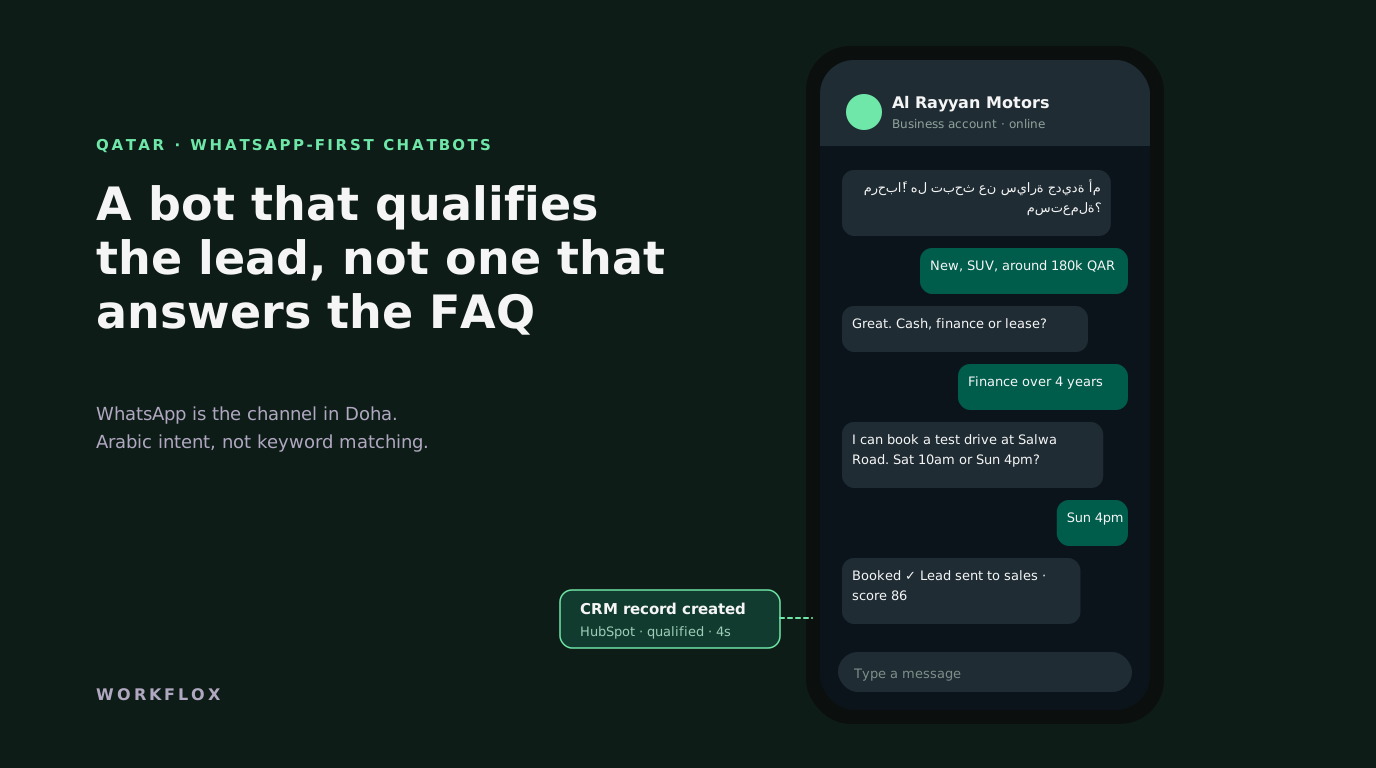
Yes. This is one of the most powerful use cases. When a prospect starts a WhatsApp conversation, the AI agent asks qualifying questions (budget, timeline, requirements), extracts structured data from the conversation, creates or updates the lead record in your CRM (HubSpot, Salesforce, Pipedrive), scores the lead based on your criteria, and routes qualified leads directly to the right sales rep via a Slack or WhatsApp notification: all automatically, in real time, without any human intervention in the first stage of the funnel.