AI Technology
How to Choose an AI Chatbot Development Company: 12 Questions That Separate Vendors
By Rana Sami Ullah • June 2026
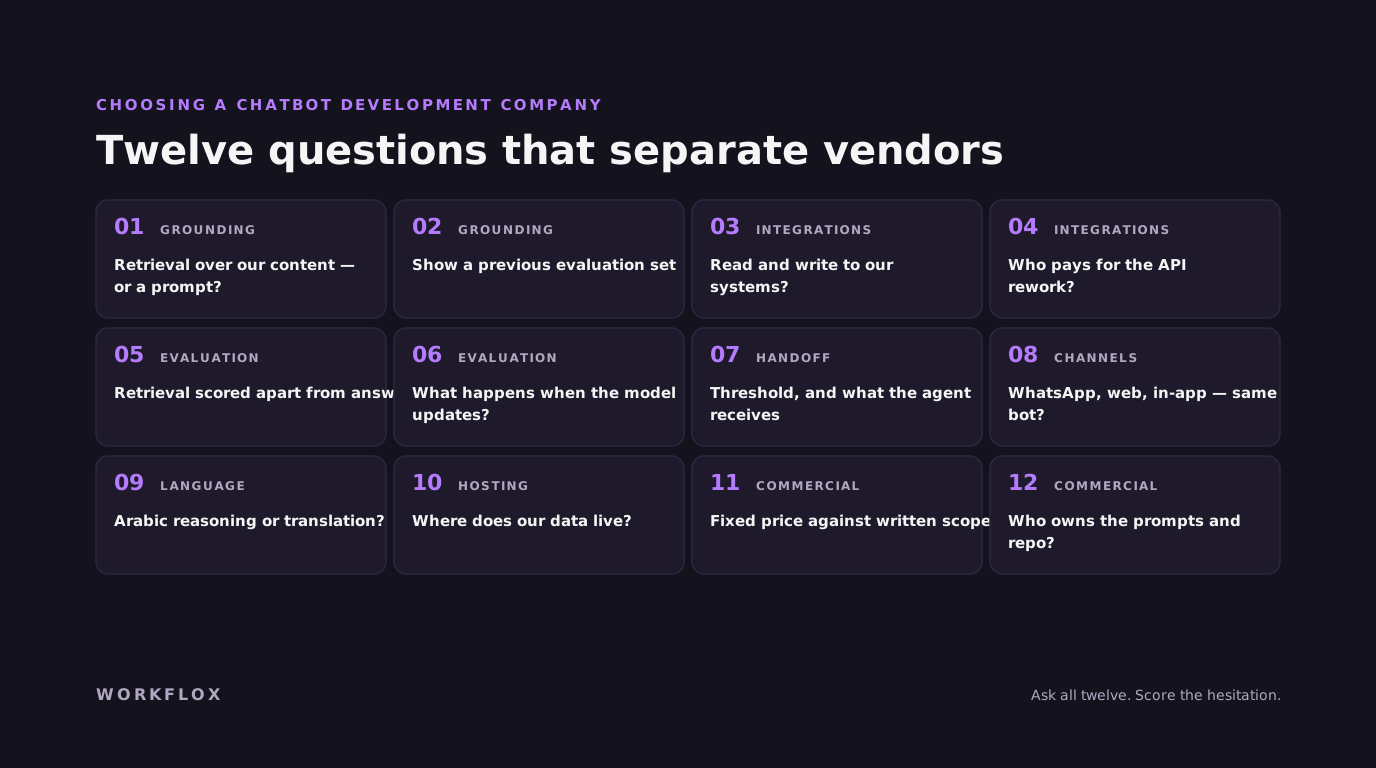
Table of Contents
There are hundreds of companies that will build you an AI chatbot, and the marketing pages are nearly indistinguishable. The engineering underneath is not. These twelve questions separate a chatbot development company that will ship something that works from one that will ship a demo.
On grounding
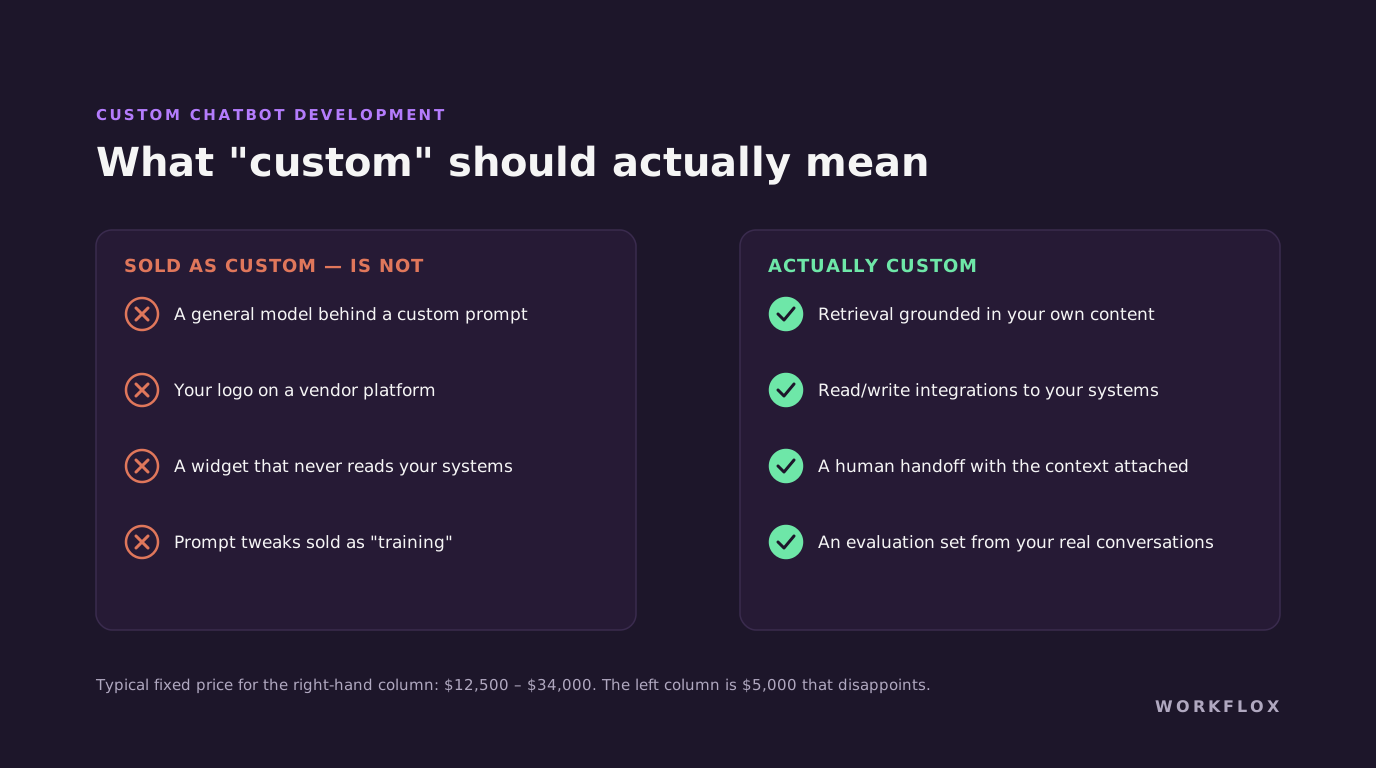
1. Where does the bot's knowledge come from? The right answer is your documents, policies and resolved tickets, through a retrieval layer. The wrong answer is a system prompt on a general model. Ask how the bot handles a question outside what it has been given, it should decline, not guess.
2. What happens when our content changes? A retrieval layer that was indexed once and never refreshed drifts within a quarter. Ask how sync works and who owns it.
On integrations
3. What can the bot do, not just say? Read an order status, check a booking, open a ticket, update a record. Each integration is real engineering. A vendor who hand-waves this is selling a widget.
4. How are permissions and errors handled? A bot that writes to your CRM needs scoped credentials, idempotent operations so a retry does not create duplicates, and a defined failure path. Ask to see how a previous integration was tested.
On evaluation
5. Show me the evaluation set. Before launch, the bot should be scored against real conversations from your history, retrieval quality and answer quality measured separately. Without an evaluation set there is no way to tell whether it works.
6. What deflection rate did your last deployment achieve, and how was it measured? A company that has done this work has a number and can explain the method. Genuine resolutions must be separated from abandonments, which are easy to misread as successes.
On the human handoff
7. Where is the confidence boundary, and what travels with the handoff? The bot should escalate below a defined threshold with the full transcript and context attached, into a queue somebody owns. Ask who decided the threshold on previous projects and how it was tuned.
On channels and language
8. Which channels have you shipped on? WhatsApp Business API, web, in-app, Slack, Teams, each has different constraints. If your customers live on WhatsApp, a web-only portfolio is a warning. Our Qatar chatbot guide shows what regional channel work actually involves.
9. How do you handle our languages? If your market switches between Arabic and English mid-message, or Urdu and English, translation is not support. Ask for native-reviewer evaluation, not a translation score.
On hosting and data
10. Where is conversation data stored and processed? Under PDPL in the Gulf, GDPR in Europe and sector rules everywhere, this is a legal answer with architectural consequences. It should be settled before the data model, not during legal review.
On commercial terms
11. Is this a fixed price against a written scope? Hourly quotes with no scope reward the clock. A fixed price against a document you both signed rewards delivery.
12. What is the estimated monthly running cost at our volume? Model inference scales with usage. A vendor who cannot estimate it before you commit has not run a bot in production long enough to know.
The demo, and how to run it
Most vendors will offer a demo on their own data. Insist on yours. Send twenty real questions from your support queue a few days before the call, including at least five that need a lookup in one of your systems and at least three that a good bot should refuse or hand off. Then watch what happens. A vendor who has built for real will have grounded the bot in the documents you sent and will be candid about the lookups they could not do without integration access. A vendor selling a wrapper will have the bot answer everything fluently, including the ones it should not, and that fluency is the warning. Ask to see the retrieval trace for one answer: which documents were fetched and why. If they cannot show you, there is no retrieval layer.
Reading a chatbot proposal
Look for four things on the page. A list of intents the bot will handle, with the ones it will not. A list of integrations by system name, with which are read-only and which take actions. A description of the evaluation, ideally with a target accuracy on a set you helped assemble. And a maintenance plan with someone named as responsible for reviewing conversations. A proposal with none of these is a proposal for a demo. A proposal with all four is usually longer, more expensive and the only one worth signing. Also check for a line about ownership of prompts, the index and the logs, because vendors who intend to keep those rarely mention them.
Two stories from the same year
A retailer in Dubai chose the cheapest of four quotes for a WhatsApp bot. It launched in three weeks, answered product questions well, and could not look up an order, which was sixty percent of contacts. Deflection was under twenty percent and the support team switched it off within two months. A logistics company in Jeddah chose a build with a scoping phase first, which found that the shipment tracking system had an unused API. The bot handled tracking, delivery rescheduling and proof-of-delivery requests, with a human handoff for damage claims. Deflection settled around sixty-five percent, and the support team now spends its time on the claims. The second project cost about three times the first and returned the difference in the first quarter.
Red flags in the first conversation
The vendor does not ask what your top ten customer questions are. They describe the bot as trained on your data without explaining what that means. They cannot say where your data will be stored. They promise a deflection rate before seeing your ticket volume. They talk about the model more than about your systems. They offer to start next week without a discovery phase. Every one of these is a vendor optimising for a signature rather than for a bot that works in month three, and the first conversation is the cheapest place to find out.
What to expect on price
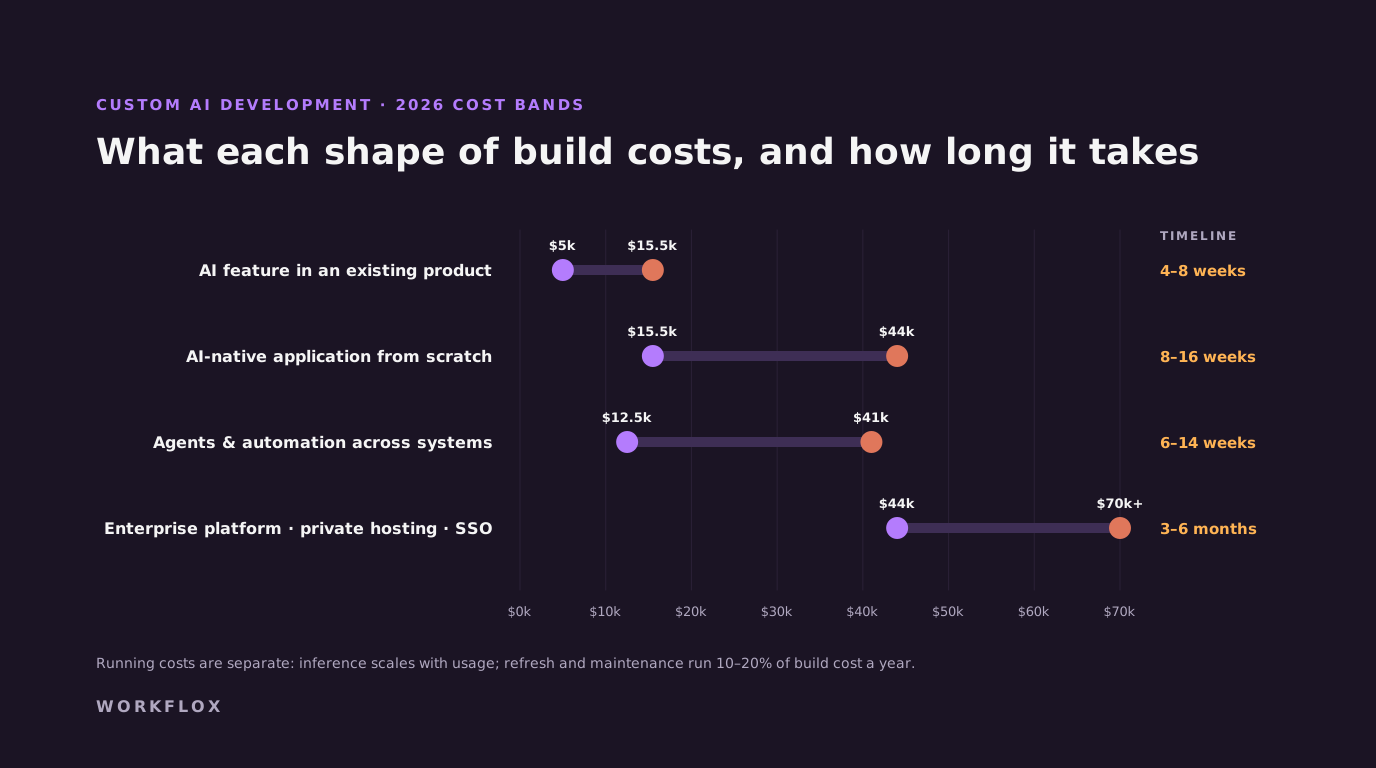
For a grounded support bot over your documentation, with a handoff and an evaluation set, the honest range is $4,000 to $10,000. With integrations that let it act in your systems, $10,000 to $25,000. Multilingual adds a little to the build and more to the evaluation. Maintenance is a monthly retainer, and a vendor who does not propose one is planning to disappear after launch. Quotes far below these ranges are usually a configured product with your logo on it, which is fine if that is what you need, and quotes far above are usually enterprise consultancies charging for process. The scoping questions in this article are how you tell which one you are looking at.
Using the questions
You will not get perfect answers to all twelve from anyone. What you are listening for is whether the company has thought about each one, because the ones they have not thought about are the ones that will surface in month three as the reasons the bot is being switched off.
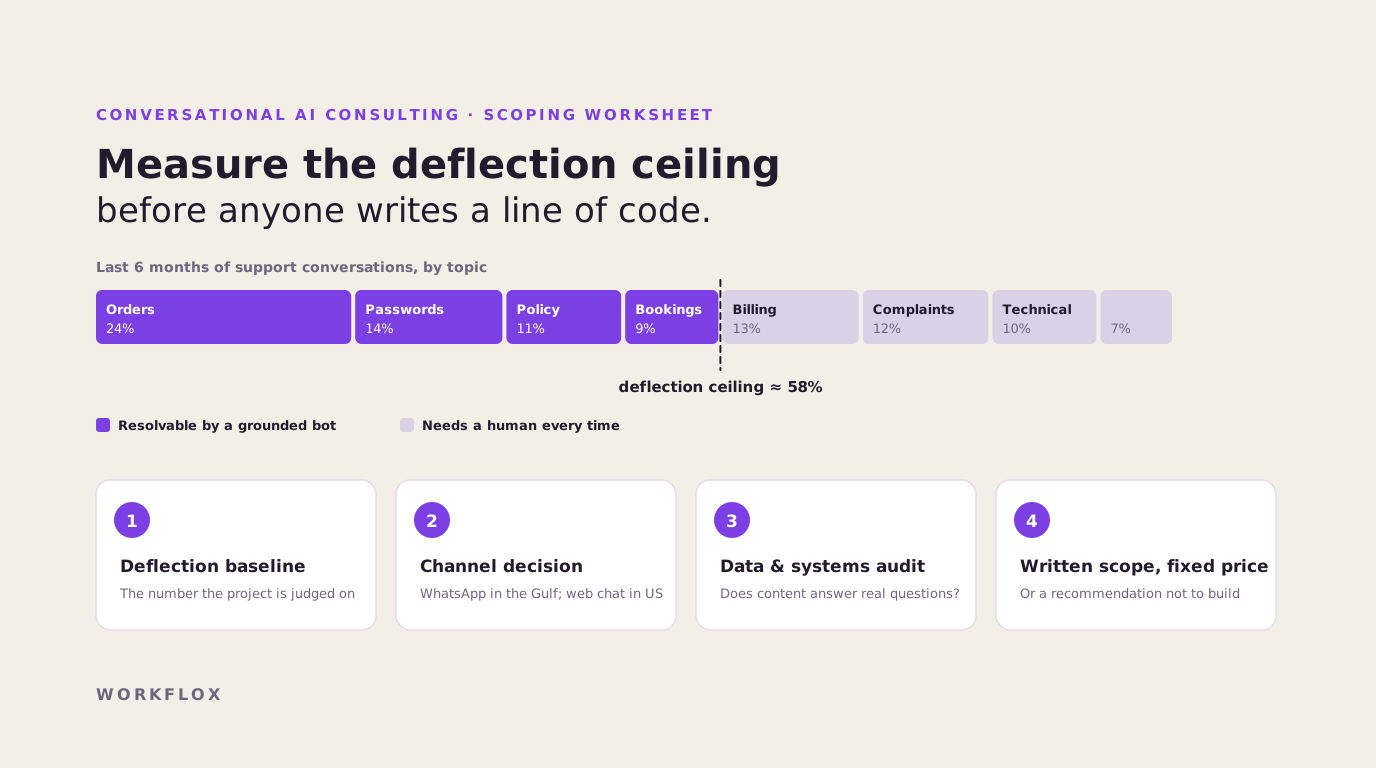
We answer all twelve on our AI chatbot development page and in scoping calls, and we would rather lose a project on question 6 than win it on question 1. If you want the scope written before you compare vendors, our note on conversational AI consulting explains what that engagement produces. Indicative pricing is on our packages page.
Frequently Asked Questions
What should I look for in an AI chatbot development company?
Evidence that they ground bots in your own data rather than a general model, integrations with real business systems, an evaluation process using your actual conversations, a defined human handoff, clarity on where conversation data is hosted, and a fixed price against a written scope. Ask to see a deflection-rate figure from a live deployment; a company that cannot produce one has not measured its own work.
How much does an AI chatbot development company charge?
Grounded single-channel bots typically run $4,000 to $10,000; multi-channel bots with several integrations $10,000 to $25,000; enterprise deployments with SSO, audit logging and private hosting above that. Be wary of quotes far below these bands, they usually describe a templated widget rather than a custom build, and of hourly quotes with no scope, which reward the clock rather than the outcome.
Should I choose a chatbot development company in my own country?
It matters less than timezone overlap and regulatory fit. A vendor that works your business hours and understands your data-residency rules can be anywhere. What does matter is whether they have built for your market's channels and languages, WhatsApp and Arabic in the Gulf, for instance, because those are not details that transfer from a US-only portfolio.
How do I compare quotes from different chatbot development companies?
Only against the same written scope. Give every vendor the same document, channels, question set, integrations, handoff, evaluation, and ask for a fixed price against it. Quotes against different assumptions are not comparable, and the cheapest one is usually the one that assumed the least.
What is a reasonable deflection rate to expect?
Forty to seventy percent of tier-one support volume on well-scoped deployments, with the spread driven by how repetitive your questions are. A vendor promising ninety percent across all your support has not looked at your conversations. A vendor who will not give a range has not measured a previous deployment.
Related services
Related Articles