Pricing & Strategy
What a Custom AI Agent Costs in Saudi Arabia
By Rana Sami Ullah • May 2026
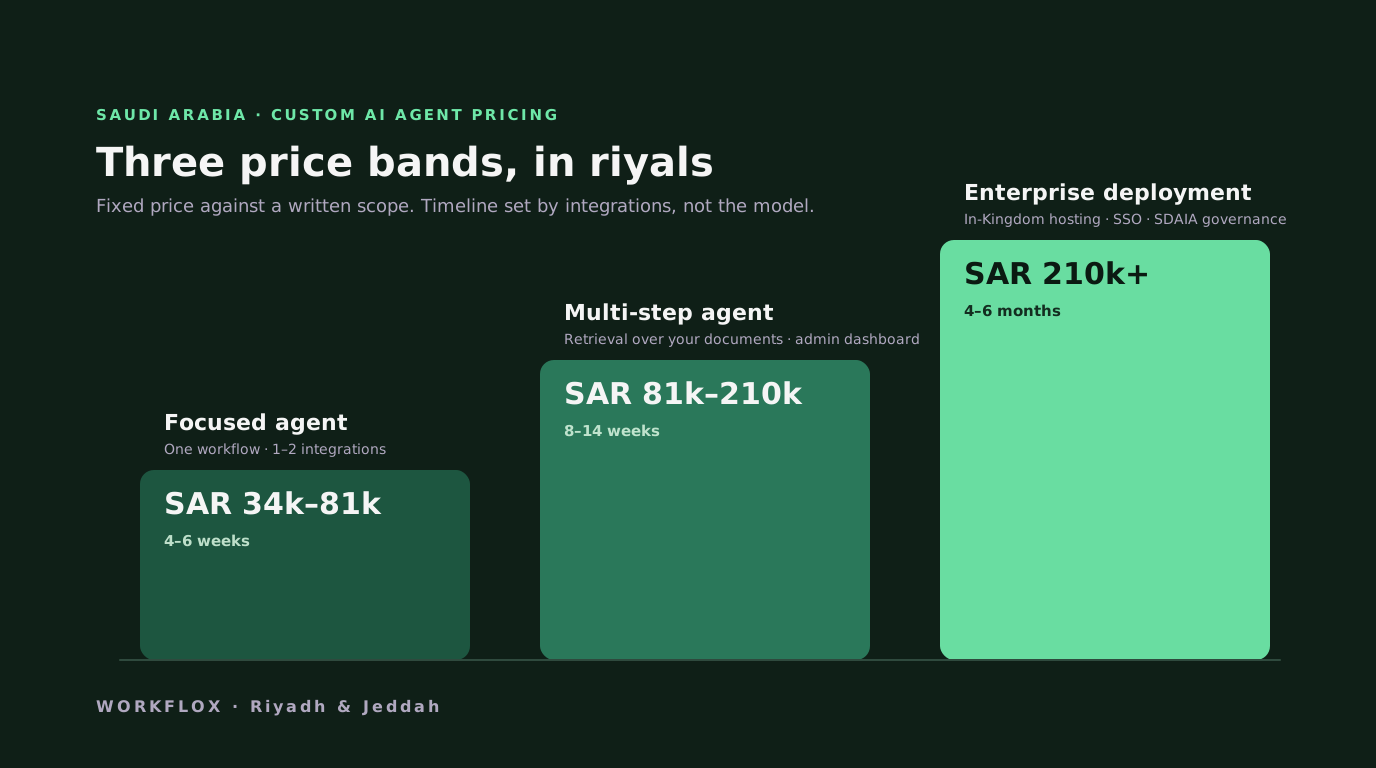
Table of Contents
Most AI agent quotes in the Kingdom arrive as a single number with no working shown, which makes them impossible to compare. One vendor says SAR 90,000, another says SAR 400,000, and the scope descriptions are similar enough that the difference is unexplained.
The gap is usually real, and it usually comes down to four things: how much of your own data the agent has to reason over, how many systems it writes back into, whether Arabic is built in or bolted on, and where the data is allowed to live.
This is what AI agent projects actually cost in Saudi Arabia in 2026, what moves the number, and which costs appear after launch rather than in the quote.
The three price bands
Almost every agent engagement we scope in the Kingdom falls into one of three shapes.
| Scope | Timeline | Fixed price | |
|---|---|---|---|
| Focused agent | One workflow, one or two integrations, human review on exceptions | 4 - 6 weeks | SAR 15,000 - 37,500 |
| Multi-step agent | Retrieval over your documents, several integrations, admin dashboard | 8 - 14 weeks | SAR 50,500 - 154,000 |
| Enterprise deployment | In-Kingdom hosting, SSO, audit logging, SDAIA-aligned governance | 4 - 6 months | SAR 210,000+ |
A focused agent does one job well: qualifying inbound leads and writing them into your CRM, triaging support requests, extracting fields from invoices and validating them against purchase orders. Most organisations should start here, and many never need to go further.
A multi-step agent reasons over your own content and acts across several systems: checking an order, applying a policy, updating a record, drafting a response. The cost step is driven by retrieval infrastructure and by each integration carrying its own permissions, error handling and testing.
An enterprise deployment adds the things regulated organisations require regardless of what the agent does: identity integration, audit trails, approval gates, data residency and formal governance.
What actually drives the number
Retrieval over your own data
The single largest cost variable. An agent answering from a model's general knowledge is cheap and largely useless for your business. An agent grounded in your policies, contracts, product data and support history requires a retrieval layer: chunking, embeddings, re-ranking, and a sync process that keeps it current as your content changes.
The work that gets underestimated is evaluation. Retrieval quality has to be measured separately from answer quality, because a strong model over weak retrieval produces fluent, confident, wrong answers, which is worse than no agent at all. Budget for building an evaluation set from your real cases. Projects that skip this are the ones that demo well and fail quietly in month three.
Integrations, counted honestly
Each system the agent reads from or writes to is a discrete piece of work: authentication, permissions, error handling, retry logic, and tests. Two integrations is not twice one. It is closer to twice, plus the interaction between them.
In the Kingdom this often includes government and payment infrastructure. Nafath for digital identity, Absher, Etimad for procurement, and Mada or STC Pay for payments. The technical work is usually modest. The approval processes are not, and they take calendar time regardless of engineering speed. If your project depends on one, start that process in week one rather than week eight.
Arabic, done properly
This is where regional projects most often go wrong, and where the cheapest quotes are usually hiding the compromise.
Machine-translating an English agent produces stilted Modern Standard Arabic that reads as foreign to Saudi users, mishandles dialect in incoming messages, and breaks when users code-switch mid-sentence, which they do constantly. Doing it properly means dialect-aware handling of input, responses tuned to how Saudi businesses actually write, correct right-to-left rendering, Hijri date handling, and evaluation by native reviewers against real transcripts rather than a translation score.
Expect Arabic support to add 15 to 25 percent. A quote that includes full Arabic at no premium is either reusing something generic or has not scoped it.
Where the data lives
Under PDPL, personal data carries obligations around processing, cross-border transfer and retention. Depending on sector and data type, that can mean hosting in-Kingdom or in a regional facility rather than defaulting to a US cloud region.
Infrastructure cost rises accordingly, and so does engineering time, because model access patterns differ when you cannot call a frontier API from an arbitrary region. Options range from regional cloud hosting through to self-hosted open-weight models for the most sensitive workloads. That last option lowers inference cost substantially and raises engineering cost, and it is worth modelling both before choosing.
This decision belongs at the start. Retrofitting data residency onto a built system is close to a rebuild.
The costs that come after launch
Quotes cover the build. These are the numbers that determine whether the agent survives its first year.
Model inference scales with usage, typically SAR 1,500 to SAR 20,000 monthly depending on volume and model choice. The most effective lever is routing: a cheap model classifies and handles simple steps, a frontier model handles only genuine reasoning. That routinely halves inference spend with no measurable quality loss. Any partner who cannot model your expected inference cost before you commit has not built enough of these.
Infrastructure runs SAR 1,000 to SAR 8,000 monthly, at the higher end where in-Kingdom hosting applies.
Maintenance is the one most often omitted, and it is not optional. Model providers update versions underneath you, your content changes and retrieval drifts, and edge cases surface that the evaluation set missed. Budget 10 to 20 percent of build cost annually. An agent nobody maintains degrades quietly, and the first people to notice are your customers.
Governance is a cost line, not paperwork
Once an agent touches customers or influences regulated decisions, SDAIA's governance framework and PDPL stop being a compliance checkbox and become design constraints.
In practice: document what data the agent can see, log decisions with enough context to explain one later, define which actions require human approval before execution, and know where processing happens. Financial services and healthcare carry additional sector requirements on top.
None of this is expensive if it is designed in. All of it is expensive if it is added after a regulator asks. Our guide to building an agentic AI governance framework covers this at enterprise scale.
How to compare two quotes properly
When two proposals differ by a factor of three, ask these:
- What is in the evaluation set, and who builds it? No answer means no objective definition of working.
- Is Arabic native or translated? Ask to see Arabic output from a previous build.
- How many integrations, and does the price include their approval processes?
- Where is data stored and processed, and does that satisfy PDPL for our sector?
- What is the estimated monthly inference cost at our volume? A partner who cannot estimate this has not run one in production.
- What happens when the model provider changes versions?
- Who owns the repository, the cloud account and the credentials? The answer should be you, from day one.
Our note on how to vet a custom AI agent development partner in Riyadh goes further into the evaluation itself.
Where to start
For most organisations the right first project is smaller than the one they have in mind. A focused agent on a single high-volume workflow proves the value, produces real numbers, and builds the internal understanding that makes the second project better scoped. It also costs a fraction of an enterprise deployment, which matters when you are still establishing whether the approach fits how you work.
If the requirement is closer to answering questions than taking actions, a well-built conversational system may serve at a lower cost. Our AI agent versus chatbot comparison sets out where that line falls.
We build custom AI agents for clients across the Kingdom, with fixed-price scoping and direct access to the engineers doing the work. See our Riyadh and Jeddah pages for local engagement detail, or our Saudi Arabia overview for the national picture. Where the architecture decision comes before the build, our AI consulting engagements start there. Teams connecting agents to existing platforms should also read our Jeddah enterprise LLM integration guide.
The short version
Budget SAR 15,000 to 37,500 for a focused agent, SAR 50,500 to 154,000 for a multi-step agent with retrieval and integrations, and SAR 210,000+ for an enterprise deployment with in-Kingdom hosting and governance. Add 15 to 25 percent for proper Arabic. Plan for 10 to 20 percent of build cost annually in maintenance, plus inference.
And treat any quote that omits evaluation, Arabic scope, data residency and running costs as incomplete rather than cheap, because those four are where the difference between the numbers actually lives.
Want a fixed-price number against your scope? Start a conversation with our team, or see indicative figures on our packages page and in our AI app development cost guide.
Frequently Asked Questions
How much does a custom AI agent cost in Saudi Arabia?
A focused single-workflow AI agent typically costs SAR 15,000 to SAR 37,500 and ships in four to six weeks. A multi-step agent with retrieval over your own documents, several system integrations and an admin dashboard generally runs SAR 50,500 to SAR 154,000 over eight to fourteen weeks. Enterprise deployments requiring in-Kingdom hosting, SSO, audit logging and SDAIA-aligned governance start around SAR 210,000. These are fixed-price bands quoted against written scope, not hourly estimates.
What makes AI agent projects more expensive in Saudi Arabia than elsewhere?
Three things. Arabic language support done properly rather than machine-translated adds roughly 15 to 25 percent, because dialect handling, right-to-left interfaces and bilingual evaluation are real engineering rather than a translation pass. Data residency requirements under PDPL can require in-Kingdom or regional hosting, which raises infrastructure cost relative to a default US region. And integration with Saudi systems such as Nafath, Absher, Etimad, Mada and STC Pay carries approval processes that take calendar time even when the technical work is modest.
How long does it take to build an AI agent in Riyadh or Jeddah?
A single-purpose agent handling one workflow typically ships in four to six weeks from kickoff. A multi-step agent with retrieval, several integrations and an admin interface generally runs eight to fourteen weeks. Enterprise deployments with in-Kingdom hosting, compliance review and government API approvals extend to four to six months, with the approval processes rather than the engineering usually setting the critical path.
What are the ongoing costs of running an AI agent?
Running costs split into model inference, infrastructure and maintenance. Inference is volume-driven and typically runs SAR 1,500 to SAR 20,000 per month depending on traffic and model choice. Routing simple steps to a cheaper model and reserving a frontier model for genuine reasoning commonly halves this. Infrastructure runs SAR 1,000 to SAR 8,000 monthly, higher where in-Kingdom hosting is required. Maintenance covers model updates, retrieval refresh and monitoring, typically 10 to 20 percent of build cost annually.
Does an AI agent in Saudi Arabia need to comply with PDPL and SDAIA rules?
Yes for any system handling personal data. Saudi Arabia's Personal Data Protection Law governs collection, processing, cross-border transfer and retention, and SDAIA's AI governance framework sets expectations around transparency, accountability and human oversight. In practice this means documenting what data the agent sees, keeping an audit trail of decisions, defining which actions require human approval, and confirming where data is stored and processed. Agents in regulated sectors including finance and healthcare carry additional sector requirements.