AI Automation
How to Vet a Custom AI Agent Development Partner in Riyadh
By Rana Sami Ullah • July 2026
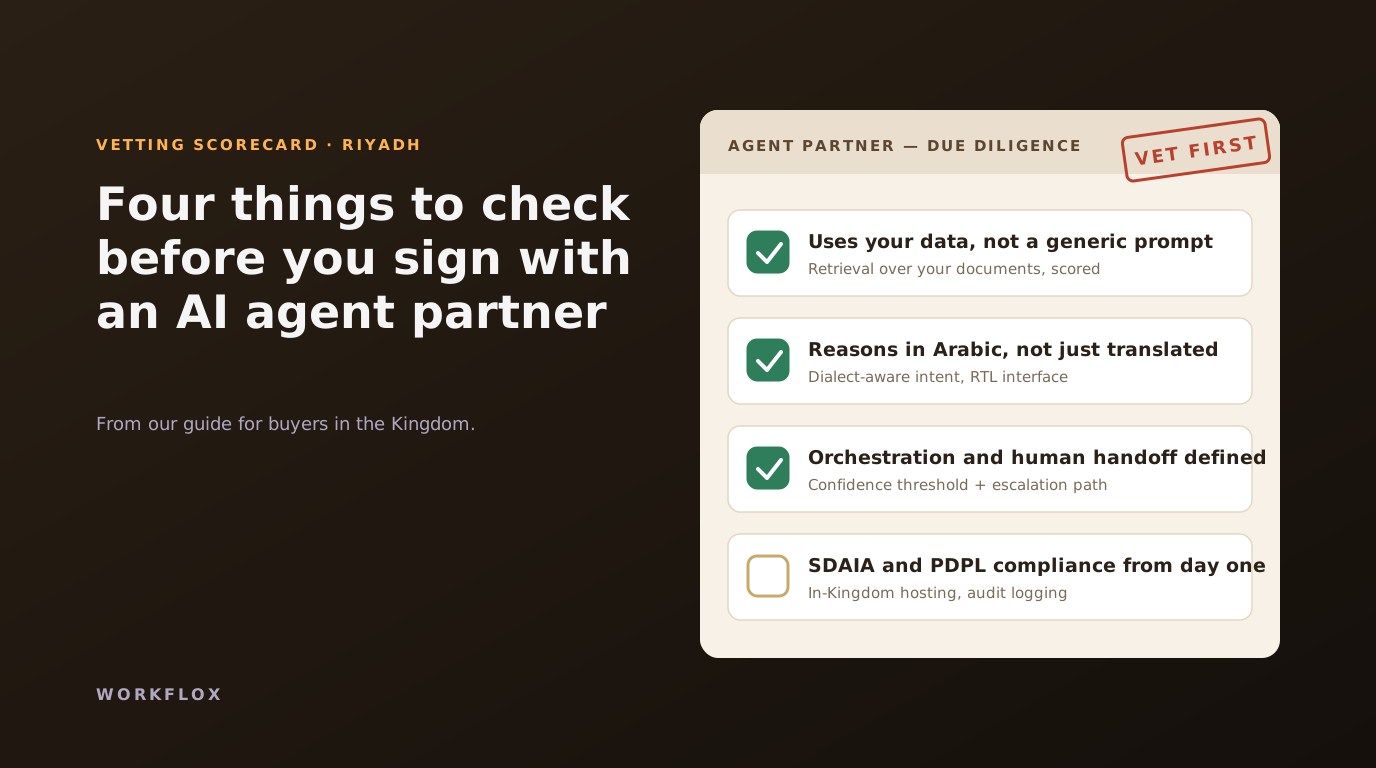
Table of Contents
- "Custom" Should Mean Your Data, Not a Generic Prompt
- Arabic-First Reasoning, Not Just Arabic Translation
- Where the Agent Actually Lives: Orchestration and Human Handoff
- SDAIA and PDPL Compliance From Day One
- A vetting session that went well
- Six questions, and the answers that matter
- What a GPT wrapper looks like from the outside
- Pricing for Riyadh, and what moves it
- After the pilot
- If you only ask one thing
- Reference calls, done properly
Riyadh's enterprise buyers are done with chatbot demos. Vision 2030's push toward digital government and private-sector automation means procurement teams are now evaluating custom ai agent development the same way they'd evaluate an ERP vendor: on architecture, compliance, and what happens after the pilot. Here is what actually separates production-grade agent development from a GPT wrapper with a landing page.
"Custom" Should Mean Your Data, Not a Generic Prompt
Most agents marketed as custom are a shared prompt template pointed at a public API. A real custom ai agent development engagement builds retrieval-augmented generation (RAG) over your own ERP, CRM, and support ticket history, so the agent answers from your actual operational data, not a generic model's training set.
Arabic-First Reasoning, Not Just Arabic Translation
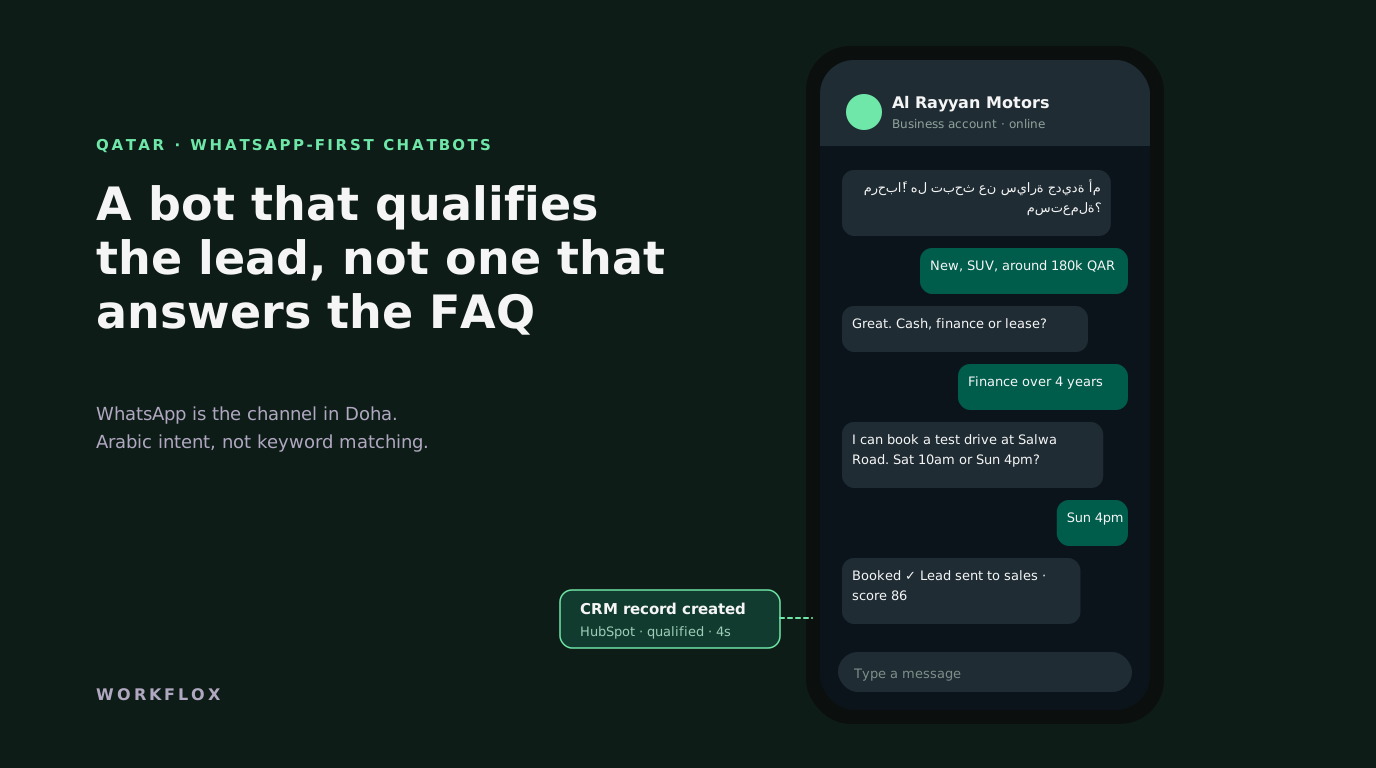
Translating an English chatbot into Arabic is not the same as reasoning in Arabic. Riyadh enterprises need agents that hold formal Modern Standard Arabic for written correspondence and shift naturally into Gulf dialect for WhatsApp conversations, without losing context mid-thread.
Where the Agent Actually Lives: Orchestration and Human Handoff
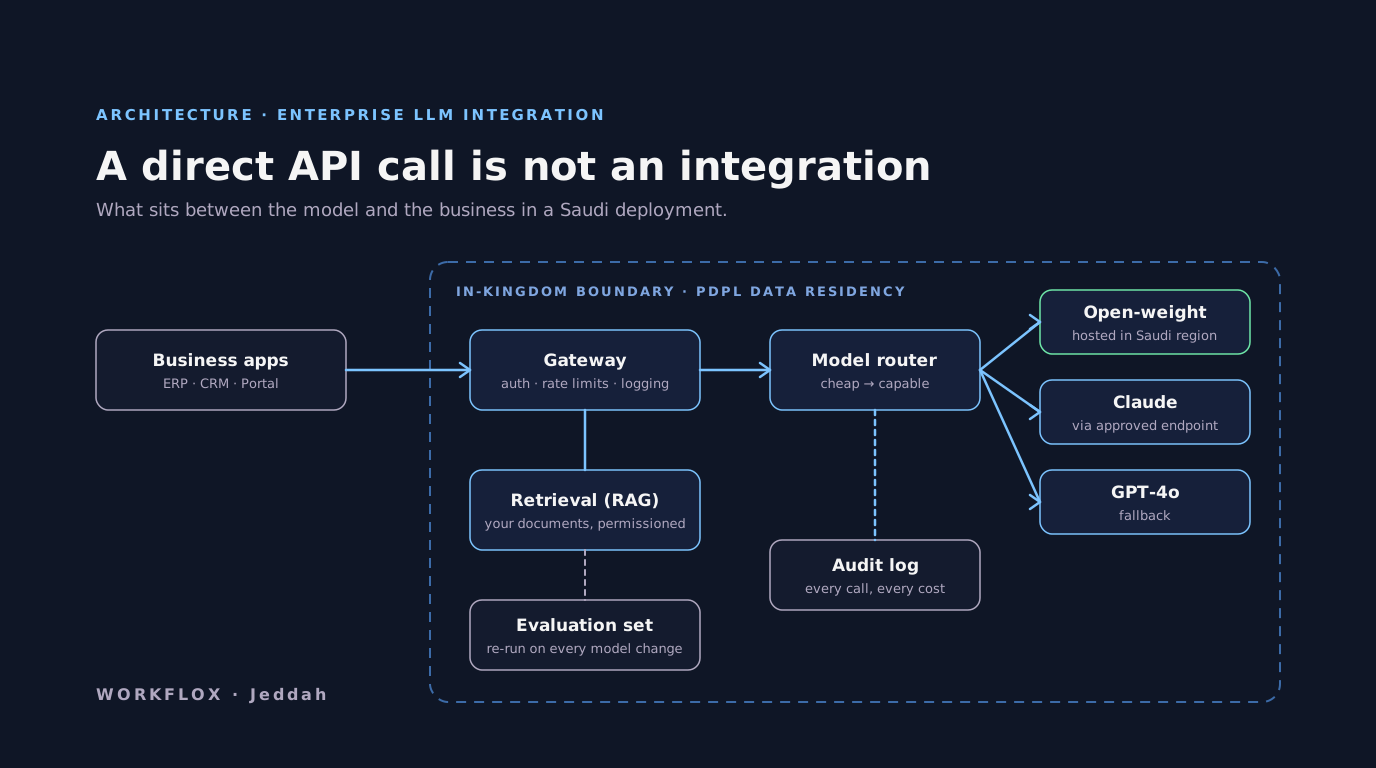
A production agent is not a single API call, it is an orchestration layer. We build these on n8n so every agent action, a CRM update, a scheduled follow-up, an escalation, is logged, auditable, and reversible. When a conversation needs a human, the agent hands off to a sales director's WhatsApp or Slack with full context attached, not a cold transfer.
SDAIA and PDPL Compliance From Day One
Saudi Arabia's Personal Data Protection Law and SDAIA's AI governance guidance are not an afterthought you bolt on before launch. We architect data residency on AWS Middle East (Bahrain) and consent handling into the agent from the first sprint, so your legal team isn't the one finding the gaps. See how we approach the wider region on our AI App Development Riyadh page.
A vetting session that went well
A Riyadh insurer invited four vendors to present. Three showed a chat interface answering questions about a sample policy document. The fourth showed a spreadsheet: two hundred real customer questions from a previous client, the agent's answers, a score for each, and the date the set was last run. Then they showed the agent failing on three of them and explained what they changed. The insurer chose the fourth vendor, not because the demo was the most impressive but because it was the only one that could be measured. Eight months later the agent handles renewal queries and claim status in Arabic and English, and the insurer's own team runs the evaluation set after every change.
Six questions, and the answers that matter
Where does the agent's knowledge come from, and can you show me the retrieval trace for one answer? A real answer names an index over the client's documents and shows which passages were fetched. What can the agent do, not just say, and what stops it doing more? A real answer is a list of tools with their permissions. How do you test Arabic? A real answer describes an evaluation set with Gulf dialect and mixed-language cases. Where does the data live? A real answer names a region and offers to document it for PDPL. What happens after launch? A real answer names a person and a cadence for reviewing conversations. And who owns the prompts, index and logs? The only acceptable answer is you.
What a GPT wrapper looks like from the outside
It has a beautiful interface. It answers everything, including the questions it should refuse. It cannot show you which document an answer came from. It has no numbers, only adjectives. Its proposal talks about the model and not about your systems. It promises a deflection rate before seeing your ticket volume. And it can start next week, because there is no discovery to do. None of these is proof on its own. Together they are a pattern, and it is the pattern behind most of the agents that were switched off within a quarter.
Pricing for Riyadh, and what moves it
A single-workflow agent, such as one that answers policy questions from your documents and creates a ticket when it cannot, runs SAR 15,000 to 37,500 with us and ships in four to six weeks. An agent with retrieval over several systems, actions in your CRM or ERP, Arabic and English, and a review queue runs SAR 50,500 to 154,000 over two to four months. In-Kingdom hosting, single sign-on and the governance documentation SDAIA-aligned reviewers expect are priced on top. The variable that moves the quote most is the state of the systems the agent must touch: an ERP with a documented API is weeks cheaper than one with a screen and a manual.
After the pilot
Most agent projects in Riyadh end at the pilot, and the reason is rarely the technology. It is that nobody planned what happens next: who reviews conversations, who updates the knowledge base when a policy changes, who re-runs the evaluation after the model provider ships an update, and what the budget is for the second workflow. Ask the vendor for that plan before the pilot starts. If the answer is a support email address, the pilot will be the end. If the answer is a named person, a monthly review and a roadmap for the next two workflows, the pilot is the beginning.
If you only ask one thing
Ask for the evaluation set from their last deployment, with the scores and the date it was last run. It is the one artefact a vendor cannot produce without having done the work, and it tells you whether they have a way of knowing when the agent is wrong. Every other question in this article is a way of getting at the same thing. The vendors who can answer it tend to answer the rest without being asked.
Reference calls, done properly
Ask for a client whose agent has been in production for more than six months, and ask them three things. What broke, and how fast was it fixed? Who on their side runs the evaluation now? And would they build the second agent with the same vendor? A reference who cannot name anything that broke was not close to the project. A reference who says nobody on their side runs anything has a vendor dependency, not an agent. A yes to the third question, with a reason, is worth more than any demo.
If you are evaluating vendors for custom ai agent development in Riyadh and want a technical second opinion before you sign anything, we will walk through your architecture for free. Schedule an Executive Architecture Review with WORKFLOX today.
Frequently Asked Questions
What is the first question to ask an AI agent vendor in Riyadh?
Ask to see the evaluation set from a previous deployment: the real cases the agent was scored against and the numbers. A vendor with a production agent will show it immediately. A vendor with a demo will talk about the model instead.
What does SDAIA and PDPL compliance mean for an AI agent build?
In-Kingdom hosting for personal data, documented data flows, human oversight on consequential decisions, audit logging of every action the agent takes, and a governance record SDAIA-aligned reviewers can read. It has to be designed in from the data model, not added before go-live.
What should a Riyadh company budget for a custom AI agent?
A focused single-workflow agent runs roughly SAR 15,000 to 37,500 and ships in four to six weeks. A multi-step agent with retrieval over your documents and several integrations runs SAR 50,500 to 154,000. Enterprise deployments with in-Kingdom hosting, SSO and governance scale beyond that.
Related Articles