AI Automation
Enterprise LLM Integration for Jeddah Businesses: A Practical Architecture Guide
By Rana Sami Ullah • August 2026
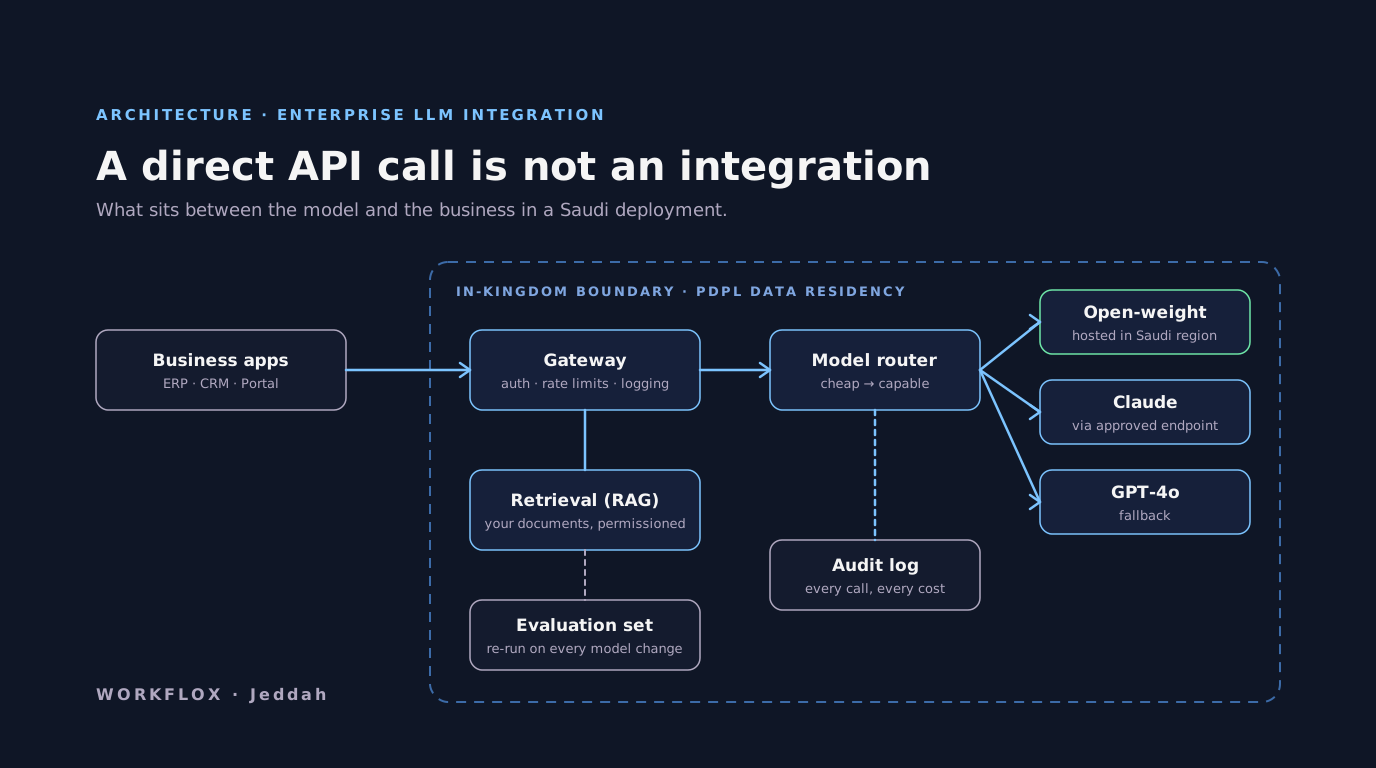
Table of Contents
- Why a Direct API Call Is Not an Integration
- Secure RAG Over Your Private Business Data
- Model Routing to Control Cost and Latency
- Data Residency for Saudi Enterprises
- What this looks like for a Jeddah trading house
- Where the Saudi projects go wrong
- Arabic, and what the evaluation has to cover
- Cost, and what drives it
- The questions to ask before signing with anyone
- What to prepare before the first meeting
- The second system
Jeddah's trading houses, logistics firms, and family-owned conglomerates are asking the same question this year: how do we actually connect GPT-6 or Claude to our existing systems without creating a security or cost problem? Here is the architecture we use for enterprise llm integration projects across Saudi Arabia.
Why a Direct API Call Is Not an Integration
Wiring your app straight to a model provider's API is a demo, not an integration. Every production llm integration needs a gateway layer that handles authentication, rate limiting, prompt logging, and fallback, so a single API outage or cost spike does not take down your customer-facing product.
Secure RAG Over Your Private Business Data
The value of LLM integration for an enterprise is not the model, it is connecting that model securely to your own contracts, inventory records, and shipment data through retrieval-augmented generation, with row-level access control so the model only ever sees what the requesting user is authorized to see.
Model Routing to Control Cost and Latency
Not every query needs your most expensive model. We route simple lookups to smaller, faster models like GPT-6 Luna and reserve Claude or GPT-6 for complex reasoning tasks, cutting API costs significantly without users noticing a difference in quality.
Data Residency for Saudi Enterprises
For regulated industries in Jeddah, logistics, trading, finance, data residency is not optional. We deploy the integration layer on AWS Middle East (Bahrain) infrastructure to keep enterprise data within the Kingdom's compliance boundary. Read more on our LLM Integration services page.
What this looks like for a Jeddah trading house
A trading company we work with on the Jeddah corniche imports building materials and runs on an ERP that predates the founder's children. The question they brought us was whether their sales team could ask, in Arabic, what a customer's outstanding balance and last three orders were, without opening four screens. The answer took eight weeks. A gateway service in front of the model provider. A retrieval index over contracts and the ERP's order history, filtered by the salesperson's territory so nobody sees another region's accounts. A router that sends balance lookups to a small model and contract questions to a larger one. And an evaluation set of two hundred real questions the sales team wrote themselves, scored before launch. The first month's API bill was under SAR 1,100. The sales director's estimate is that each rep saves about forty minutes a day.
Where the Saudi projects go wrong
Three patterns, from projects we have inherited rather than started. The first is a pilot built on a personal API key that becomes production without anyone deciding it should, so there is no gateway, no logging and no way to know what the model has been told. The second is retrieval without permissions: the index contains everything, the model answers from everything, and an intern can ask about executive pay. The third is the residency question left until the security review, at which point the whole integration layer has to move. All three are cheaper to prevent than to fix, and the prevention is the architecture in this article, applied from the first week.
Arabic, and what the evaluation has to cover
The documents in a Jeddah enterprise are mixed: contracts in Arabic, supplier correspondence in English, ERP field names in whatever the implementer chose in 2009. The retrieval layer has to find an Arabic contract clause when the question is asked in English and the reverse, which means the embedding model is chosen for cross-language recall and tested for it. The evaluation set has to include questions in both languages and in the mixed register people actually use on WhatsApp. We have seen integrations that scored well on an English test set and failed in production because nobody had checked the Arabic half.
Cost, and what drives it
A first grounded assistant over one system, with the gateway, retrieval, routing and evaluation described above, runs SAR 15,000 to 37,500 with us and ships in six to ten weeks. Connecting several systems, adding single sign-on and in-Kingdom hosting, and producing the governance documents a regulated buyer needs runs SAR 50,500 to 154,000 over three to five months. The variable that moves the price most is not the model. It is how well documented the systems being connected are, and whether the ERP has an API or only a screen. Ongoing model usage for a department-sized deployment is usually a few hundred dollars a month once routing is in place.
The questions to ask before signing with anyone
Where will the gateway run, and who holds its keys? How are permissions enforced at retrieval time, and can you show me? What is in the evaluation set and who wrote it? Which requests go to which model, and why? What happens when the provider is down? Where does the data live, and can you write that down for our compliance team? A vendor who answers all six in specifics has done this before. A vendor who answers with the name of a model has built a demo.
What to prepare before the first meeting
Three things make the first architecture conversation useful rather than general. A list of the systems the assistant would need to read, with a note on whether each has an API. Fifty real questions your staff would ask it, written by them, in the language they would actually use. And a sentence from your compliance lead on where data may and may not be processed. With those, we can draw the architecture and quote in the first meeting. Without them, the first meeting is about collecting them.
The second system
The first integration proves the pattern. The second, a few months later, is where the architecture pays back: the gateway, the permission model, the routing and the evaluation setup already exist, so connecting the CRM or the document store is weeks rather than months. Jeddah companies that built the first integration as a one-off find the second is another project from scratch. Those that built the layer find it is a configuration change and a new evaluation set. Ask any vendor how their first build makes the second cheaper.
If you are scoping an LLM integration project and want an architecture that survives contact with production traffic, let's talk. Schedule an Executive Architecture Review with WORKFLOX today.
Frequently Asked Questions
What does enterprise LLM integration involve beyond calling the API?
A gateway that handles authentication, rate limits and logging; retrieval over your own documents with permissions enforced at query time; a router that sends simple requests to a cheaper model; an evaluation set from real cases; and audit logging of every call. The API call is the smallest part.
Can our data stay inside Saudi Arabia?
Yes. Open-weight models can run in a Saudi cloud region so no data leaves the Kingdom, and retrieval, logging and the evaluation set live inside the same boundary. Where a hosted frontier model is used, it is reached through an approved endpoint with data handling documented for PDPL.
How long does an enterprise LLM integration take in Jeddah?
A first grounded assistant over one system typically ships in six to ten weeks. Multi-system integrations with in-Kingdom hosting, SSO and governance run three to five months, with procurement and security review usually setting the pace rather than engineering.