Data & Analytics
How to Choose a Data Engineering Company: What to Check Before the Pipeline Gets Built
By Rana Sami Ullah • September 2026
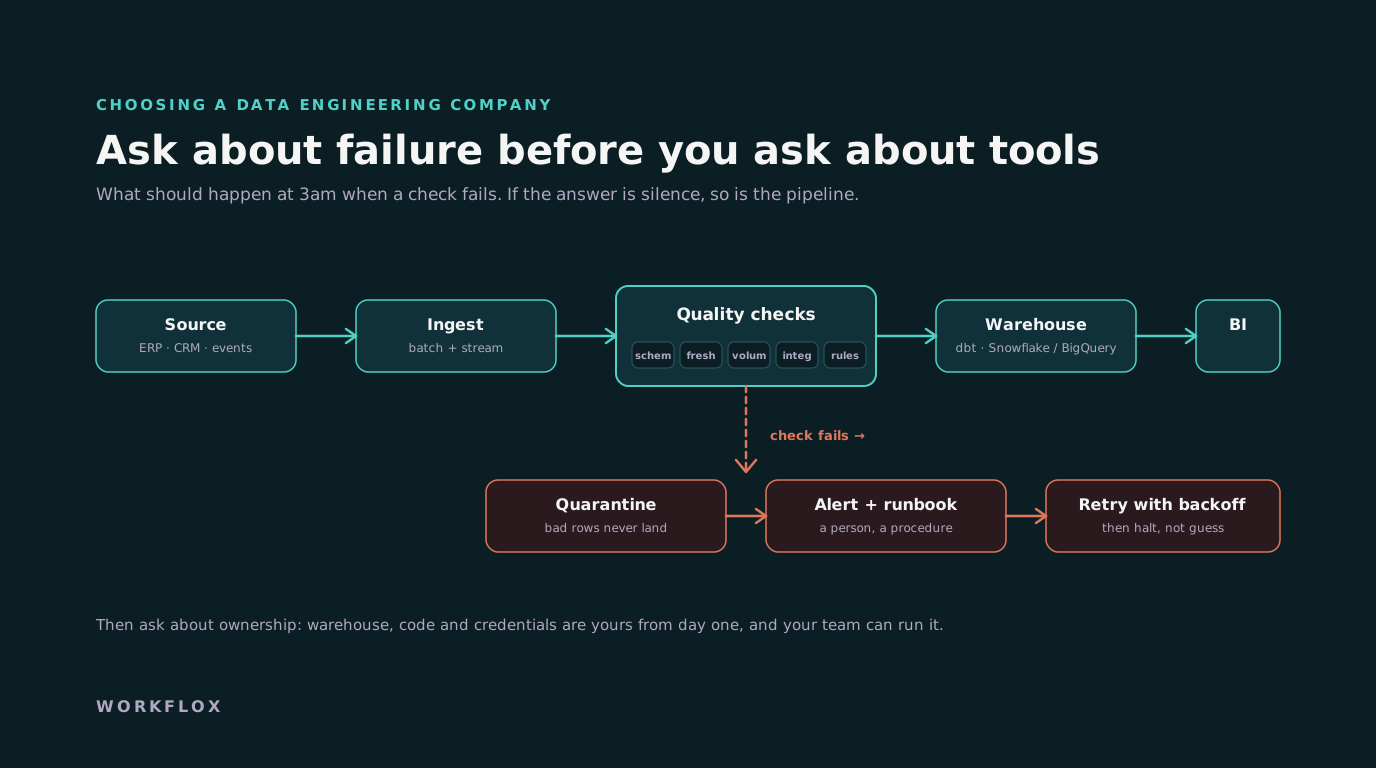
Table of Contents
- Ask about failure before you ask about tools
- Then ask about ownership
- Data engineering tools worth asking about
- The AI angle
- What a good first meeting sounds like
- Questions to ask their reference
- Fixed price or retainer
- A short checklist to bring to the call
- When to change partners
- What good looks like six months in
- What it costs
Choosing a data engineering company is different from choosing an app developer, because the thing you are buying is not visible. A pipeline that runs is indistinguishable from one that runs correctly until the day it does not, and by then the reports have been wrong for a month. These are the checks that tell the difference before you sign.
Ask about failure before you ask about tools
How do you measure data quality, and what happens when a check fails? The right answer names specific checks, schema, freshness, volume, referential integrity, business rules, and a defined path: the pipeline halts or quarantines, someone is alerted, the bad data does not reach the warehouse. A company that has not thought about this has not operated a pipeline.
How are pipelines orchestrated, retried and monitored? Scheduling, dependency handling, retry with backoff, and a dashboard that shows what ran, what failed and what is late. Our own hydrological monitoring platform is built around a processing status matrix for exactly this reason.
What does the on-call story look like at 3am? If the answer is silence, so is the pipeline.
Then ask about ownership
Who owns the warehouse, the code and the credentials? You, from day one. A data engineering company that wants to hold your data platform is holding your business.
Can our team maintain this? Tooling a partner installs and only they understand is a dependency, not a deliverable. Ask what your team will need to know, and whether the company will document to that standard.
What have you built that is still running a year later? Then phone the reference.
Data engineering tools worth asking about
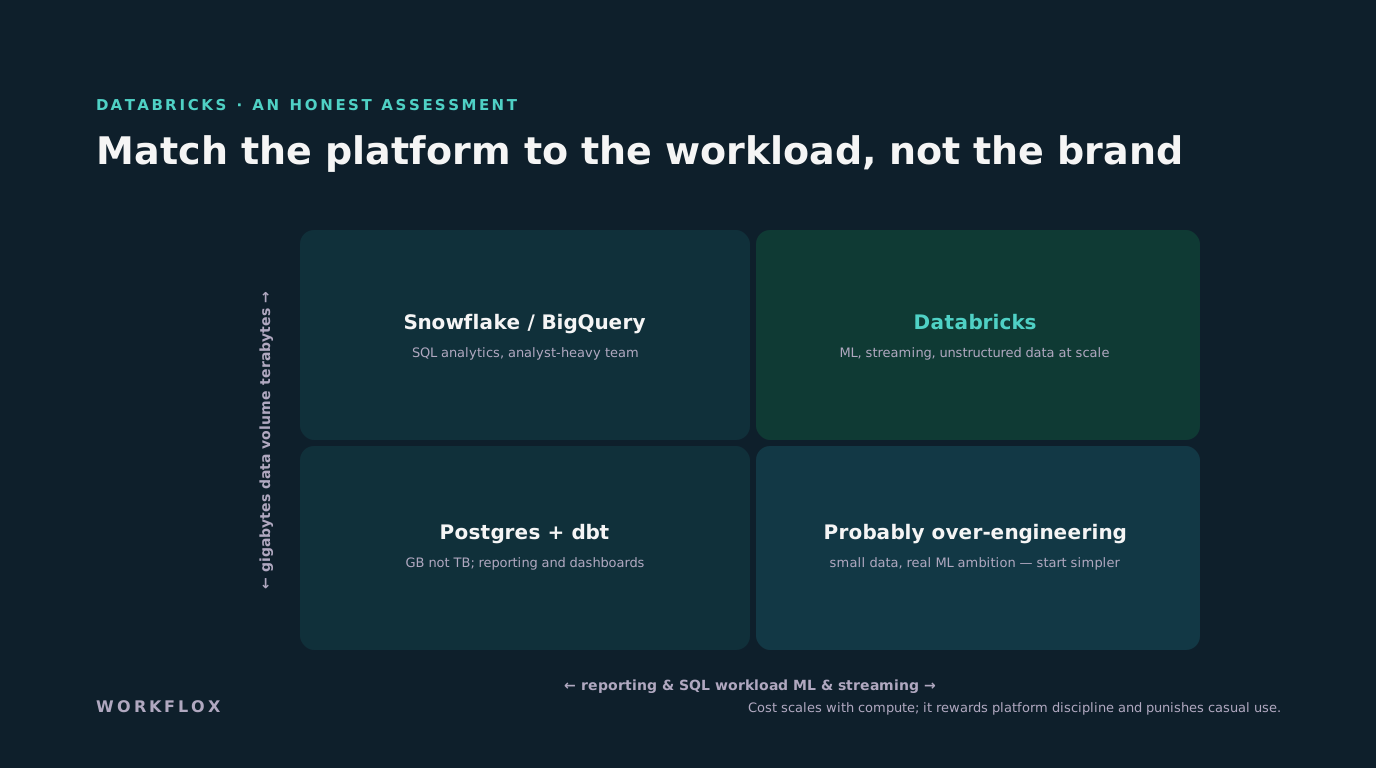
The 2026 production stack most companies converge on pairs a cloud warehouse or lakehouse, Snowflake, BigQuery, Databricks, with dbt for transformation, Airflow or Dagster for orchestration, a quality layer such as Great Expectations, and Kafka or a managed stream for real-time sources. The choice matters less than whether the company can explain why each piece fits your scale and team. Our Databricks assessment is an example of the honest, specific answer you should expect.
The AI angle
If the reason you are building data infrastructure is to feed AI systems, retrieval, agents, forecasting, the requirements tighten. Freshness, lineage and access control become correctness issues rather than hygiene, because a stale or misfiled document surfaces as a confident wrong answer. Our note on agentic AI in data engineering covers what changes.
What a good first meeting sounds like
The best data engineering conversations we have start with the vendor asking about the reports nobody trusts. Every company has them: the Monday dashboard that finance re-checks in a spreadsheet, the customer count that differs by department. Those are the symptoms of pipeline problems, and a company that asks about them is diagnosing rather than pitching. Listen for what they do with the answer. A good partner will want to see the pipeline that feeds the untrusted report, ask where it breaks, and talk about quality checks and ownership before mentioning a single tool. A weaker one will hear the symptom and propose a platform migration. Migrations sometimes are the answer, but rarely in the first meeting.
Questions to ask their reference
When you phone the reference, and you should phone rather than email, skip the satisfaction questions. Ask what happened the first time a pipeline failed after launch. Who noticed, how long it took, and whether the reference's own team could fix it or had to call the vendor. Ask whether the documentation was good enough to onboard a new engineer without the vendor's help. Ask what the monthly cloud bill looked like six months after go-live compared with the estimate. And ask what they would have done differently. A reference who can answer all four in detail has run the system for a while. A reference who talks only about the launch has not had it long enough to know.
Fixed price or retainer
Data engineering work comes in two shapes and they should be priced differently. Building something new, a pipeline, a warehouse model, a platform migration, has a definable end and should be quoted at a fixed price against a written scope, with the integrations listed. Operating what was built is continuous and suits a retainer: monitoring, on-call, the quarterly changes that upstream systems force on you. Be wary of a vendor who wants the build on a retainer, because a retainer rewards the clock. Be equally wary of one who will not offer a retainer at all, because it usually means they do not expect to be around when the pipeline breaks at three in the morning. The arrangement that works is a fixed-price build followed by a modest retainer your own team can cancel once they are comfortable running it.
A short checklist to bring to the call
Print this and tick it during the conversation. Did they ask about the reports your team does not trust? Did they describe what happens when a quality check fails, with specifics? Did they name the tools your team could operate, or only the ones they prefer? Did they say the warehouse, the code and the credentials would be in your name from the first day? Did they offer a reference from a system that has been running for at least a year? Did they quote the build at a fixed price with the integrations listed? Six ticks and you are probably talking to a partner. Three or fewer and you are talking to a contractor who will build something and leave. Neither is wrong for every situation, but you should know which one you are buying before the proposal arrives.
When to change partners
Some signs that the company you already work with is the wrong one. The pipeline breaks and the first you hear of it is from a business user. Changes that should take a day take a fortnight because only one person understands the code. The monthly cloud bill drifts up and nobody can say which job caused it. Documentation is a folder of screenshots. You ask for the credentials and get a reason instead. None of these is fatal on its own, but two or three together mean the platform is theirs in practice even if it is yours on paper. Moving is less painful than it feels, provided the new partner starts by reading what exists rather than proposing to replace it, and provided you insist on ownership from the first day this time.
What good looks like six months in
The platform runs without anyone from the vendor logging in. Your analysts trust the numbers enough to argue about the business rather than the data. A new source can be added in days by your own team or by the vendor at a quoted price. The cloud bill is flat or explained. The documentation is current because it is generated from the code rather than written after it. And the person who built it could leave tomorrow without anything breaking. That is the standard, and it is the one to hold every proposal against.
What it costs
A focused pipeline or integration typically runs $3,500 to $8,000. A data platform, ingestion from several sources, warehouse modelling, transformation, orchestration, quality, monitoring, generally runs $10,000 to $27,000. Modernising off a legacy warehouse scales beyond that, and the honest first step is usually a short assessment. Our data engineering practice quotes fixed price against a written scope, and our data analytics services handle the reporting layer on top.
Frequently Asked Questions
What does a data engineering company do?
Builds and operates the pipelines, warehouses and platforms that move data from source systems into a form the business, and its AI systems, can rely on: ingestion, transformation, quality checks, modelling, orchestration and monitoring. The good ones treat data quality and ownership as the product, not the pipeline code.
How do I evaluate a data engineering company?
Ask how they measure data quality and what happens when a check fails; how pipelines are orchestrated, monitored and retried; whether they build on tools your team can maintain; who owns the warehouse, the code and the credentials; and for a reference where a pipeline has run for a year. A company that talks only about tools and not about failure handling has not operated one.
Which data engineering tools should a company use in 2026?
Depends on scale and team. Common production stacks pair a cloud warehouse or lakehouse, Snowflake, BigQuery, Databricks, with dbt for transformation, Airflow or Dagster for orchestration, and a quality layer such as Great Expectations. The right choice is the one your team can operate; tooling a partner installs and only they understand is a liability.
How much does a data engineering company charge?
A focused pipeline or integration typically runs $3,500 to $8,000. A data platform build, ingestion from several systems, warehouse modelling, transformation, orchestration, quality and monitoring, generally runs $10,000 to $27,000. Platform modernisation off a legacy warehouse scales beyond that. Fixed price against a written scope is the model to insist on.
Related services
Related Articles