Data Engineering
How Agentic AI for Data Engineering is Revolutionizing Pipelines
By Rana Sami Ullah • March 2026

Table of Contents
- What an Agentic Pipeline Does Differently
- Implementing Agentic AI in Data Engineering
- A schema change at two in the morning
- What the agent may and may not do
- Observability comes first
- Where it pays, and where it does not
- Cost and a first step
- Reviewing what the agent did
- Where to be careful
- One line to remember
- What It Runs On
Data engineering pipelines have historically been fragile. API changes, schema drifts, or formatting discrepancies frequently cause ETL scripts to crash, requiring hours of manual debugging. An agent in the pipeline changes what happens next: instead of a crash and a page, the pipeline works out what changed, fixes what it is allowed to fix, and tells someone.
What an Agentic Pipeline Does Differently
In a standard pipeline, an API change triggers an error and halts data flow. In contrast, agentic pipelines use LLM reasoning to interpret the new API schema on the fly, adjust translation keys, run the migration, and notify engineering via Slack while keeping the pipeline active.
Implementing Agentic AI in Data Engineering
When you deploy agentic ai in data engineering, you are essentially introducing specialized agents for separate data tasks:
- Audit Agents: Scan databases for duplicate or corrupted records.
- Schema Migration Agents: Safely rewrite SQL queries and database schemas.
- Anomaly Agents: Flag outliers and transactional fraud in real time.
A schema change at two in the morning
A retail client's nightly pipeline pulled orders from a partner's API. One night the partner renamed a field and added a nested address object. The old pipeline failed at the first row, the on-call engineer was paged, and the morning reports were empty. After the rebuild, the same event plays differently. The load step fails validation, the agent reads the error and a sample of the new payload, works out that the field was renamed and the address restructured, proposes a mapping change, runs it against the last day's data in an isolated environment, compares row counts and totals with the previous day, and, because the change is within the bounds it is allowed, applies it and re-runs the load. The engineer finds a message in the morning describing what happened and what changed. If the comparison had failed, the pipeline would have stopped and the message would have been a request for help.
What the agent may and may not do
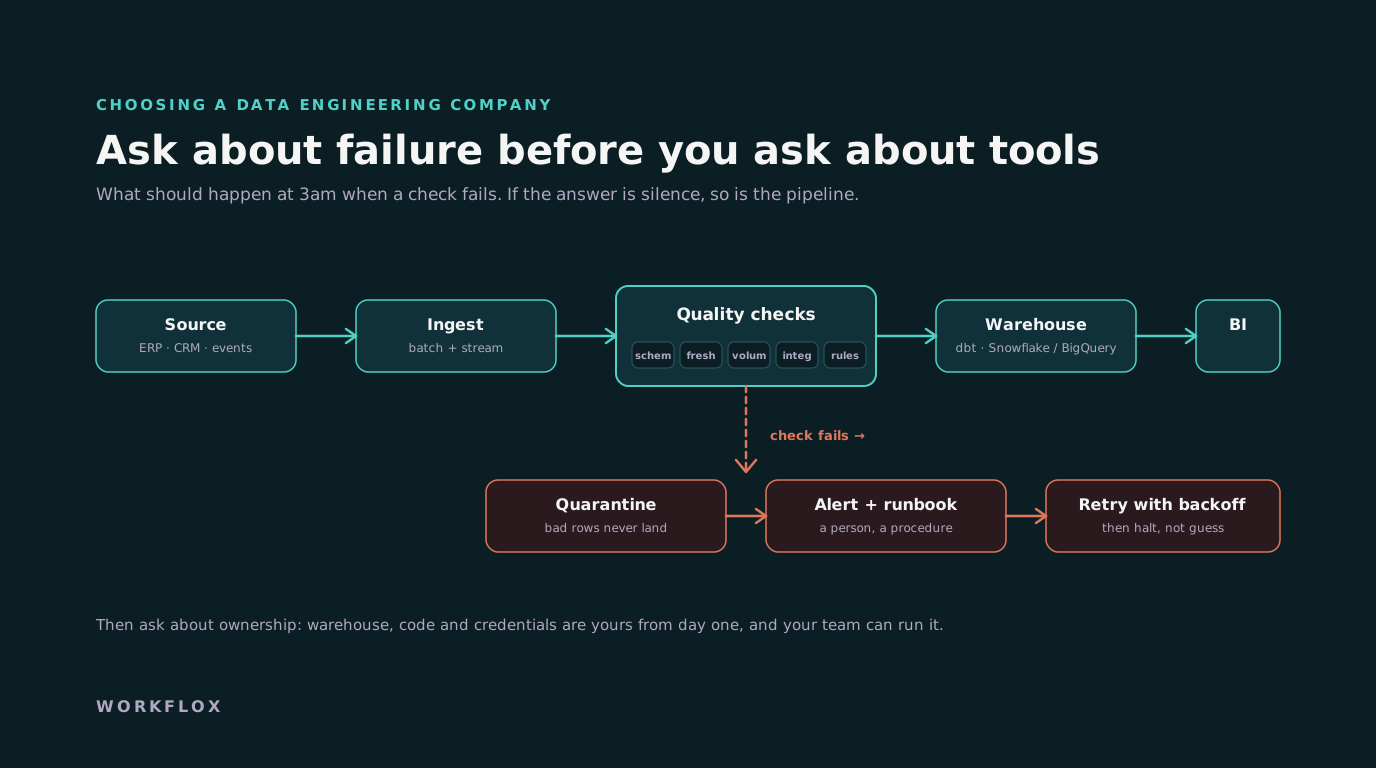
The bounds are the design. An agent may retry a failed job, quarantine rows that fail validation, adapt to a renamed or reordered field, adjust a date or number format, and re-run a load after a fix. It may not change a business rule, drop or alter a table, change how a metric is calculated, or apply a fix whose comparison against the previous run fails. Anything outside the bounds becomes a proposal with the reasoning attached, sent to a person. Every action, inside or outside the bounds, is logged and reversible. Teams that skip the bounds get an agent that fixes the symptom and corrupts the data quietly, which is worse than the crash it replaced.
Observability comes first
An agent cannot fix what it cannot see. Before any agent is added, the pipeline needs data quality checks at each stage, row counts and totals compared against the previous run, schema validation on every input, and a log of every job with its inputs and outputs. Most of the value of an agentic pipeline project turns out to be this layer, because it catches failures that used to reach the business silently. A client who asked for self-healing pipelines found that half their monthly data incidents were detected for the first time by the checks, before the agent had done anything.
Where it pays, and where it does not
Agentic pipelines pay where failures are frequent, well-understood in type and boring to fix: schema drift from partners, format changes in files, flaky APIs, late-arriving data. They do not pay where failures are rare or novel, because the agent has nothing to learn from, or where the cost of a wrong fix is high and the comparison cannot prove correctness. A financial close pipeline should stop and ask. A marketing data feed can be allowed to adapt. Deciding which is which is the first week of the engagement, and it is a conversation with the people who own the data rather than a technical decision.
Cost and a first step
Adding observability, quality checks and an agent for one failure class to an existing pipeline runs $9,500 to $25,000 with us and takes four to eight weeks. Extending it across a platform with several sources and a review process for proposals runs $25,000 to $62,000. The first step costs nothing: list the pipeline incidents from the last quarter, sort by cause, and count. The cause at the top of that list is the first thing to hand to an agent, and the count is the business case.
Reviewing what the agent did
Every morning, someone reads the agent's log. Not every action, but the summary: which jobs failed, what the agent diagnosed, what it fixed within its bounds, what it proposed and is waiting on. The proposals get a decision. The fixes get a spot check. Once a month, the fixes are reviewed as a set, because a class of failure the agent keeps repairing is a sign that something upstream should be fixed properly. This review takes fifteen minutes a day and it is the reason the bounds can be trusted. An agent nobody reviews drifts toward fixing things it should have escalated.
Where to be careful
Financial reconciliation, regulatory reporting and anything where a silently wrong number costs more than a delay should stop and ask rather than adapt. Pipelines feeding machine learning models need extra care, because a plausible-looking fix that shifts a distribution will degrade the model without any error appearing. And an agent should never be given credentials broad enough to alter schemas or drop data, whatever the workflow tool makes convenient. The bounds are enforced by permissions, not by prompts, because a prompt is advice and a permission is a wall.
One line to remember
An agent in a pipeline is worth having when it turns a two-in-the-morning page into a morning message. It is worth avoiding when it turns a visible failure into an invisible one. The bounds, the checks and the review are what keep it on the right side of that line.
What It Runs On
The agent needs an event-driven orchestrator such as n8n or a workflow engine to catch failures, a way to run proposed fixes in isolation, and a place to log every decision. To see how we orchestrate these pipelines, visit our AI automation services page.
Frequently Asked Questions
What is agentic AI in data engineering?
Pipelines where an AI agent detects a failure such as a schema change or a broken API response, reasons about the cause, proposes or applies a fix within set bounds, and re-runs the job, instead of a rigid script that crashes and waits for an engineer. Every action is logged and reversible.
Will an agent change our data without anyone knowing?
Not in a well-designed pipeline. The agent operates inside guardrails: it can quarantine rows, retry, or adapt to a renamed field, but structural changes and anything touching business rules go to a person for approval, with the proposed change and its reasoning attached.
Where do we start with agentic data pipelines?
With the pipeline that fails most often. Add quality checks and observability first, then let an agent handle the recurring failure class, such as schema drift from one upstream source. Measure the hours saved before expanding to the next pipeline.
Related services
Related Articles