AI Automation
GoHighLevel Automation Beyond the Workflow Builder: n8n, API Integrations and AI Agents
By Rana Sami Ullah • October 2026
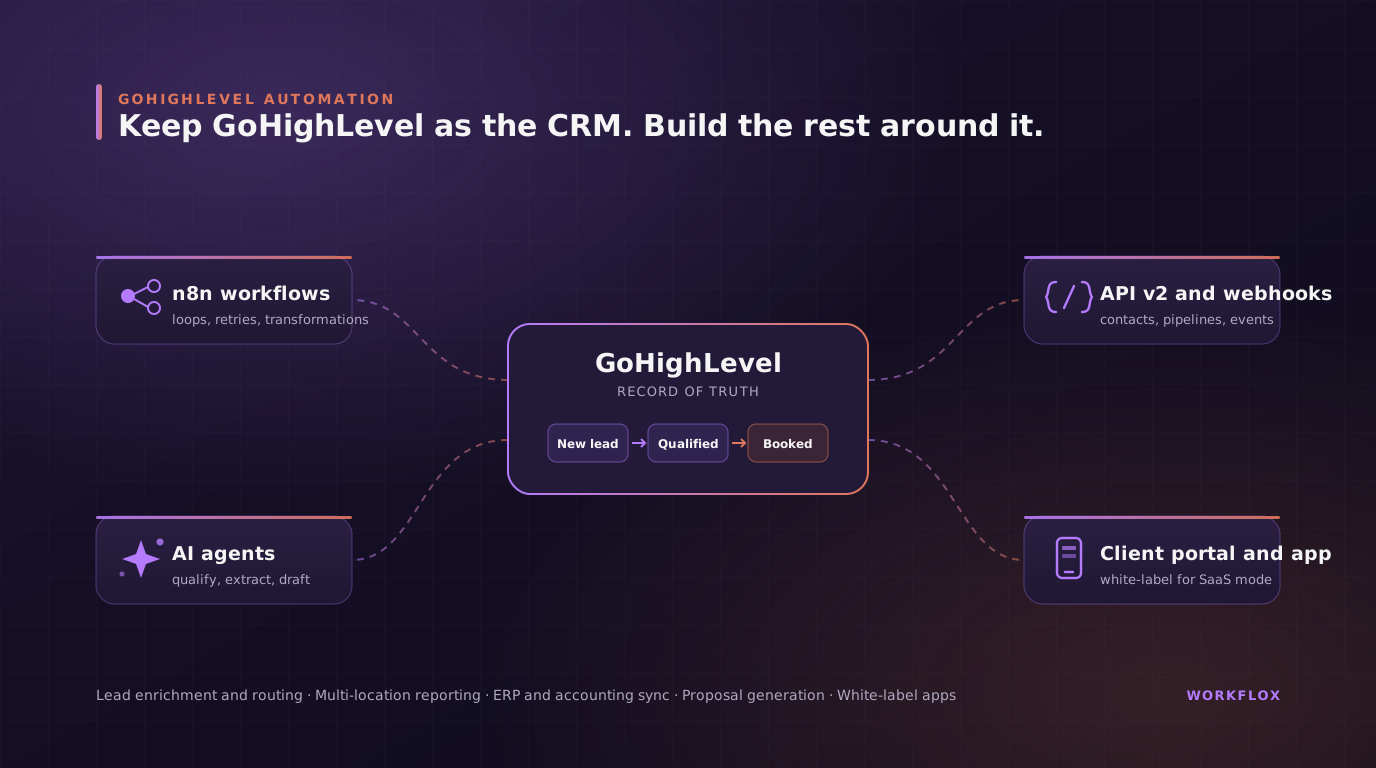
Table of Contents
- Where native GoHighLevel workflows stop
- What the GoHighLevel API makes possible
- n8n as the integration layer around GoHighLevel
- AI agents that work inside GoHighLevel pipelines
- Five builds agencies ask for most
- White-label and SaaS-mode considerations
- What it costs and how long it takes
- How to brief a GoHighLevel developer
GoHighLevel has become the operating system for a large share of marketing agencies and the local businesses they serve. Contacts, pipelines, calendars, SMS and email, funnels and the workflow builder all sit in one place, and for a single-location business that is often enough.
The questions we get are from the people who have outgrown that point. An agency running forty sub-accounts that needs reporting across all of them. A franchise that wants GoHighLevel to talk to its accounting system. A SaaS-mode agency that wants a branded client app instead of the stock portal. A sales team that wants leads qualified before a human sees them, not just tagged.
None of that is a reason to leave GoHighLevel. It is a reason to build around it. This guide covers what the native workflow builder can and cannot do, what the API opens up, where n8n fits, what an AI agent inside a GoHighLevel pipeline looks like, and what the common builds cost.
Where native GoHighLevel workflows stop
The workflow builder is good at what it was designed for: trigger on a form, a tag, a pipeline stage or an appointment, then send messages, update fields, wait, and branch on simple conditions. Most nurture sequences, appointment reminders and review requests need nothing else.
It becomes a constraint in four situations.
The first is logic that depends on data GoHighLevel does not hold. A workflow can branch on a contact field, but it cannot ask your inventory system whether a product is in stock, or check a property listing before replying to an enquiry.
The second is anything across sub-accounts. Workflows live inside one location. Agency-level reporting, cross-location lead distribution and shared suppression lists all need something that can read and write across many locations at once.
The third is transformation. If a lead arrives with a free-text message, a photo of a document, or a PDF, the workflow builder cannot read it. It can only route on fields that already exist.
The fourth is error handling. When an external step fails, a native workflow has limited ways to retry, alert someone and resume. For a message sequence that is fine. For a step that creates an invoice, it is not.
What the GoHighLevel API makes possible
GoHighLevel's API v2 exposes contacts, opportunities, pipelines, calendars, conversations, custom fields, users and locations, with OAuth-based apps that an agency can authorise across its sub-accounts. Webhooks push events out as they happen, so an external system does not have to poll.
In practice this means any system that can call an HTTP endpoint can treat GoHighLevel as the record of truth. An ERP can create an opportunity when a quote is accepted. A property portal can push enquiries straight into the right pipeline stage. A warehouse system can update a custom field when an order ships, which then triggers the native workflow that sends the tracking message.
Two cautions from experience. Rate limits apply per app and per location, so a bulk sync that works on one sub-account can stall across fifty unless it is queued. And custom fields are easy to create and hard to govern. Agree a naming scheme before the first integration, or the third one will be mapping around the mess left by the first two.
n8n as the integration layer around GoHighLevel
We use n8n as the layer between GoHighLevel and everything else, for three reasons.
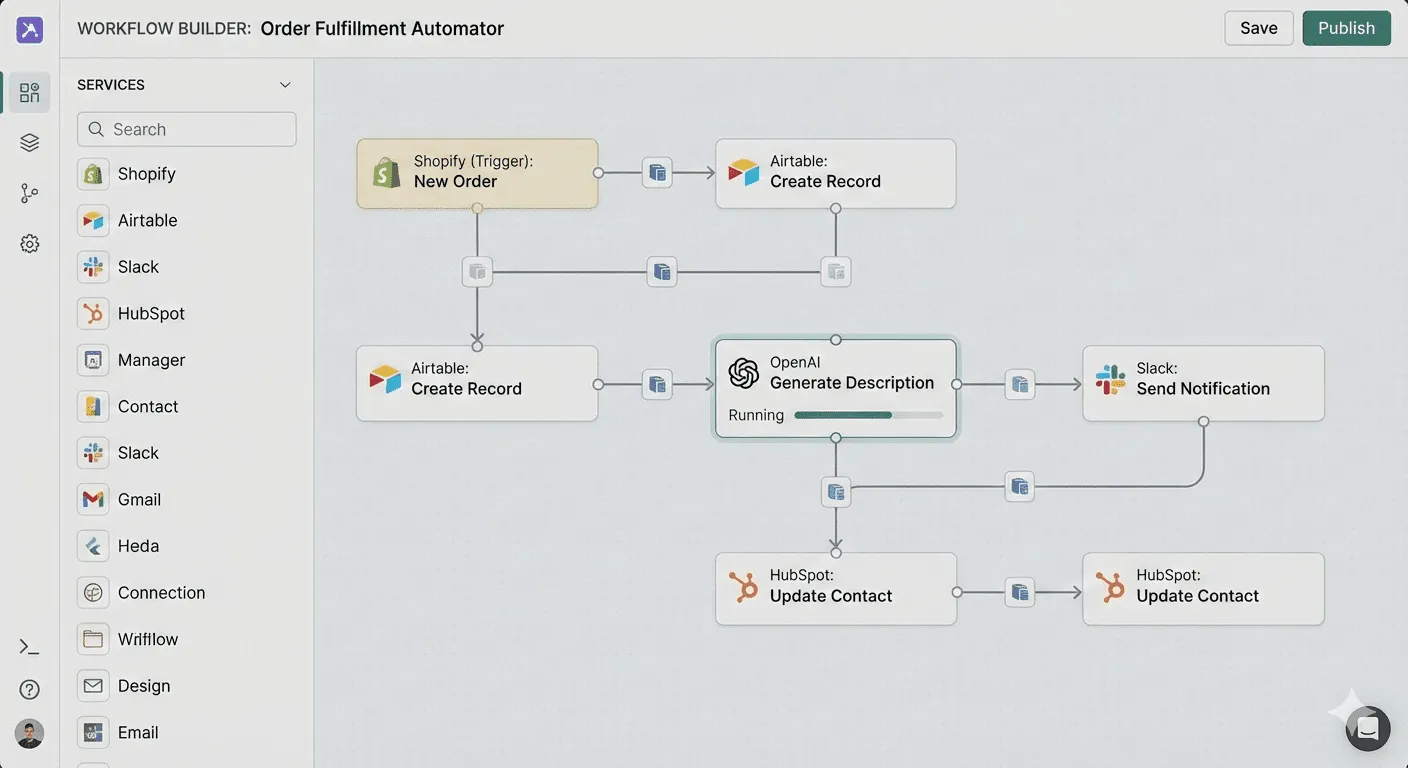
It handles the parts the workflow builder cannot: calling other APIs, transforming data, looping over records, waiting on conditions and retrying with backoff. A GoHighLevel webhook triggers an n8n workflow, n8n does the work, and the result is written back through the API as fields, tags or a pipeline stage. From inside GoHighLevel it looks like the native automation did it.
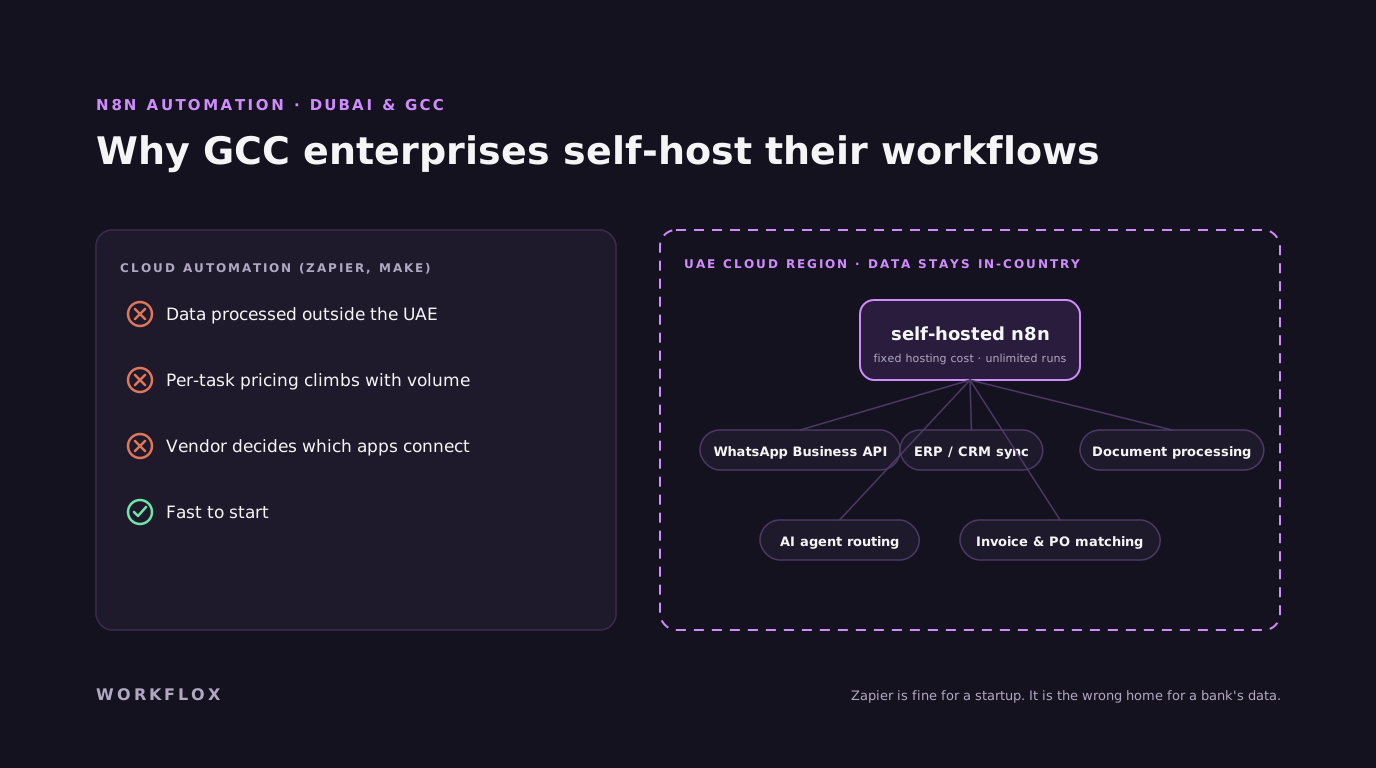
It can be self-hosted. Agencies serving regulated clients, or clients outside the US, often need to know where lead data is processed. A self-hosted n8n instance in the client's own cloud region answers that question in one sentence.
And it is priced by execution rather than by task or by seat, which matters once volumes grow. A workflow that enriches every inbound lead across forty locations runs tens of thousands of times a month. On per-task pricing that becomes a line item. On a self-hosted instance it is server cost.
Zapier and Make both work with GoHighLevel too, and we use them where a client already runs them. For anything with loops, large volumes or custom code steps, n8n is the better fit, and our AI workflow automation practice runs it as a managed service where the client does not want to operate it.
AI agents that work inside GoHighLevel pipelines
GoHighLevel's own conversational AI can answer questions and book appointments, and for a simple booking flow it does the job. An agent built outside it is for the cases where the reply depends on reasoning over your own data or on taking an action in another system.
A lead qualification agent is the most common. The inbound message, form and any attachment are passed to a model with the business's qualification rules and, where useful, retrieval over its pricing, service area and availability. The agent returns a score, a reason, suggested next step and extracted fields, which n8n writes back to the contact. Hot leads move to a stage that triggers an immediate call task. Unqualified leads get a polite close. The salesperson sees a short summary instead of a raw transcript.
A follow-up drafting agent reads the conversation history and the pipeline stage, drafts the next message in the business's voice, and leaves it for a person to send or edit. This keeps a human in the loop while removing the blank-page delay.
A document agent reads what customers send, such as a photo of an insurance card, a quote from a competitor or a floor plan, extracts what matters, and fills the custom fields the workflow needs.
The guardrails are the same as in any AI agent build: a written list of what the agent may do on its own, a review queue for everything else, a log of every action with the model's reasoning, and an evaluation set of real past conversations run before launch and after every prompt change. Agents that skip these steps are the ones that send a discount to a competitor's test enquiry.
Five builds agencies ask for most
Lead enrichment and routing. A webhook fires on contact creation, n8n enriches the record from a data provider, the agent scores it, and the lead is assigned to the right location and user by rules the agency can edit in a sheet rather than in code.
Multi-location reporting. A nightly job pulls opportunities, appointments and conversation stats from every sub-account into a warehouse or a Google Sheet, and a dashboard shows the agency which clients are converting and which locations are leaking leads.
Accounting and ERP sync. Won opportunities become invoices in Xero, QuickBooks or an ERP; paid invoices update the opportunity and trigger the onboarding workflow. Each direction has its own retry and alert path.
Custom client portal or mobile app. For SaaS-mode agencies, a branded web portal or mobile app on top of the API, showing the client their leads, bookings and reports without exposing the GoHighLevel interface.
Proposal and document generation. A pipeline stage change assembles a proposal from templates, pricing rules and the contact's data, generates the PDF, sends it through GoHighLevel's messaging and records the open.
White-label and SaaS-mode considerations
Agencies reselling GoHighLevel under their own brand have two extra questions. The first is whose API app the integration runs under. An agency-level marketplace app authorised across sub-accounts is cleaner than per-location API keys, and it survives staff changes. The second is data separation. Anything that reads across locations must be built so one client's data can never appear in another's report, and that should be tested, not assumed.
Branded mobile apps deserve a realistic expectation. The app stores' review process, push notification setup and ongoing updates are a product commitment, not a one-off build. We scope them as such.
What it costs and how long it takes
A focused build, one workflow with a couple of integrations, such as lead enrichment and routing for one agency, typically runs $4,000 to $10,000 and ships in two to four weeks.
Connected builds across several systems, such as reporting across sub-accounts plus accounting sync with an admin view and monitoring, run $10,000 to $25,000 over six to twelve weeks. Each additional workflow on the same instance is usually $2,000 to $5,000.
A focused AI agent inside a pipeline, with retrieval and human review, is $4,000 to $10,000 and takes four to six weeks. A custom client portal starts at the web MVP band, $3,800 to $11,000, depending on what it shows and who can log in.
Every figure is a fixed price against a written scope, with 60 days of support after launch. Ongoing monitoring is a separate monthly plan.
How to brief a GoHighLevel developer
Bring four things to the first call. The list of sub-accounts and which ones the build touches. The systems on the other side of the integration and whether they have an API. Three real examples of the leads, documents or records the automation must handle, including an ugly one. And the rule for what should happen when a step fails, because that decision shapes the build more than any feature.
With those, a developer can scope the work in a week and quote it fixed. Without them, the quote is a guess, and the build will be re-scoped mid-way.
Frequently Asked Questions
Can you integrate GoHighLevel with n8n?
Yes. GoHighLevel's webhooks trigger n8n workflows, and n8n writes results back through the GoHighLevel API as contact fields, tags, notes or pipeline stage changes. We run n8n self-hosted in the client's own cloud region where lead data must stay in a specific country, or on n8n's cloud where that is not a concern.
Does GoHighLevel have an API for custom development?
Yes. API v2 covers contacts, opportunities, pipelines, calendars, conversations, custom fields, users and locations, with OAuth apps that an agency can authorise across sub-accounts and webhooks that push events out in real time. Rate limits apply per app and per location, so high-volume syncs are queued rather than fired all at once.
Can an AI agent qualify leads inside GoHighLevel?
Yes. The inbound message and form data go to an agent that applies the business's qualification rules, optionally with retrieval over pricing and service area, and returns a score, a reason and extracted fields. These are written back to the contact and the pipeline, so the native workflows take over from there. A human review queue handles anything the agent is unsure about.
What does a GoHighLevel automation project cost?
A focused single-workflow build is typically $4,000 to $10,000 and ships in two to four weeks. Connected automation across several systems with monitoring runs $10,000 to $25,000. A lead qualification agent is $4,000 to $10,000. All figures are fixed price against a written scope.
Do you build white-label apps on top of GoHighLevel?
Yes, for agencies running SaaS mode. A branded web portal or mobile app shows clients their leads, bookings and reports through the API without exposing the GoHighLevel interface. We scope the app store submission, push notifications and ongoing updates as part of the project rather than treating the app as a one-off build.