AI Automation
Scaling Dubai Enterprises with n8n Automation
By Rana Sami Ullah • February 2026

Table of Contents
- The Hidden Cost of Manual Data Entry in UAE Corporations
- Why Legacy ERPs Create Data Silos
- Zapier vs. Make vs. n8n: Choosing the Right Tool for Enterprise Scale
- Self-Hosted n8n and UAE Data Rules
- Real-World Use Cases: CRM Synchronization & AI Agent Routing
- The onboarding workflow, rebuilt
- What to automate first in a UAE enterprise
- Running n8n in the UAE properly
- Where the language model fits
- Cost, and the return
- Who owns the workflows
Walk into the operations floor of a Dubai trading company or property group and you will find the same thing: capable people re-typing data between a legacy ERP, a CRM, WhatsApp and a spreadsheet. The work gets done, slowly, with errors nobody sees until a customer does. This article is about replacing that layer with self-hosted n8n workflows that keep the data inside the UAE and remove the manual steps for good.
The Hidden Cost of Manual Data Entry in UAE Corporations
Consider a standard enterprise operation: a new corporate client is onboarded. In a traditional setup, the sales team manually inputs the contract data into Salesforce. An administrative assistant then duplicates this data into an invoicing system, while HR creates the corresponding vendor profiles. Finally, the project management team manually provisions Microsoft Teams channels and Jira boards. Four people have typed the same contract into four systems, and each of them has had the chance to type it differently.
Why Legacy ERPs Create Data Silos
Many GCC enterprises attempt to solve these inefficiencies by investing millions in massive, monolithic Enterprise Resource Planning (ERP) software. Unfortunately, legacy ERP systems are notoriously rigid. Without a central nervous system bridging applications like HubSpot, SAP, and Zendesk, critical corporate data becomes trapped in isolated silos, and management ends up reading a report assembled by hand on the last day of the month.
Zapier vs. Make vs. n8n: Choosing the Right Tool for Enterprise Scale
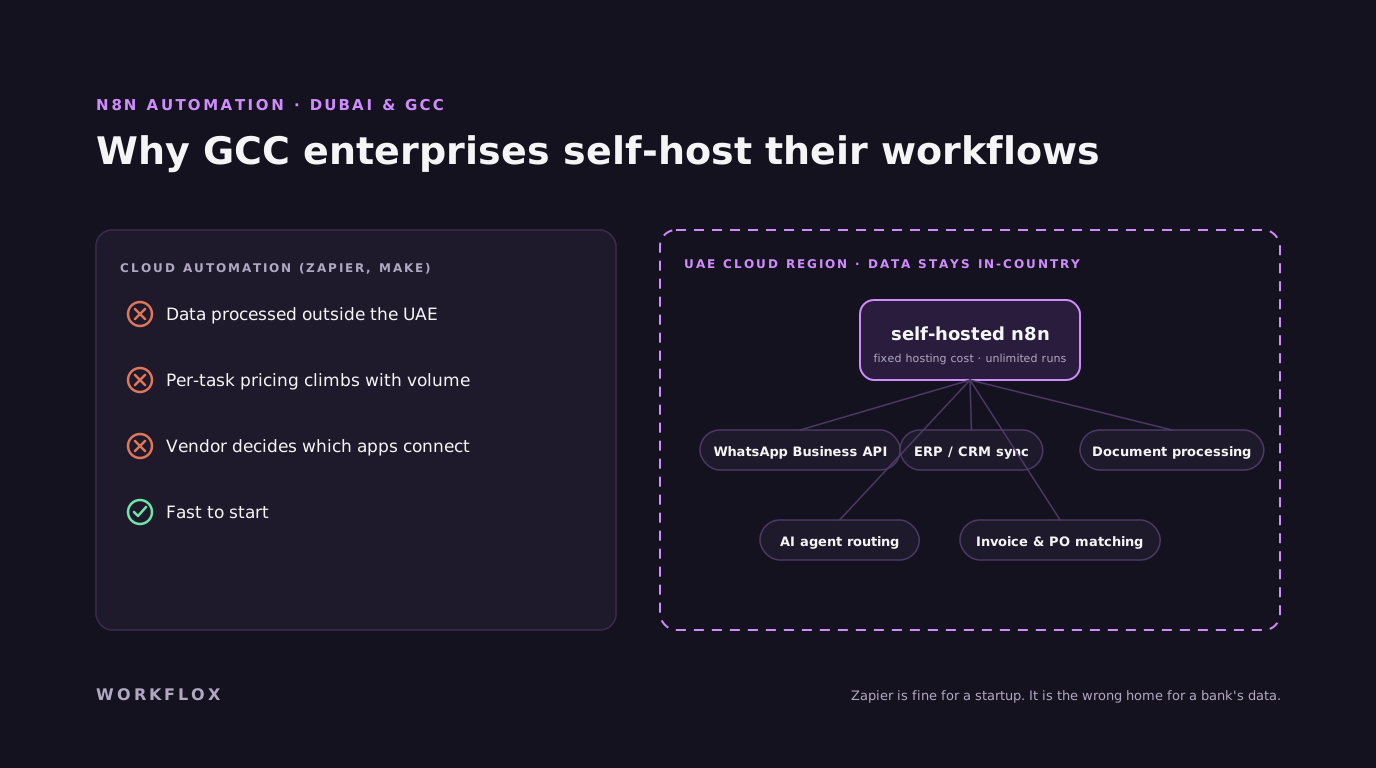
To bridge these data silos, we have settled on n8n for most enterprise work, for two reasons. Zapier's rigid pricing model punishes high-volume data transfers, and Make operates strictly as a cloud-hosted SaaS, presenting significant security hurdles. n8n combines visual node-based mapping with the absolute code-level control required by senior developers, and it does not charge per task.
Self-Hosted n8n and UAE Data Rules
The most significant advantage of n8n for UAE corporations is data sovereignty. By utilizing a self-hosted n8n infrastructure deployed directly onto your private AWS Middle East servers, your data never leaves your control. When protecting localized data, partnering with an enterprise AI automation agency in Dubai means the data residency question is settled before the first workflow is built.
Real-World Use Cases: CRM Synchronization & AI Agent Routing
Large real estate brokerages utilize n8n to ensure zero data drift. When a high-net-worth lead submits a form, n8n instantly triggers, cross-references Salesforce, enriches the profile via LinkedIn APIs, and dynamically assigns the lead via Slack in under three seconds.
The onboarding workflow, rebuilt
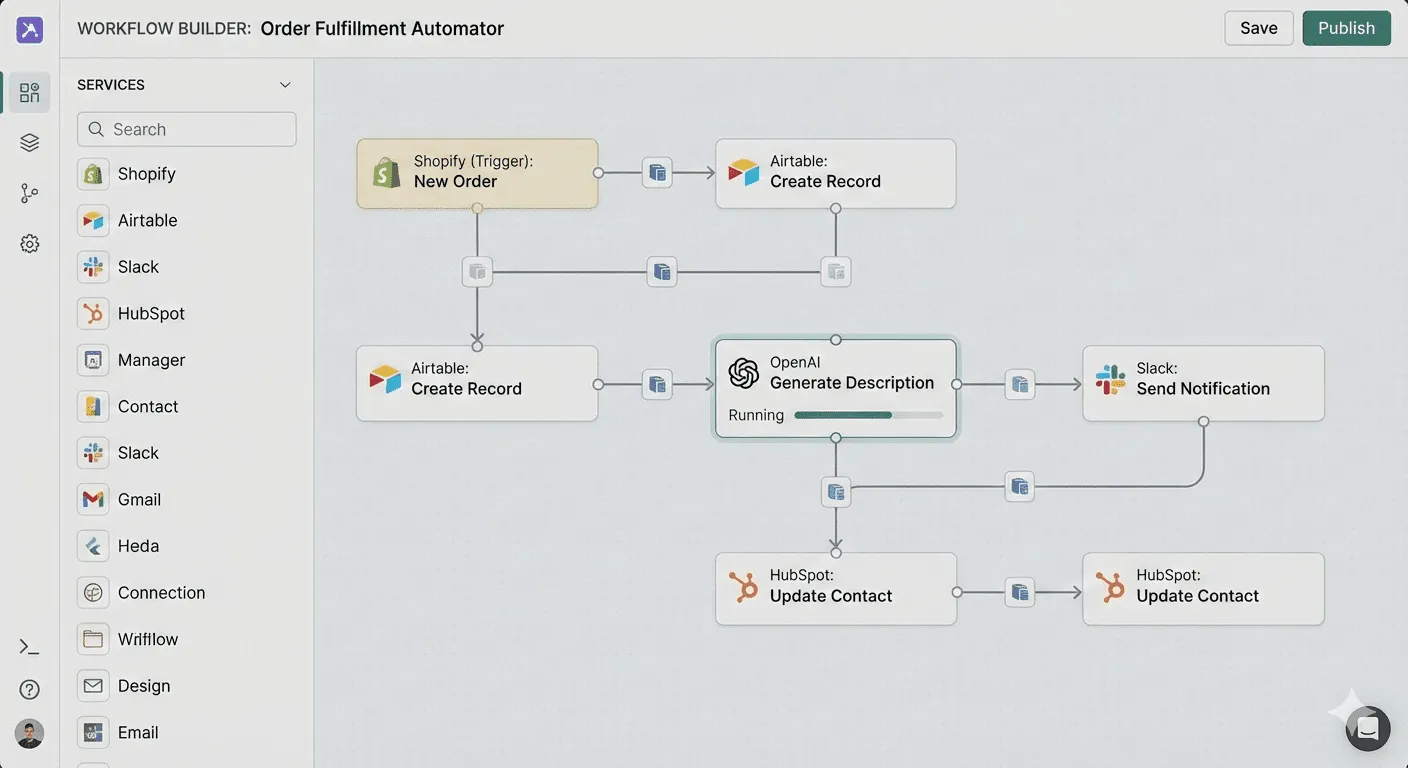
Take the corporate onboarding above and run it through n8n instead. The signed contract lands in a shared inbox or a CRM stage change. n8n picks it up, extracts the client details with a language model step, creates the account in the invoicing system, opens the vendor profile in the HR tool, provisions the Teams channel and the Jira board from templates, and posts a summary to the account manager with links to each. Where a field cannot be read with confidence, the workflow stops and asks a person, showing the extracted values next to the document. A Dubai property group we did this for went from a two-day onboarding with four handoffs to about twenty minutes, most of it the review step. The workflow took eleven working days to build and test.
What to automate first in a UAE enterprise
The first workflow should be high volume, low ambiguity and owned by someone who feels the pain daily. In most Dubai companies that is one of three: inbound lead handling from web forms, WhatsApp and property portals into the CRM; invoice and delivery-note matching between the ERP and accounting; or employee onboarding across HR, IT and finance. Start with one, measure the hours it took before and the hours it takes after, and use that number to justify the second. Companies that start with the most complex process because it is the most impressive usually stall there.
Running n8n in the UAE properly
Self-hosting is only an advantage if it is done well. The instance runs in a UAE region on AWS, Azure or a local provider, behind single sign-on, with credentials stored in the platform's vault rather than in workflow nodes. Workflows are exported to version control so a change can be reviewed and reverted. Every run is logged with its inputs and outputs, and failures alert a named person rather than an inbox. Backups run nightly and have been restored at least once to prove they work. This is a few days of setup and a few hours a month of upkeep, and it is the difference between an automation platform and a single point of failure.
Where the language model fits
Most enterprise workflows in Dubai are plumbing: move a record, transform a field, notify a person. A language model step earns its place where the input is unstructured: a contract PDF, an emailed purchase order, a WhatsApp message in mixed Arabic and English. The model extracts the structured fields, the workflow validates them against business rules, and anything below a confidence threshold goes to a person. Used this way the model calls are cheap, a few cents per document, and the workflow stays predictable. Used as a general-purpose brain that decides what to do next, the workflow becomes hard to test and harder to trust.
Cost, and the return
A first enterprise workflow, including the n8n instance set up properly in a UAE region, typically runs AED 14,500 to 36,500 with us and takes two to four weeks. Each additional workflow on the same instance is usually AED 7,300 to 18,500 depending on the systems involved. Hosting is a fixed few hundred dirhams a month whatever the volume. Against that, a workflow that removes ten hours of manual data entry a week pays for itself in the first quarter, and the second and third workflows, which reuse the same integrations, pay back faster still.
Who owns the workflows
The instance, the credentials and the workflow definitions belong to the company, in its own cloud account, from the first day. We build inside that account, export every workflow to the company's version control, and write a runbook the IT team can follow without us. Some clients keep us on a monthly arrangement for monitoring and new workflows; others take it in-house after the third one. Both are fine. An automation platform that only the vendor can operate is a dependency, not an asset, and Dubai enterprises have bought enough of those.
If your operations team is still moving data between systems by hand, the first workflow usually pays for itself within a month. Talk to us about which one to automate first, and where the n8n instance should live.
Frequently Asked Questions
Why self-host n8n instead of using Zapier or Make?
Data residency and cost. A self-hosted n8n instance in a UAE cloud region keeps customer and financial data inside the country, which matters under UAE data protection rules, and it runs unlimited workflows for a fixed hosting cost rather than per-task pricing that climbs with volume.
What do Dubai companies usually automate first with n8n?
CRM synchronisation between web forms, WhatsApp and the sales system, invoice and document handling between the ERP and accounting, and routing of inbound leads or tickets to the right person. Each of these removes hours of manual data entry every week.
Who maintains a self-hosted n8n instance?
Either your IT team, with our runbooks and monitoring, or WORKFLOX under a managed arrangement. Updates, backups, credential rotation and workflow monitoring are the recurring tasks, and they take a few hours a month for a typical enterprise deployment.
Related services
Related Articles