AI Technology
20 Conversational AI Use Cases, Ranked by How Much They Actually Deflect
By Rana Sami Ullah • June 2026
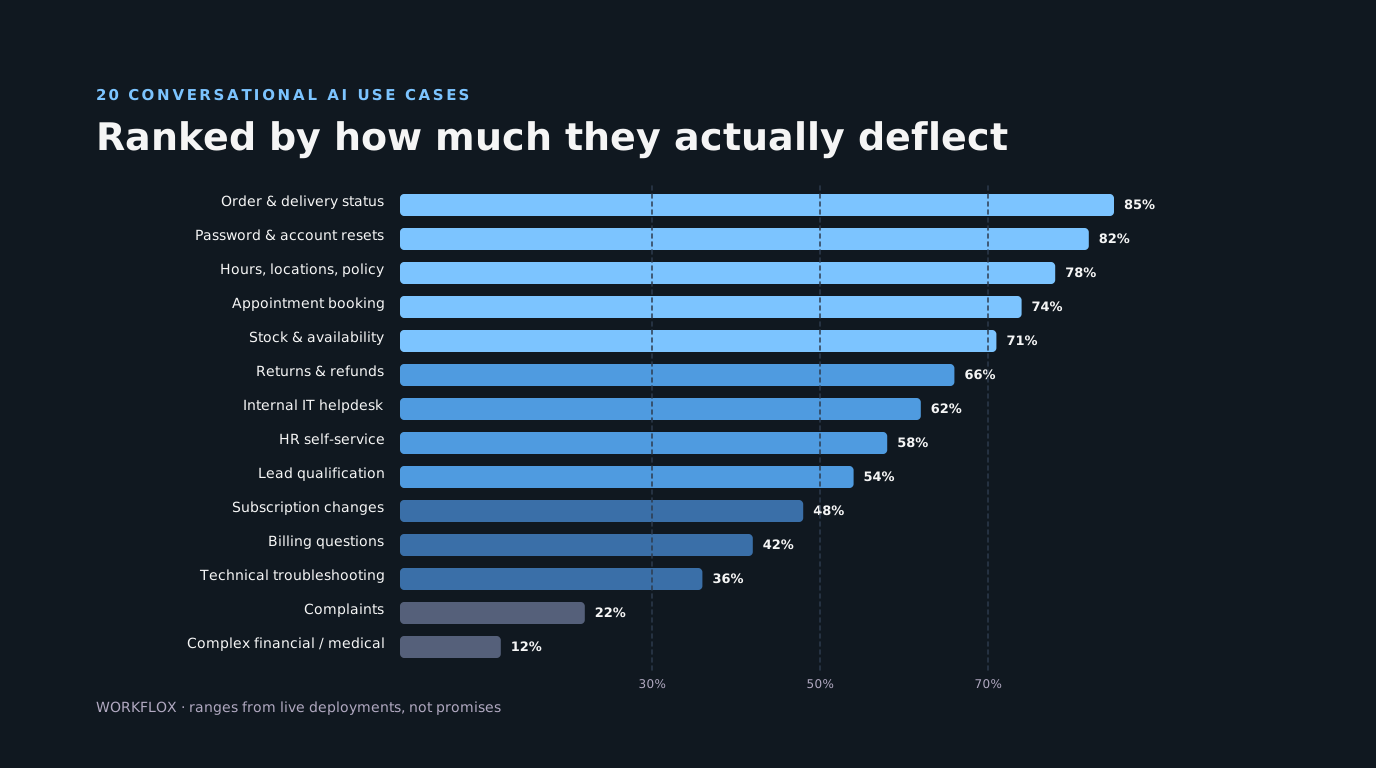
Table of Contents
Lists of conversational AI use cases are easy to find and almost all of them are unranked, which makes them useless for deciding what to build first. Deflection rate, the share of conversations a bot fully resolves without a human, is the number that decides whether a use case pays for itself. Here are twenty, ordered by what they realistically achieve on well-built deployments, with a note on what each needs to work.
The figures are ranges from live deployments and published benchmarks, not promises. Your topic mix decides where your blended number lands.
Tier one: 70–90% deflection
1. Order and delivery status. Deterministic, high volume, and the data is in your order system. Needs one read integration and a clear "not found" path.
2. Password and account resets. Nearly fully automatable with an identity check. The constraint is security policy, not technology.
3. Opening hours, locations and policy questions. Pure retrieval over your own content. Fails only when the content is wrong or missing, which is a content project, not a bot project.
4. Appointment booking and rescheduling. Needs write access to the calendar or booking platform and a conflict-handling rule. Clinics, salons, trades and services businesses see the fastest payback here.
5. Store, stock and product availability. Read integration to inventory; deflects the "do you have this" call that retail and pharmacies handle hundreds of times a day.
6. Returns and refund initiation. Rule-based up to a value threshold, then a human boundary. Works when the policy is actually written down.
Tier two: 50–70%
7. Internal IT helpdesk. VPN, access requests, software installs. High deflection, but internal users tolerate less friction than customers.
8. HR self-service. Leave balances, payslips, policy lookups. Sensitive data means the identity layer matters more than the model.
9. Lead qualification. Budget, timeline, need, authority, captured conversationally and written to the CRM. Deflection here means fewer unqualified leads reaching sales, not fewer conversations. Our chatbot case study shows the numbers from one deployment.
10. Onboarding and setup guidance. Step-by-step help for a product's first week. Strong where the steps are documented; weak where every account is different.
11. Subscription changes. Upgrade, downgrade, pause. Needs billing integration and a clear boundary on anything involving money over a threshold.
12. Shipping cost and delivery estimates. Deterministic once the rules are encoded; often reveals that the rules were never written down.
Tier three: 30–50%
13. Technical troubleshooting. Works for known issues with documented fixes; falls off sharply on anything novel. Best paired with a fast handoff.
14. Billing questions. Explaining a charge is retrieval; disputing one is judgement. Deflection depends on how the two are separated.
15. Pre-sales product questions. Comparison, compatibility, fit. Good grounding gets you to the mid-range; the sale itself usually still needs a person.
16. Multilingual customer service. The same use cases as above, in Arabic-English or Urdu-English switching. Deflection drops if language is handled as translation rather than native understanding. See our note on WhatsApp chatbots in the UAE.
17. Event, travel and hospitality requests. Booking changes deflect well; local recommendations and special requests less so.
Tier four: under 30%, triage, not resolution
18. Complaints. A bot should capture, classify and route, then hand off with context. Attempting to resolve complaints automatically damages trust faster than it saves cost.
19. Complex financial or medical queries. Regulatory limits on what a bot may say cap deflection by design. The value is accurate routing and pre-collected information.
20. Anything requiring negotiation or discretion. Contract terms, exceptions, goodwill gestures. Route fast, route well, and let a person decide.
How the numbers were measured
Deflection here means a conversation that ended without a human being involved and without the customer returning on the same issue within seven days. Both halves matter. A bot that ends conversations by frustrating people into giving up scores well on the first half and badly on the second, and the second is the one that costs money. The figures are from our own deployments and from clients' reporting, not from vendor case studies, and they are ranges because the same use case deflects differently depending on how good the underlying data is. Order status deflects ninety percent when the tracking API is reliable and forty percent when it is not, and the difference is not the bot.
What moves a use case up a tier
Three things, in order of effect. Integration depth: a use case where the bot can read from or act in the system of record jumps at least one tier compared with the same use case answered from documentation alone. Quality of the source content: half of tier-three cases are tier two with a rewritten help centre. And a clean handoff: when the bot passes a transcript and its own best guess to an agent, the customer does not repeat themselves, the agent resolves faster, and the customer is less likely to return. Nothing on that list is about the model. Teams that try to move a use case up a tier by switching to a larger model are usually disappointed.
Use cases that look easy and are not
Refunds and cancellations sit lower than their simplicity suggests, because the policy has exceptions, the customer is often upset, and a wrong automatic decision is expensive in both money and goodwill. The right pattern is for the bot to gather the details and pre-approve the clear cases against the policy, then hand the rest to a person with everything filled in. Appointment scheduling looks like a lookup and is actually a negotiation, with constraints on both sides, and it deflects well only when the calendar system exposes availability cleanly. Account changes that touch identity, such as a new phone number or a password reset on a financial account, should hand off deliberately whatever the bot could technically do.
Sequencing a rollout
Start in tier one with the two or three highest-volume intents, because they establish trust with the support team and the customers and they show a number within a month. Add tier two once the integrations are stable. Treat tier three as a content project first and a bot project second. Leave tier four to triage: collect the details, route to the right queue, and let people resolve. A common mistake is to launch with every intent switched on, so the bot's first impression is set by its weakest cases. Launch narrow, measure, widen. A Gulf retailer we work with launched with order status and returns only, on WhatsApp, and reached forty percent overall deflection in six weeks before adding anything else.
What deflection is worth
A support contact handled by a person costs somewhere between $4 and $12 in most businesses once salary, tooling and management are counted, and more in regulated industries. A company handling five thousand contacts a month that deflects forty percent saves between $8,000 and $24,000 a month, and the figure grows with volume. Against that, a grounded bot with the integrations that make tier one and two possible costs $10,000 to $25,000 to build with us, plus a retainer to keep it accurate. The arithmetic is not subtle. What makes it fail is choosing use cases from the bottom of the list first, or building a bot that cannot reach the systems that make the top of the list possible.
Reading the list
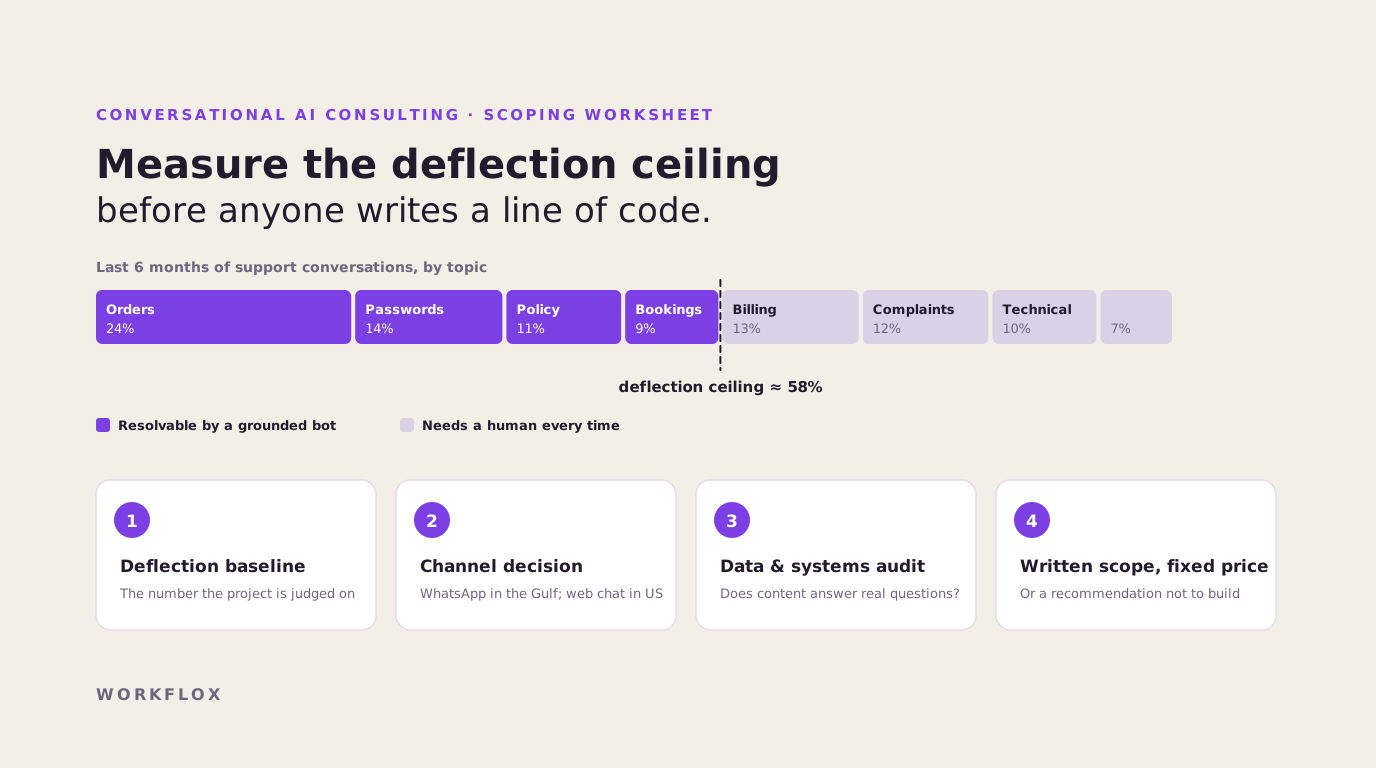
The blended deflection rate a business achieves is mostly a function of its topic mix, not the sophistication of the bot. Measure the mix first, that is the whole point of conversational AI consulting, then build for the tier-one and tier-two topics before touching anything below. When the use case is actions rather than answers, you are moving from a chatbot to an AI agent, and the engineering and risk profile change with it.
We build AI chatbots for the top three tiers and design the handoff for the fourth. Fixed price, written scope, deflection measured against your baseline.
Frequently Asked Questions
What are the most common conversational AI use cases?
Order and delivery status, password and account resets, policy and FAQ questions, appointment booking and rescheduling, returns and refund initiation, lead qualification, and internal IT and HR helpdesks. These share a shape: high volume, rule-based, and answerable from data the business already holds. They are also the use cases with the highest measured deflection.
Which conversational AI use cases have the highest deflection rate?
Order status, password resets, opening-hours and policy questions, and appointment scheduling routinely reach seventy to ninety percent deflection because the answer is deterministic and the data is available. Complaints, complex billing disputes and anything requiring judgement sit far lower, often under thirty percent, and are better handled as triage-and-route than resolution.
What is a realistic overall deflection rate for a support chatbot?
Forty to seventy percent of tier-one volume on well-scoped deployments. The overall figure is a blend: a business whose volume is mostly order status will sit near the top; one dominated by complaints will sit near the bottom regardless of how good the bot is. Measure your topic mix before you estimate.
Do conversational AI use cases differ by industry?
The mechanics are the same; the topic mix differs. E-commerce is dominated by order, returns and delivery questions. Financial services by balance, transaction and card queries, with tight regulatory limits on what a bot may say. Healthcare by scheduling and pre-visit information, with strict rules on clinical advice. Hospitality by booking changes and local recommendations, usually multilingual.
Related services
Related Articles