AI Strategy
10 AI Agent Business Ideas and Opportunities for 2026
By Muhammad Usman • March 2026
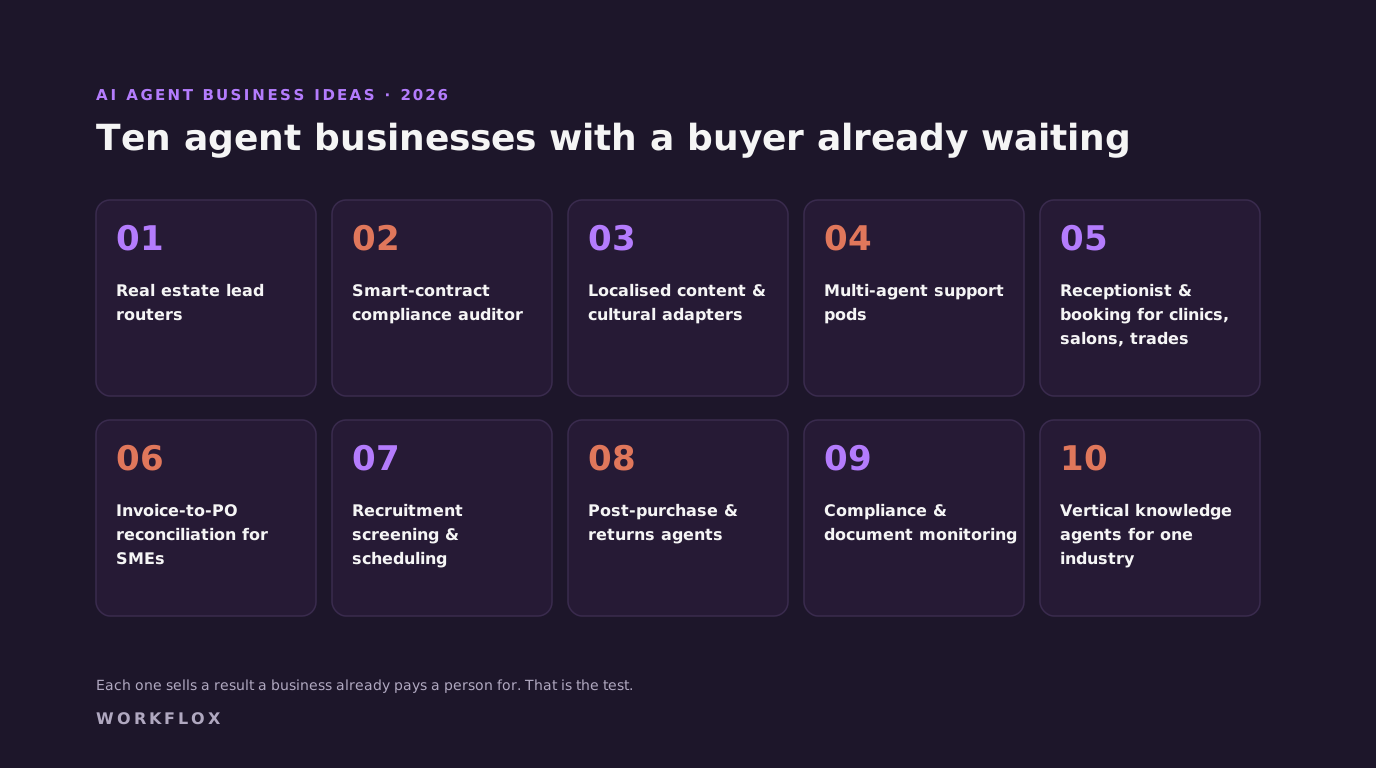
Table of Contents
- 1. Algorithmic Real Estate Lead Routers
- 2. Automated Smart Contract Compliance Auditor
- 3. Autonomous Localized Content Translation & Cultural Adapters
- 4. Multi-Agent Customer Support Pods
- 5. AI Receptionist and Booking Agents for Clinics, Salons and Trades
- 6. Invoice-to-Purchase-Order Reconciliation Agents for SMEs
- 7. Recruitment Screening and Scheduling Agents
- 8. Post-Purchase and Returns Agents for E-commerce
- 9. Compliance and Document-Monitoring Agents for Regulated SMEs
- 10. Vertical Knowledge Agents Sold to One Industry
- Where the Opportunities Are in 2026
- Establishing an AI Assessment Framework
The environment of artificial intelligence has shifted dramatically. In 2026, founders are no longer just building thin UI wrappers over base LLMs. Instead, they are launching autonomous systems that solve multi-step problems with zero human intervention. If you are looking to build an ai agent business, understanding high-volume niches is critical. Here are ten AI agent business ideas and opportunities for 2026: ranked by how real the demand is, what each costs to start, and how quickly it reaches revenue.
1. Algorithmic Real Estate Lead Routers
Instead of simple lead-capture forms, these agents interact with property buyers on WhatsApp, capture budget and location intent, score the leads, and schedule viewings automatically. See how we implement this for our real estate industries clients.
2. Automated Smart Contract Compliance Auditor
An agent that continuously monitors blockchain transactions and audits smart contract code for vulnerability patterns, generating compliance documentation in real time.
3. Autonomous Localized Content Translation & Cultural Adapters
Going beyond literal translation, these agents adjust idioms, currencies, and references to fit target markets natively.
4. Multi-Agent Customer Support Pods
Instead of a single chatbot, build systems where one agent queries database history, a second agent drafts the response, and a third agent audits the response for tone and accuracy. Explore our AI chatbot development services to see how we build this.
5. AI Receptionist and Booking Agents for Clinics, Salons and Trades
Small service businesses lose a large share of inbound calls and WhatsApp messages outside opening hours, and most cannot justify a full-time receptionist. An agent that answers, qualifies, books into the calendar and sends reminders is a bounded product with an obvious price point, typically a monthly subscription per location. The opportunity is vertical: build for dental clinics, or salons, or HVAC contractors, and sell the integration with the booking software that vertical already uses.
6. Invoice-to-Purchase-Order Reconciliation Agents for SMEs
Mid-sized businesses still have people matching supplier invoices to purchase orders and delivery notes by hand. An agent that reads the documents, checks quantities and prices against the order, flags discrepancies and posts clean entries to the accounting system saves hours a week and pays for itself in the first month. This is one of the most immediately profitable AI agent business opportunities because the outcome is measured in recovered hours and avoided overpayments, not in engagement.
7. Recruitment Screening and Scheduling Agents
Recruiters spend most of their time on the first pass: reading CVs against a brief, asking the same five screening questions, and coordinating interview slots. An agent that does that first pass consistently, records its reasoning, and hands a shortlist to a human is a product agencies and in-house teams will pay for. The constraint that defines the opportunity is fairness: the agent must be auditable and must never make the hiring decision, only the screening one.
8. Post-Purchase and Returns Agents for E-commerce
Order status, returns, exchanges and refunds are the majority of e-commerce support volume and almost entirely rule-based. An agent connected to the store platform and the courier APIs can resolve most of it end to end, with a human boundary on anything involving money over a threshold. Sell it as a per-store subscription to Shopify and WooCommerce merchants, where the deflection rate is easy to demonstrate against their existing ticket count.
9. Compliance and Document-Monitoring Agents for Regulated SMEs
Small firms in finance, healthcare, logistics and food handling live under rules they cannot afford a compliance officer to track. An agent that monitors regulatory updates, checks the firm's documents and processes against them, and produces a plain-language action list is a retained service with strong renewal economics. The opportunity is largest where the rules are specific and changing: data protection, customs, and sector licensing.
10. Vertical Knowledge Agents Sold to One Industry
The generic "chat with your documents" product is commoditised. The opportunity is the same capability sold to one industry with that industry's data model, integrations and vocabulary built in: a knowledge agent for property managers, for freight forwarders, for law firms handling a particular practice area. Founders who pick the vertical first and the technology second are the ones reaching revenue, and it is the pattern behind most of the AI agent development work we see going to market.
Where the Opportunities Are in 2026
Across all ten, the pattern is consistent: the winners are bounded, measurable, and vertical. A bounded agent does one workflow well rather than promising general intelligence. A measurable one is sold on hours recovered or tickets deflected, numbers a buyer can check. A vertical one comes with the integrations a specific industry already runs. If you are weighing whether to build the product yourself or with a partner, our note on offshore versus in-house development covers the real cost either way.
Establishing an AI Assessment Framework
To validate if your target organization is ready to adopt these systems, you must perform a structured audit using an ai assessment framework. This grades existing software pipelines, data structures, and operational processes to ensure maximum ROI.
If one of these is the business you want to build, talk to our team. We scope AI agent products at a fixed price and put you in direct contact with the engineers building them.
Frequently Asked Questions
What are the best AI agent business ideas to start in 2026?
The highest-potential AI agent business ideas in 2026 include: (1) Real estate lead qualification agents that auto-qualify buyers from WhatsApp or web forms, (2) Multi-agent customer support pods that handle the full support lifecycle autonomously, (3) Automated content pipelines that research, write, and publish content with minimal human input, (4) Smart contract compliance auditors that monitor blockchain transactions continuously, (5) AI-powered bookkeeping and invoice reconciliation agents for SMBs, and (6) Localized translation and cultural adaptation agents for international businesses entering new markets.
How profitable is an AI automation agency in 2026?
Very profitable. A solo operator building AI automation workflows using n8n, LangChain, and Make.com can charge $3,000–$15,500 per client implementation. With 4–6 active clients per month, monthly revenue easily reaches $20,000–$80,000. Retainer-based maintenance contracts add $250–$2,000/month per client for ongoing workflow management and optimization. The barrier to entry is dropping quickly, but the gap between what SMBs need and what they can afford from traditional agencies remains massive.
Do you need to know how to code to start an AI agent business?
Not necessarily. No-code tools like n8n (visual workflow builder), Voiceflow (conversational AI), and Make.com let you build sophisticated automation pipelines without writing traditional code. However, basic familiarity with APIs, JSON data structures, and prompt engineering significantly expands what you can build and troubleshoot. The founders doing the most sophisticated work in AI automation combine visual tools for orchestration with custom Python or JavaScript nodes for complex logic.
What AI tools do AI automation agencies use in 2026?
The core stack for an AI automation agency in 2026: n8n or Make.com for workflow orchestration, LangChain or LangGraph for agentic reasoning, OpenAI / Anthropic / Google APIs for LLM inference, Pinecone or pgvector for RAG knowledge bases, Vapi or ElevenLabs for voice AI, and WhatsApp Business API / Twilio for communication channels. Agencies that master this stack can serve real estate, financial services, e-commerce, healthcare, and hospitality clients with little modification between verticals.
How does WORKFLOX help clients launch AI agent products?
WORKFLOX builds the full-stack AI agent infrastructure: from architecture design and LLM integration to frontend dashboards and deployment on your cloud. We've built multi-agent customer support systems, autonomous lead qualification pipelines, AI-powered content engines, and real estate CRM automation workflows. If you have an AI agent business idea, we can take it from concept to production in as little as 6 weeks. Contact us at workflox.net to start.
What are the biggest AI agent business opportunities in 2026?
The largest opportunities are bounded, measurable and vertical: booking and reception agents for service businesses, invoice reconciliation for SMEs, e-commerce returns handling, and knowledge agents built for one industry. Each is sold on a number the buyer can verify, hours recovered or tickets deflected, which is why they close faster than general-purpose AI products.
Which AI agent business opportunities have the lowest startup cost?
Single-workflow agents built on existing platforms: a booking agent on top of a scheduling tool, a returns agent on Shopify, a reconciliation agent on Xero or QuickBooks. They need one integration and a narrow evaluation set, can ship in four to six weeks, and are priced as a monthly subscription per customer, so revenue starts before the product is broad.