Mobile App Development
The True ROI of Building Custom Enterprise Mobile Apps in Saudi Arabia
By Muhammad Usman • February 2026

Table of Contents
- Digital Transformation Under Saudi Vision 2030
- Off-the-Shelf Software vs. Custom Architecture Security
- Why Financial and Logistics Sectors Demand Flutter and React Native
- How High-Performance UI/UX Drives User Retention in KSA
- A worked return, with numbers
- When the licensed product is the right answer
- What the build has to include for a Saudi enterprise
- Cost, and what sets it
- How to decide in one afternoon
- After launch
Saudi enterprises are buying mobile software at a pace Vision 2030 set, and most of them face the same decision: license a product built for a generic company, or build an app around how their own operation runs. The right answer depends on numbers that rarely make it into the vendor pitch. This article works through the actual return on a custom enterprise app in the Kingdom, and when the off-the-shelf option wins.
Digital Transformation Under Saudi Vision 2030
The push for modernization across the Kingdom requires businesses to interact with their customers and internal logistics teams with zero friction. Generic, templated mobile applications are failing to meet the strict security and performance standards required by Saudi regulators and enterprise clients.
Off-the-Shelf Software vs. Custom Architecture Security
A licensed product is secured for the average customer. It supports the identity provider it supports, stores data where the vendor stores it, and exposes the audit trail the vendor chose to expose. For a Saudi bank, insurer or logistics operator, each of those is a question the regulator will ask, and the answer has to be yours rather than the vendor's. A custom build lets you decide the identity provider, the hosting region, the encryption and the logging, and to show the reviewer a document that describes exactly what was built. That is the security argument for custom, and it applies only to companies that will actually be asked.
Why Financial and Logistics Sectors Demand Flutter and React Native
A bank or a logistics operator cannot have its app fail on the first day of Ramadan or during a Hajj-season peak. React Native and Flutter let one team ship one codebase to both iOS and Android. This reduces maintenance overhead while providing the native-level encryption and security protocols required by local financial authorities.
How High-Performance UI/UX Drives User Retention in KSA
Saudi users have high expectations, set by the banking and government apps they use daily, and they abandon interfaces that feel slower or less polished. Custom mobile architecture allows for custom UI/UX that aligns perfectly with corporate branding and localized Arabic right-to-left (RTL) reading patterns.
For corporations looking to modernize their logistics, a secure, custom React Native app development team in Riyadh provides the zero-latency performance required.
A worked return, with numbers
A logistics company in Dammam with two hundred drivers was paying a per-seat licence for a fleet app that came to roughly SAR 480,000 a year and did not talk to their dispatch system, so dispatchers re-keyed jobs twice. A custom app for drivers and dispatchers, integrated with the dispatch system and built for offline use on the Eastern Province's highways, cost SAR 340,000 to build and about SAR 60,000 a year to run and maintain. The licence was cancelled at renewal. On licence savings alone the app paid back in ten months. Counting the dispatcher hours no longer spent re-keying, it was closer to seven. That is a typical shape for the projects where custom wins: a scaling licence, a missing integration, and a workflow the product was never built for.
When the licensed product is the right answer
If the workflow is standard, the licence is flat rather than per seat, the product integrates with your systems out of the box, and your regulator does not care where its data lives, buy the product. A custom build for a standard expense-claims process is money spent to reinvent something that exists. We say this at scoping, and about a third of the companies that ask us for a custom app are told to renew their licence instead. The return on custom comes from specificity, and a standard process has none.
What the build has to include for a Saudi enterprise
Arabic and English with a right-to-left layout designed in, not mirrored afterwards. Offline operation for anyone who works away from reliable coverage, with sync that resolves conflicts sensibly. Integration with the identity provider the company already uses. Hosting in-Kingdom or in an approved region, with a written description of where each kind of data lives for the PDPL review. An audit trail of who did what. And a release process through the app stores that the company controls, with the developer accounts in its name. Each of these is cheap when planned and expensive when retrofitted, and each is something a generic product will do its own way.
Cost, and what sets it
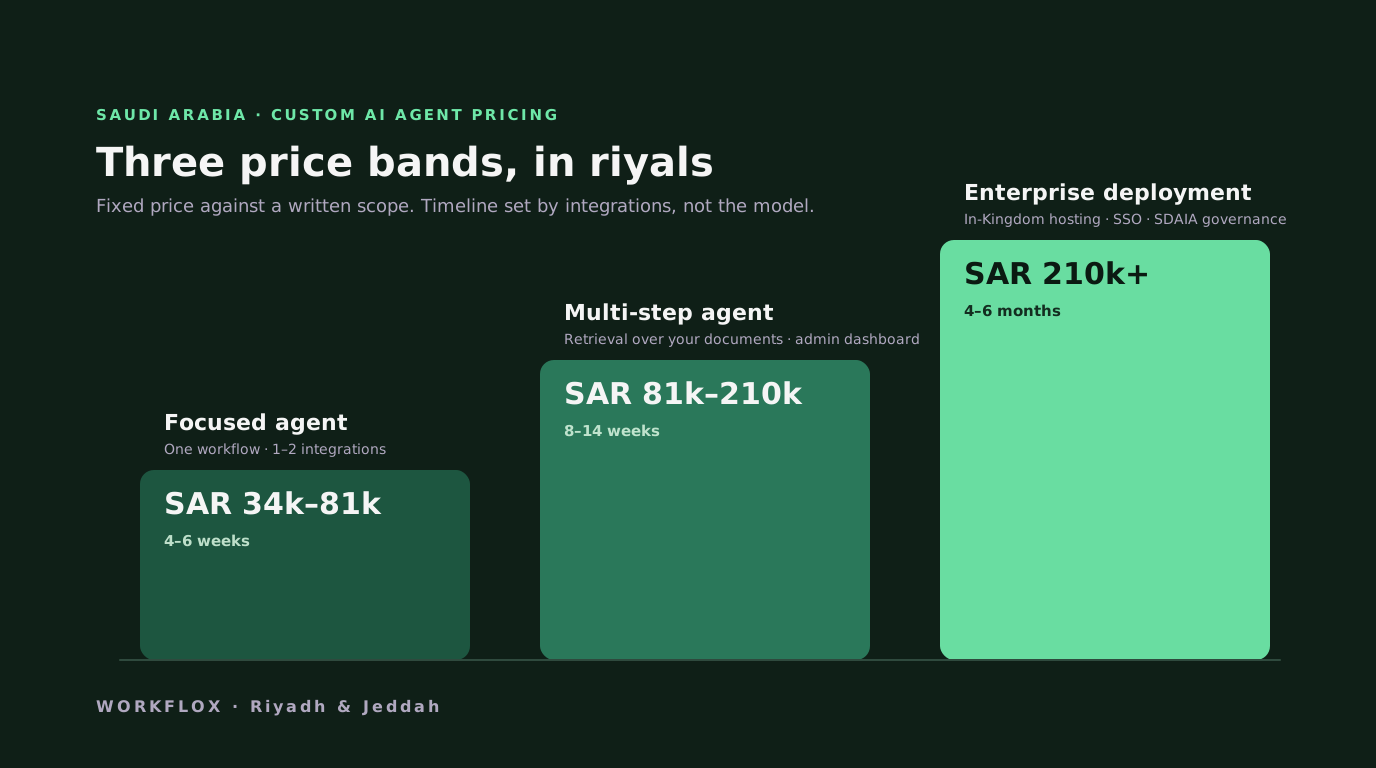
A focused internal app for one workflow and one or two roles runs SAR 35,500 to 94,000 with us and ships in eight to twelve weeks. A multi-role app integrated with an ERP or a core operational system, with in-Kingdom hosting and the compliance documentation a regulated buyer needs, runs SAR 232,000 to 470,000 over four to six months. What moves the number is integration: an ERP with a documented API costs weeks less than one that needs a middleware layer built first. Ongoing maintenance, updates for new OS versions and small changes typically run fifteen to twenty percent of the build cost a year.
How to decide in one afternoon
Write down the current licence cost for three years, including the seats you will add. Write down the hours per week spent working around what the product does not do, and price them. Write down the integration you wish it had. Then ask for a fixed-price quote for an app that does exactly the workflow, no more. If the quote plus three years of maintenance is less than the licence plus the workaround hours, build. If it is not, renew, and revisit when the seat count or the workflow changes. The decision is rarely closer than that.
After launch
The return depends on the app being used, and adoption in a Saudi enterprise is a management task as much as a design one. The field staff who will use it should see it in week three of the build, not at launch. Training is a short video in Arabic and a person on WhatsApp for the first fortnight. Usage is measured weekly for the first quarter, by role and by region, and the workflow that is not being used is redesigned rather than mandated. The apps that pay back are the ones somebody on the client side owns after we leave.
If you are weighing a custom app against a licence renewal, send us the workflow and the current licence cost. We will give you a fixed price and an honest view of which option pays back sooner.
Frequently Asked Questions
Is a custom enterprise app worth it compared to an off-the-shelf product?
When the workflow is specific to how the company operates, when the app must integrate with existing systems, or when licence fees scale with headcount, custom usually pays back within 12 to 24 months. For standard workflows an off-the-shelf product is cheaper, and we say so at scoping.
What does an enterprise mobile app cost in Saudi Arabia?
A focused internal app for one workflow typically runs SAR 35,500 to 94,000. Multi-role apps integrated with an ERP or core system, with in-Kingdom hosting and PDPL compliance, run SAR 232,000 to 470,000. Fixed price against a written scope.
Why Flutter or React Native for Saudi enterprise apps?
One codebase covers iOS and Android, which halves ongoing maintenance, and both frameworks handle Arabic right-to-left layouts, offline operation for field staff and integration with the security tooling enterprises require. Native code is added only where a feature demands it.