Local SEO & Tech
AI App Development in Dubai: Complete Guide
By Rana Sami Ullah • April 2026
Table of Contents
- 1. Aligning with Dubai Vision 2030 & UAE AI Strategy
- 2. UAE Data Protection Law (PDPL) and Where Data Lives
- 3. WhatsApp before the web
- 4. Arabic and English in one thread
- 5. Payments, identity and the local integrations
- 6. Free zone or mainland, and why it matters for hosting
- 7. What it costs in Dubai
- 8. The partner question
- Conclusion
Dubai has established itself as the global capital for AI investment. With the UAE government aiming to double the digital economy's contribution to GDP by 2031, local businesses are investing heavily in custom software and artificial intelligence.
Here is what actually matters when you build an AI product for the Dubai market: the rules, the channels, the language and the cost.
1. Aligning with Dubai Vision 2030 & UAE AI Strategy
Dubai Internet City, DIFC, and ADGM are hubs for digital transformation. When building AI products for the UAE market, ensure your systems support Arabic natural language processing (NLP) natively. Models like GPT-6 have strong Arabic capabilities, but require specific UI handling (like right-to-left text alignment).
2. UAE Data Protection Law (PDPL) and Where Data Lives
The UAE Personal Data Protection Law (PDPL) requires strict consent mechanisms and dictates how personal data is hosted. For regulated industries (like fintech or healthcare), you must deploy databases on UAE-based cloud servers (such as AWS Middle East Bahrain or local cloud infrastructure) to satisfy data residency rules.
Explore our localized solutions on our AI App Development Middle East location page or review our core AI app development services to learn how we help GCC-based enterprises.
3. WhatsApp before the web
In Dubai, the customer's first message is on WhatsApp, not on a website widget, and an AI product that ignores this is built for a different market. The WhatsApp Business API, reached through a provider, lets the product read and reply to messages, send templates, and hand a conversation to a person in the same thread. Products built for the UAE start with the WhatsApp channel and add web and app later, because that is the order customers use them. Voice notes are common and need transcription before the model sees them. And the per-conversation fees are modest at the volumes most Dubai businesses see.
4. Arabic and English in one thread
Customers in the UAE switch languages inside a single message, and a product that handles only formal Arabic or only English will fail on the first afternoon. The evaluation set built before launch should include Gulf dialect, mixed-language messages and the abbreviations people actually use. Retrieval should find an Arabic document from an English question and the reverse. Interfaces need a right-to-left layout designed in rather than mirrored afterwards. And tone should be set per language, because a reply that is polite in English can read as abrupt in Arabic. None of this is hard when planned, and all of it is visible to customers when skipped.
5. Payments, identity and the local integrations
A product that takes payment in the UAE will use a local gateway such as Telr, PayTabs, Network International or Stripe's UAE entity, and the choice affects which cards and wallets work. Identity for consumer products increasingly means UAE PASS, and for business products it means the company's own directory. Property products connect to Bayut and Property Finder, retail to local delivery platforms, and most enterprises to an ERP that predates the AI conversation. The integration list is what sets the timeline, and it should be written down before the model is chosen.
6. Free zone or mainland, and why it matters for hosting
Companies in DIFC and ADGM operate under their own data protection regulations, which are closer to European rules than the federal law, and their regulators ask where data is processed. Mainland companies fall under the federal Personal Data Protection Law. The practical effect for an AI product is the hosting decision: UAE-region cloud for anything holding personal data, with the data flows written down, and a view from the compliance lead before the architecture is fixed. Retrofitting residency after a build is the most expensive mistake we see in Dubai AI projects, and it is entirely avoidable.
7. What it costs in Dubai
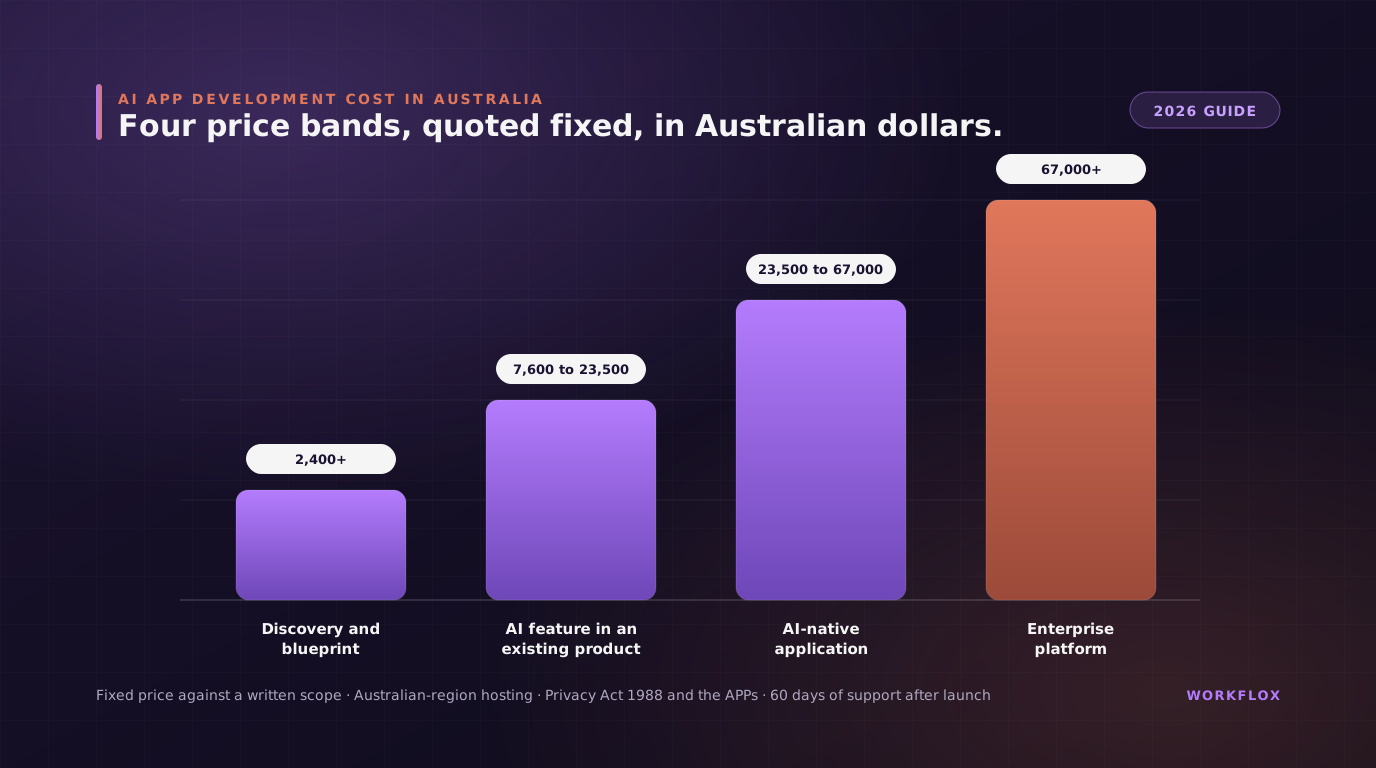
A focused AI product for the UAE market, such as a WhatsApp assistant grounded in your content with CRM lead capture and human handoff, runs AED 36,500 to 92,000 with us and ships in six to ten weeks. A product with several integrations, Arabic and English, UAE hosting and the documentation a DIFC or ADGM reviewer expects runs AED 92,000 to 228,000 over three to five months. Larger platforms are scoped individually. Model usage after launch is usually a few hundred dirhams a month once routing is in place. We quote at a fixed price against a written scope, in AED or USD, and the code, prompts and data are yours.
8. The partner question
A Dubai AI project needs a team that has handled the WhatsApp API onboarding, the Arabic evaluation, a local payment gateway and a DIFC or federal data review before, because each has a delay that only experience avoids. Ask any vendor for a reference in the UAE whose product has been live for six months, ask where that product's data lives, and ask to see the evaluation set. The answers separate teams that have built for this market from teams that have built a demo and read about it.
Conclusion
Building AI in Dubai requires a partner who understands the local tech ecosystem, payment integrations (like Telr and PayTabs), and regional data compliance.
Ready to build for the UAE market? Schedule a scoping call with our team.
Frequently Asked Questions
What are the best AI apps and services for businesses in Dubai?
The most impactful AI services for Dubai businesses in 2026 are: custom AI chatbots on WhatsApp Business API (the primary communication channel in the UAE), AI-powered CRM automation using self-hosted n8n (for PDPL compliance), RAG-based internal knowledge agents for real estate and financial services, and multilingual customer support AI that handles both Arabic and English natively. WORKFLOX specializes in all four, built specifically for the GCC market.
What are UAE data protection laws (PDPL) and how do they affect AI apps?
The UAE Personal Data Protection Law (PDPL) requires that personal data be processed lawfully, transparently, and for specific purposes. For AI apps, this means: obtaining explicit user consent before using personal data to train or personalize AI models, ensuring sensitive data is hosted on UAE-based or approved cloud infrastructure (AWS Middle East, Azure UAE North), providing users with rights to access and delete their data, and documenting data flows for regulatory audit. Companies in DIFC and ADGM are subject to their own data protection frameworks which are even stricter.
How much does custom AI app development cost in Dubai?
AI app development costs in Dubai range from AED 35,000–AED 92,000 ($9,500–$25,000) for a focused MVP with AI features, to AED 228,000–AED 460,000 ($62,000–$125,000) for a full-scale enterprise AI platform with Arabic NLP, UAE cloud hosting, PDPL compliance infrastructure, and multi-department rollout. WORKFLOX provides fixed-price proposals in AED or USD after an initial scoping session.
Do AI apps need to support Arabic language in the UAE market?
Yes. Arabic is the official language of the UAE and a primary communication language across government, real estate, banking, and healthcare. AI apps targeting UAE users should support Arabic NLP natively: including right-to-left (RTL) UI layout, Gulf dialect understanding (not just Modern Standard Arabic), and smooth context switching between Arabic and English within the same conversation. Models like GPT-6 and Claude Sonnet 5.5 have strong Arabic capabilities when properly prompted and tested.
Can WORKFLOX build a PDPL-compliant AI app for a UAE business?
Yes. WORKFLOX builds AI applications specifically designed for UAE compliance requirements, from PDPL-compliant data flows and UAE-hosted vector databases to DIFC and ADGM-aligned governance documentation. All sensitive data processing happens within your controlled UAE infrastructure. We have built compliant AI systems for real estate, financial services, and logistics clients across Dubai, Abu Dhabi, and Sharjah.
Related services
Related Articles